

The bustle of the new constructions is not only creating a factory specialized in the most advanced semiconductors in the world. Over time, the most modern chips will produce in series.
This work is carried out for the first time in the US, and the Taiwanese company that is behind promises to spend thousands of millions in this country to avoid the threat of tariffs to imported chips.
It is, in my opinion, the most important factory in the world, and is building it a company that may not have heard: TSMC, Taiwan semiconductor manufacturing Company.
It manufactures 90% of advanced semiconductors on the planet. Until now, everyone was manufactured on the island of Taiwan, 160 kilometers east of continental China.
The Apple chip of your iPhone, the Nvidia chips that feed your chatgpt queries, the chips of your laptop or your computer network, all are manufactured by TSMC.
Its Arizona facilities, known as “FAB 21”, are closely guarded. No white paper or personal devices are allowed in case designs are filtered. The factory houses part of the most important intellectual property to global levels and the process to manufacture these chips is one of the most complicated and intensive of world manufacture.
That is why they are extremely jealous of the secrets they keep inside. Important customers, such as Apple and Nvidia, trust this company to safeguard their designs for future products.
But after requesting it for months, TSMC allowed the BBC to take a look in parts of the process of what some support is the most critical, expensive, complex and important manufacture.
The symbol of Trump’s policy
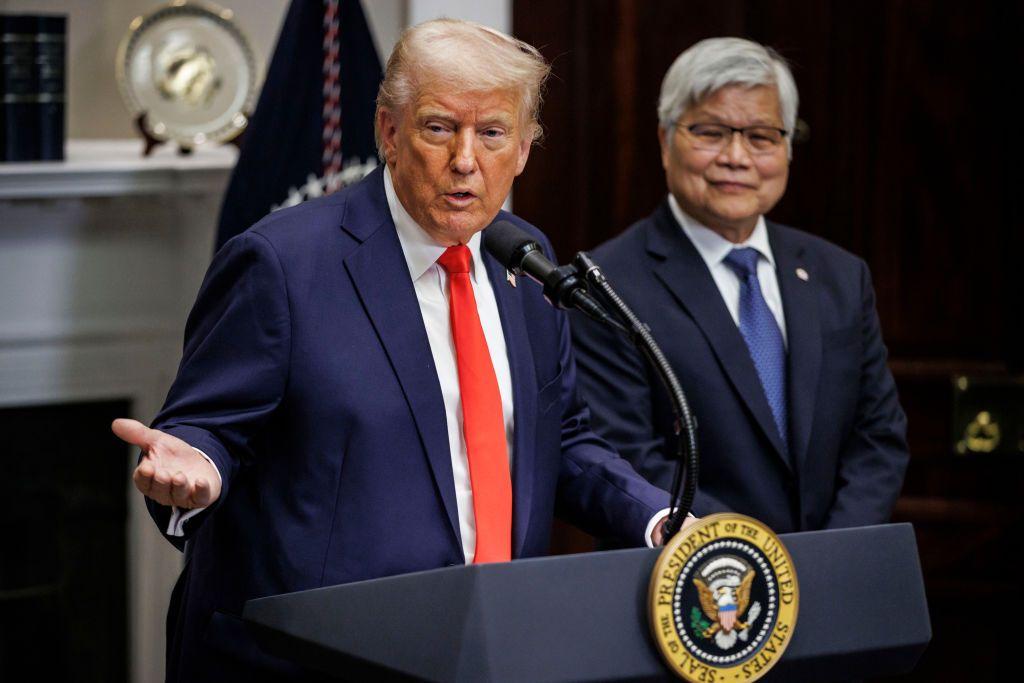
President Trump seems to think so. He often mentions the passed factory.
“TSMC is the biggest there is,” he said. “We gradually lost the chips business, and now it is almost exclusively in Taiwan. They stole it.” This is one of the usual choruses of the US president.
The recent decision of TSMC to expand its investments in the US in other US $ 100,000 million is something Trump attributes to its threats to impose tariffs on Taiwan and the world semiconductor business.
The expansion of Arizona’s facilities, announced in March, is – in their opinion – the perfect example of their economic policies, specifically to encourage foreign companies to transfer their factories to the United States to avoid high tariffs.
China also observes progress. Taiwan’s skill in chips manufacturing is part of what his government calls “silicon shield”, against a dreaded invasion.
Although the original strategy was to make Taiwan indispensable in this field of critical technology, the difficulties of the supply chain during the pandemic changed the calculation because depending on a single country was seen as a greater risk.
China claims Taiwan as its own territory, but the island is considered independent of continental China.
Thus, many currents of the world economy, the technological avant -garde and geopolitics flow through this unique location, and in it resides the essential contradiction of Trump’s economic and diplomatic policy.
He sees this plant as the example of AMERICA First (USA first), and the safeguard of economic and military superiority over China.
However, the manufacture of these modern miniaturized miracles on the border of physics and chemistry depends intrinsically on a combination of the best technologies around the world.
The cleanest place on earth
Greg Jackson, one of those responsible for the facilities, makes me guide taking me from one place to another in a golf cart. The factories are almost a tracing of the TSMC centers in Taiwan, where it was formed.
“I would say that these facilities are probably the most advanced and complicated in the world,” he says.
“It is a dichotomy. There are very, very small chips with very small structures, but these huge facilities are needed with all the infrastructure to be able to manufacture them … the complexity and the amount of systems necessary are amazing.”
In one of the buildings, the workers put on protective clothing before crossing a bridge that is supposed to create the cleanest environment of the earth, necessary to protect the production of these extraordinary microscopic transistors with which the microchips that support everything are manufactured.
Konstantinos Ninios, engineer, shows me some of the first productions of TSMC Arizona: a silicon wafer with what is known as “4 nanometers chips.”
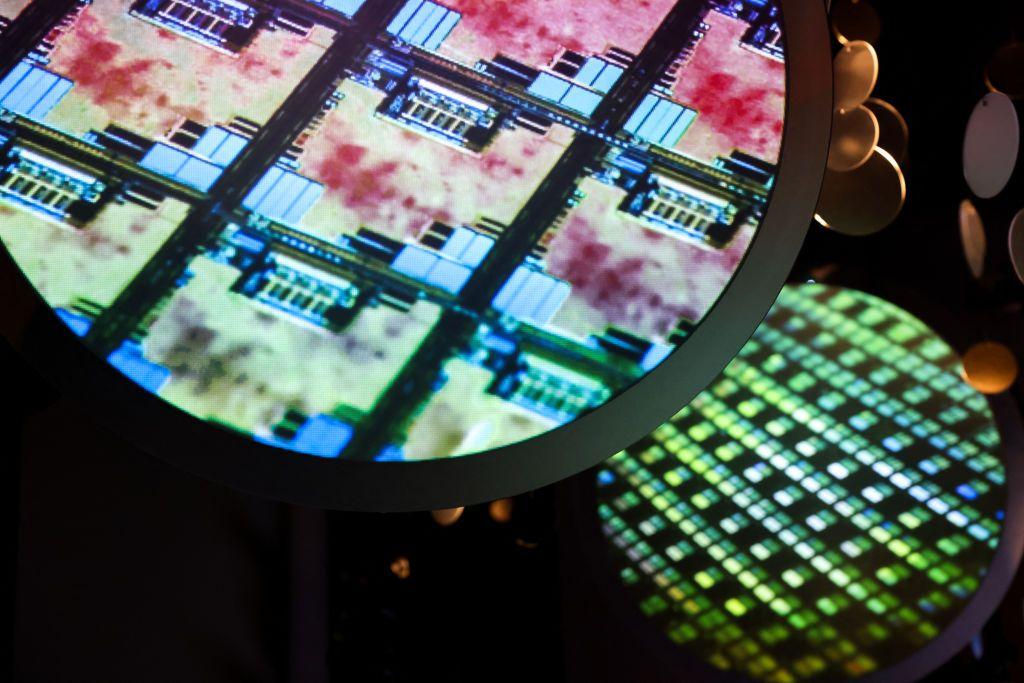
“This is the most advanced wafer that is right now in the United States,” he explains. “It contains between 10 and 14 billion transistors … the entire process consists of between 3,000 and 4,000 steps.”
If we could reduce our body to the same scale and get into the wafer, the different layers would look like very high streets and skyscrapers.
Handling atoms
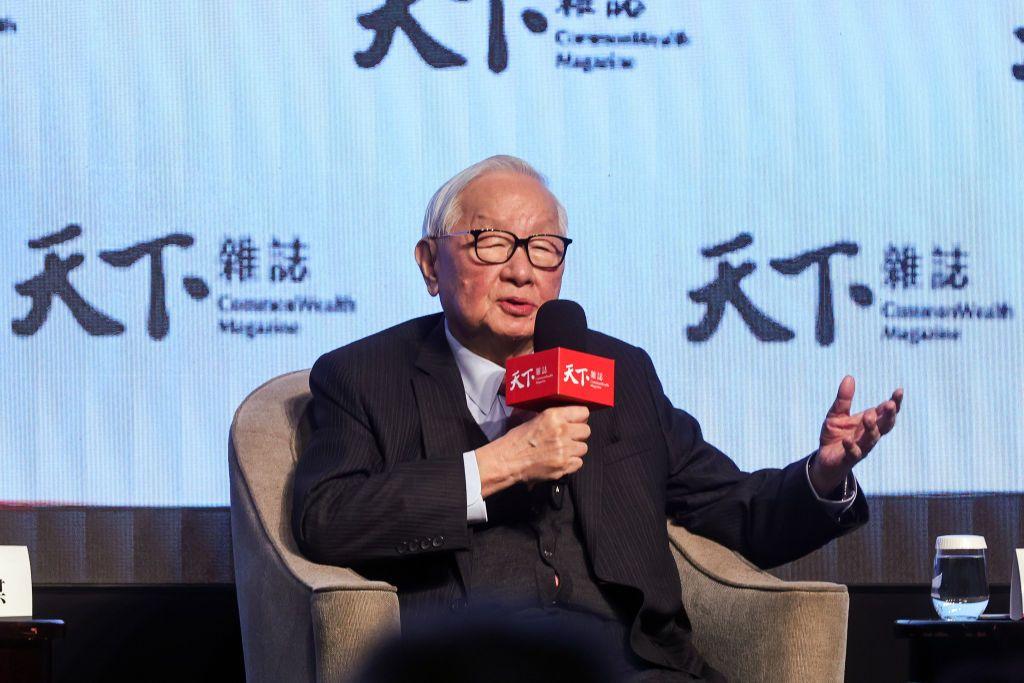
TSMC was founded at the instances of the Taiwanese government in 1987, when Morris Chang, chips executive, was commissioned, who launched the company. The model consisted of becoming a smelting dedicated to microchips that would manufacture designs from other companies. The success was resounding.
The engine of technological advance is the miniaturization of the smallest characteristics of the chips. Nowadays, its size is measured in Milonésima Metro or nanometers. This advance has allowed mobile phones to become smartphonesand now it is marking the rhythm of the large -scale implementation of artificial intelligence.
The process requires incredible complexity and expense thanks to the use of “extreme UV). This light is used to record the intricate construction blocks of our modern existence in a process called “lithography.”
The dependence that the world has of TSMC is based on a highly specialized machinery of the size of a bus, which in turn proceeds almost entirely of a Dutch company called ASML.
These machines trigger ultraviolet light tens of thousands of times through cast tin drops, which creates a plasma that is then refracted through a series of specialized mirrors.
The manufacturing process of each silicon wafer, almost totally automated, is repeated thousands of times by layers over months to form the 4 NM silicon chips wafer, which is the size of a vinyl disc and which costs US $ 1 million.
“Imagine whether a particle or a motorcycle of dust fell into this,” the child tells me incredulous. “Transistors would not work. So all this is cleaner than hospitals operating rooms.”
Caution in Taiwan
Taiwan does not have special access to raw materials, but it has the necessary knowledge to go years ahead of other companies in the intricate production process of these atomic components of modern life.
Some members of the Taiwanese government are cautious when expanding the border of this technology outside the island. Trump soon affirmed that the company’s decision to bring its toe to the United States was due to its economic policies.
He said that this would not have happened without the stick of the tariffs that he intended to impose on Taiwan and the semiconductors. The people with whom I speak in TSMC are diplomatic about it.
But much of this was already planned and subsidized by the Chips Law of the administration of former President Biden.
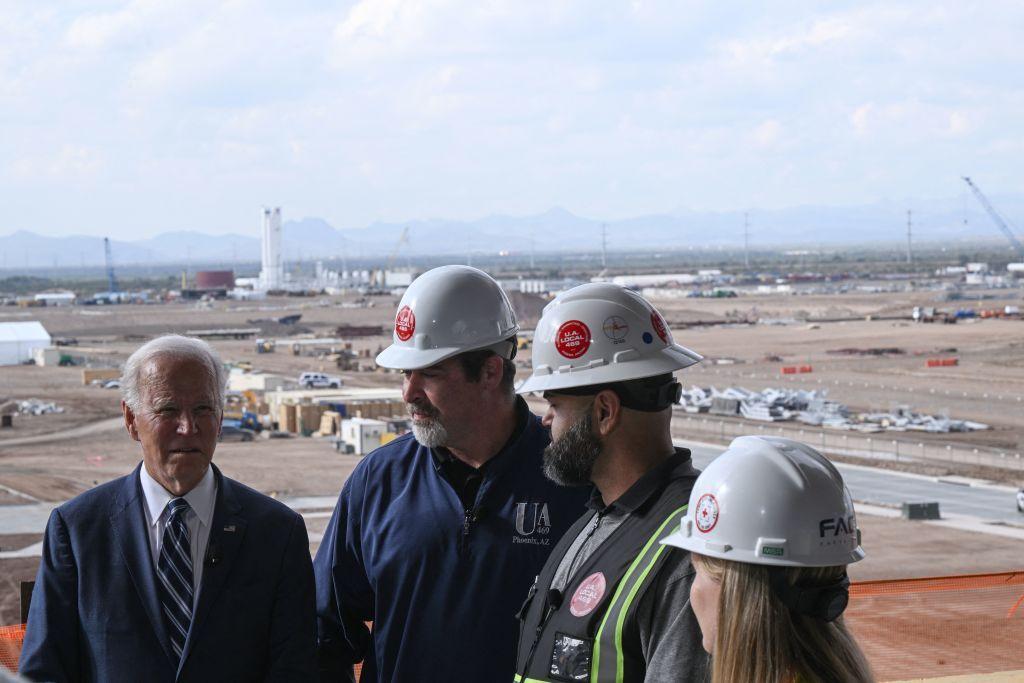
On the access catwalk there are photographs that show Biden’s visit in 2022, with the construction wrapped in bars and stars and a banner that says A FUTURE MADE IN AMERICA (A future made in the US).
“The semiconductor supply chain is global,” says Rose Castanares, president of TSMC Arizona.
“At this time there is no single country that can do everything, from chemicals to the manufacture of wafers and packaging, so it is very difficult to mount everything quickly.”
Alternative supply chains
As for the semiconductor supply chain, tariffs will not help.
The supply chain extends throughout the world. Whether they are the Silicon wafers of Japan, the machines that are required of the Netherlands or the mirrors of Germany, all kinds of materials around the world are needed.
Now they could have to face import expenses.
That said, the head of TSMC hastened to confirm the expansion of the US plant in an act with Trump in the White House.
In recent weeks, the American technological elite – from Tim Cook, from Apple, to Jensen Huang, from Nvidia – has been placed to the world that TSMC Arizona will now produce many of the chips of its American products.
The world chips industry is very sensitive to the economic cycle, but its peak technology enjoys very healthy margins, which could cushion some of these tariffs.
There are many geopolitical subtexts in this story. The factory is located in the center of the American strategy to gain technological supremacy, artificial and economic intelligence over China.
Both the Biden and Trump government have developed policies to try to limit Chinese access to semiconductor technology: from the prohibition of exporting to China ASML machines to the new legislation to prohibit the use of Huawei’s chips in US software or technology.
The president of Taiwan, Lai Ching-Te, urged democracies such as Japan and the United States to develop alternative supply chains to counteract China.
However, not everyone is convinced that this strategy works.
Chinese technologists have managed to overcome prohibitions to develop competitive native technology. And Bill Gates recently said that these policies “have forced the Chinese to advance at full speed in the manufacture of chips and everything else.”
Trump wants TSMC Arizona to become the cornerstone of his American gold age. But the history of the company so far is possibly the maximum expression of the success of modern globalization.
So, for now, it is a battle for world technological and economic supremacy, in which Taiwanese manufacturing technology, part of which is now moving to the Arizona desert, is the fundamental asset.

Click here To read more BBC News World Stories.
Subscribe here To our new newsletter to receive every Friday a selection of our best content of the week.
You can also follow us in YouTube, Instagram, Tiktok, X, Facebook and in our WhatsApp channel.
And remember that you can receive notifications in our app. Download the latest version and act.