

It was an attack of an amazing ingenuity: unprecedented, broad and that was created for 18 months.
On Sunday, more than 100 Ukrainian drones attacked air bases within Russia and the objectives were long -range Russian bombers with nuclear capacity.
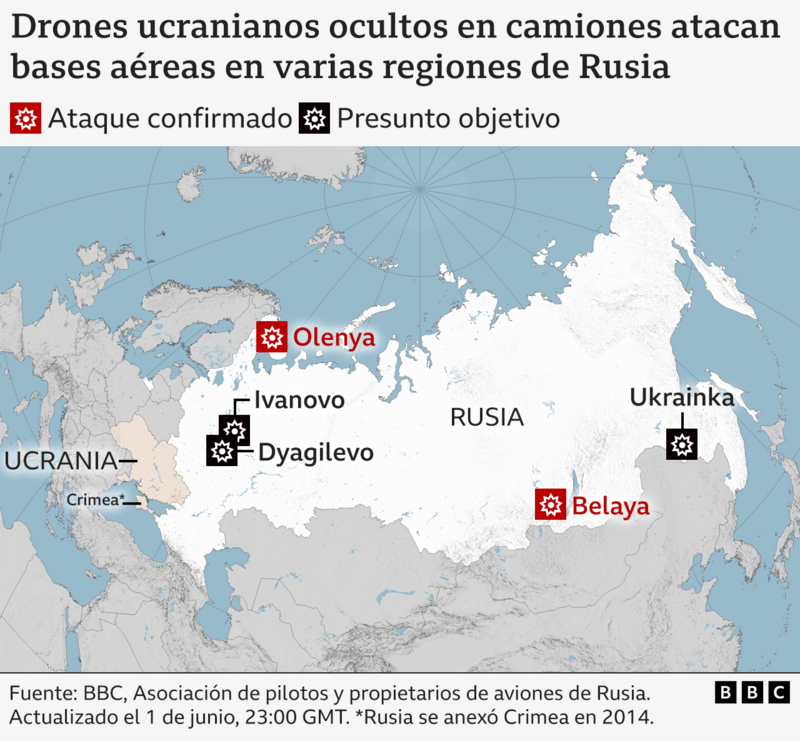
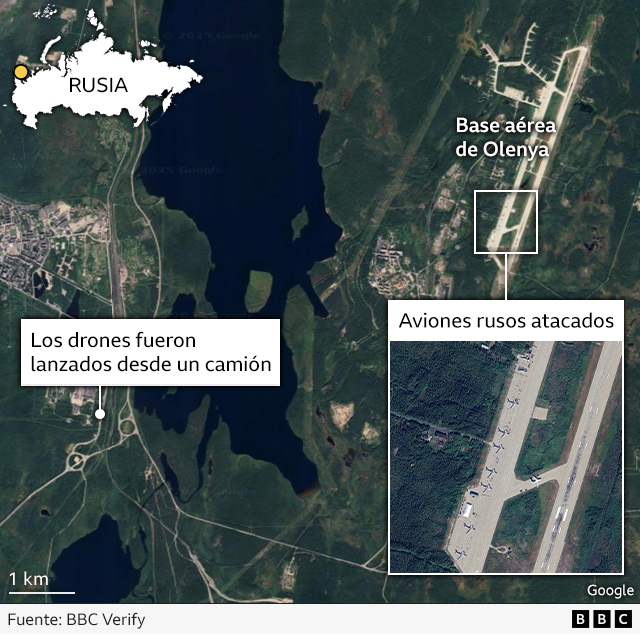
The magnitude of the operation, called “spider web”, became evident almost as soon as it began, with explosions reported in several schedules in the extensive Russian territory, from Murmansk, in the north of the Arctic Circle, to the Amur region, more than 8,000 kilometers from Ukraine.
The Russian Ministry of Defense confirmed that the attacks occurred in five regions of Russia: Murmansk, Irkutsk, Ivanovo, Ryazan and Amur, but said that the bomber had only suffered damage to Murmansk and Irkutsk, while in other places the attacks would have been repelled.
In published photos shortly after the attack, you can see Vasyl Maliuk, the head of the Ukraine Safety Service (SBU), while observing a satellite map of aviation fields in which the bases in the locations mentioned by Russia are clearly identifiable.
The operation
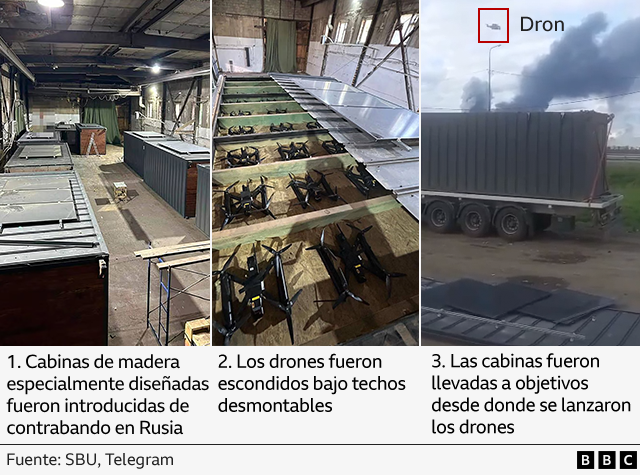
Maliuk said the drones were introduced from smuggling in Russia into wooden cabins mounted in the rear of trucks, hidden under removable roofs operated remotely.
The trucks were apparently taken to locations near the air bases through drivers who, apparently, were not aware of the load. Then, the drones were thrown and directed towards their goals.
Videos that circulate on the Internet show drones leaving the roof of one of the vehicles involved. A truck driver interviewed by the Russian state medium Ria Novosti said that he and other chauffeurs tried to knock down the drones that came out of a truck.
“They were on the back of the truck and launched stones to prevent them from flying, to keep them on the floor,” he said.
According to un verified reports of the Russian Telegram Canal Baza, known for their links with security services, truck drivers told similar stories about having been hired by entrepreneurs to deliver wooden booths in various locations in Russia.
Some of them said they later received additional instructions on the phone about the places where the trucks should park. Once they did, they were stunned to see that the drones left the vehicles.
In a triumphant publication shared on social networks on Sunday night, Ukrainian president, Volodymyr Zelensky, who directly supervised the operation, said that 117 drones had been used in the attack, which took “a year, six months and nine days” in preparing.
He also mentioned that one of the attacked locations was right next to one of the Russian security services offices.
Russia said there are several detainees in relation to the attacks, although Zelensky declared that the people who helped facilitate the operation “were removed from Russian territory … are now safe.”
In a telegram publication that was eliminated, the local authorities of the city of UST-Kut, in the Irkutsk region, reported that they are looking for a 37-year-old Ukrainian linked to the drone attack at the Belaya military aerodrome.
The drones
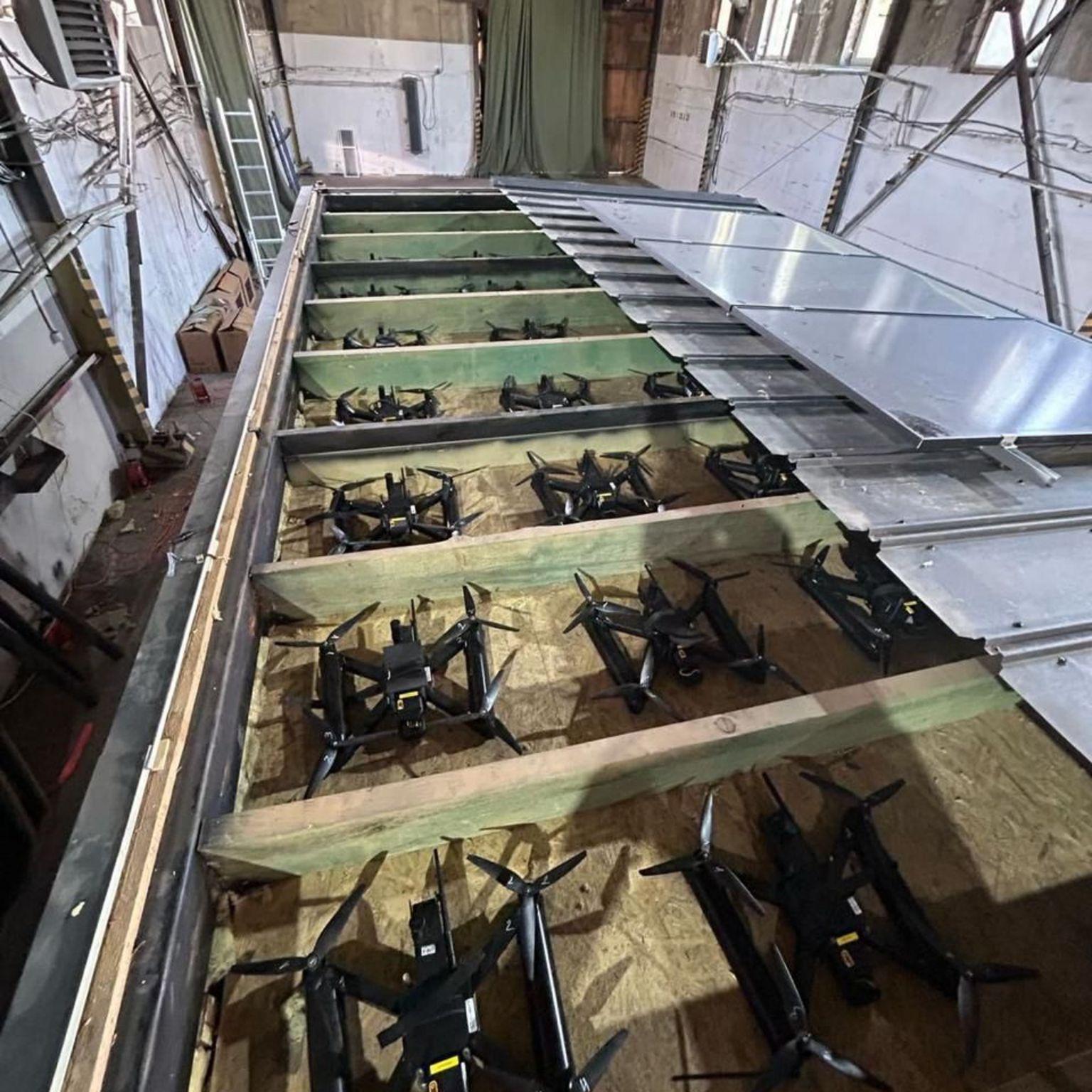
Images shared by the SBU show dozens of small black drones carefully saved in wooden booths inside a warehouse, which Russian military bloggers identified in a place in Chelyabinsk.
Steve Wright, a drone expert based in the United Kingdom, told the BBC that the drones used to attack Russian airplanes were simple quadcopteros that transport relatively heavy loads.
He added that what made this attack “quite extraordinary” was the ability to introduce them to contraband in Russia and then launch them and control them remotely.
Wright concluded that the connection was achieved thanks to a link transmitted through a satellite or internet.
Zelensky said that each of the 117 drones had its own pilot.
The drones were carefully saved in hidden wooden booths inside the trucks, the SBU confirmed.
Wright also suggested that the drones could fly using GPS, but they could also have exceeded the localized interference measures of Russia piloting the drones manually remotely.
Kyiv has not shared details about the origin of the drones, but since the beginning of the war, Ukraine has become extremely efficient in its manufacture, and it is possible that the country has produced the devices that were used in this operation.
The objectives
“Russia has had very tangible losses, and rightly,” Zelensky said in his night speech.
According to Ukraine, 41 strategic bombers were impacted and “at least” 13 were destroyed. Moscow has not confirmed any loss of aircraft beyond indicating that some airplanes would have been damaged.
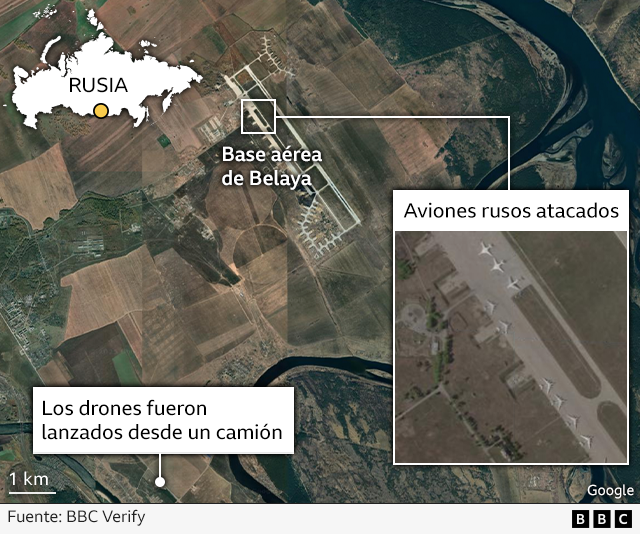
Videos verified by the BBC show damaged aircraft at the Olenegorsk air base in Murmansk and at the Belaya Air Base in Irkutsk.
It is believed that attacked strategic missile bombers are, among others, the TU-95, TU-22 and TU-160. Repairing will be difficult, and since none is in production, replacing them is impossible.
Images of satellite radars shared by Capella Space reveal at least four long -range Russian bombers seriously damaged or destroyed at the Belaya air base. This coincides with images of Ukrainian drones that also show an attack on a Tu-95 bomber.
“According to the laws and customs of war, we have worked absolutely legitimate objectives: aviation fields and airplanes that bomb our peaceful cities,” said SBU head, Vasyl Mallyuk.
It is said that Tu-95 bombers launched a massive attack with kh-101 missiles in Ukraine just last week. Each bomber can wear eight guided cruise missiles and each missile carries an explosive head of 400 kilograms.
It was reported that Military A-50 aircraft were also attacked. They are valuable aircraft that increase the ability of Russia both to intercept Ukrainian missiles and to launch their own attacks.
It is not known how many A-50 has Russia, but in February 2024, the head of military intelligence, Kyrylo Budanov, estimated that there were eight, so any loss or damage could be a serious blow to Moscow.
In a publication on social networks, the SBU said that the “spider cloth” operation will mean losses of US $ 7,000 million.
The Russian state media remained silent about the attacks, with television programs during stellar schedule that only cited statements by the regional authorities. For Monday morning, the story had disappeared from the newsletters.
On the Internet and beyond, the Ukrainians celebrated and one of them praised the operation as “titanic.”
“Of course, not everything can be revealed at this time,” Zelensky wrote in Telegram, “but these are Ukrainian actions that will undoubtedly be in history books.”
With additional reports of Kumar Malhotra, Tom Spencer, Richard Irvine-Brown, Paul Brown and Benedict Garman.

Click here To read more BBC News World Stories.
Subscribe here To our new newsletter to receive every Friday a selection of our best content of the week.
You can also follow us in YouTube, Instagram, Tiktok, X, Facebook and in our WhatsApp channel.
And remember that you can receive notifications in our app. Download the latest version and act.