

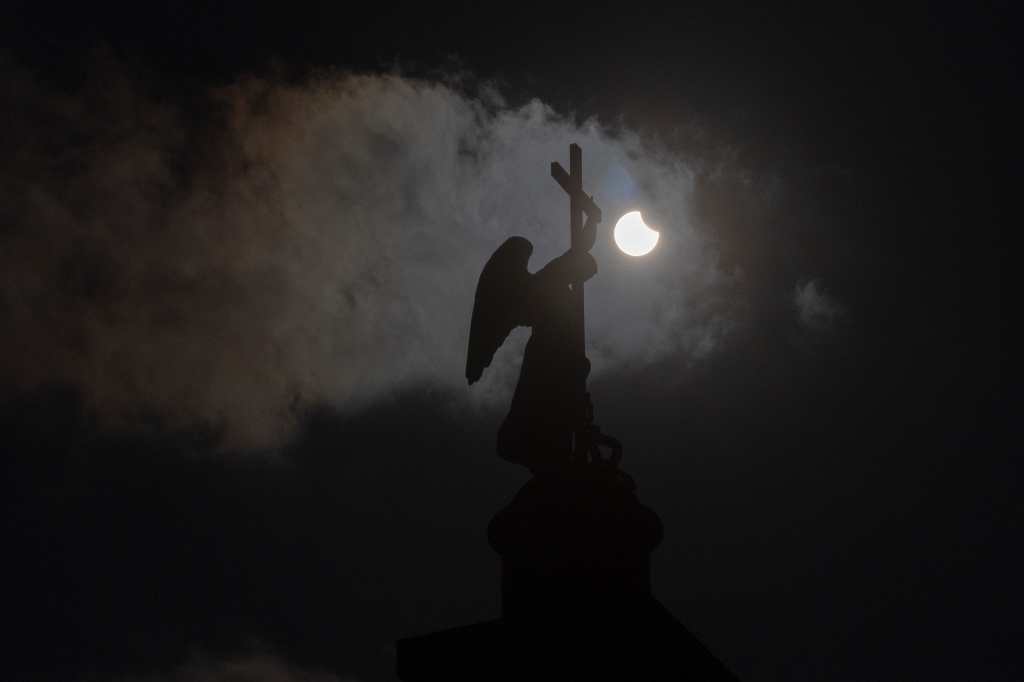
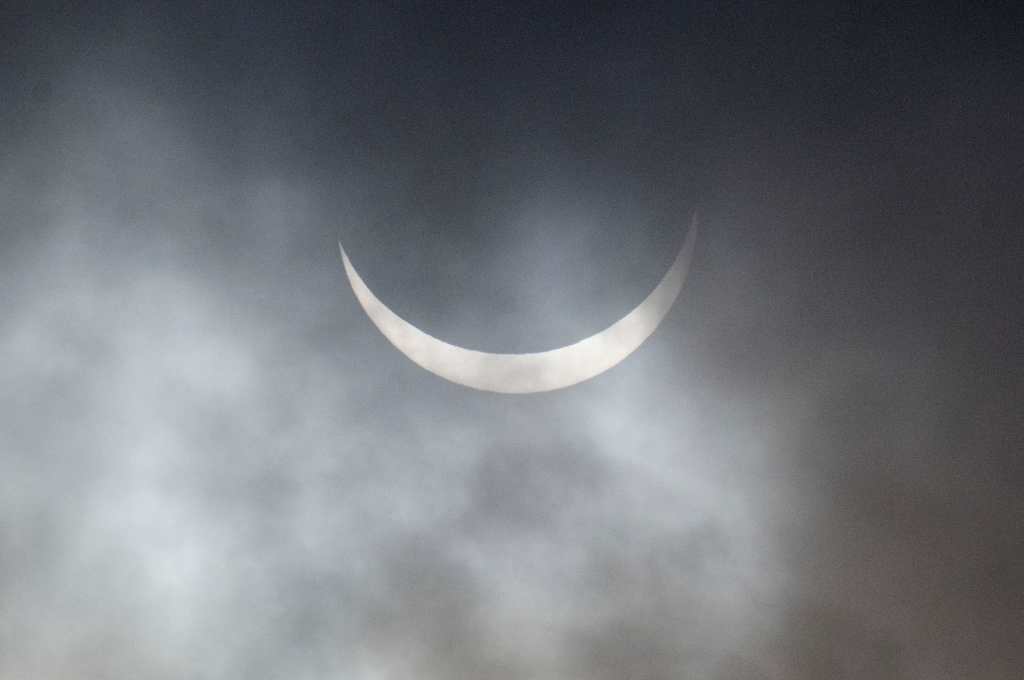
The partial eclipse, which was the First of the year And the seventeenth of this century lasted about four hours. It started at 8.50 GMT and ended at 12.43 GMT.
The first continental to see it were the inhabitants of Mauritania and Moroccoand the last, those in northern Siberia, told AFP Florent Deleflie, astronomer of the Paris-PSL Observatory.
It was also visible in Europe, according to the Tiempo-Espacio laboratory of the Paris Observatory. The phenomenon reached its peak at 10.47 GMT, on the northeast of Canada and Greenland.
These two areas had the best view, since The moon covered 90 % of the solar disc, although it was not enough for the sky to obscure.
Eclipses occur when the sun, the moon and the earth align. When that alignment is perfect, the moon completely blocks the solar disk, creating a disturbing twilight.
However, in this case Alignment was not perfect enough As for the shadow cone to be screened on the surface of the earth, said Deleflie.
At first glance no difference was perceived. The luckiest, who could Enjoy the show with the clear skythey had to use adequate equipment to protect the eyes.
To see an eclipse a pair of glasses specially adapted For this phenomenon and verifying that they are in perfect condition, since intense sunlight can cause ocular burns and irreparable damage.
The slightest defect on the surface of the glasses, if they are not new – even a microscopic hole – can cause Burns in the eyewarned the astronomer.
By August 12, 2026, experts announce a total solar eclipse, Visible in Iceland, northern Spain and parts of Portugal.
In it United Kingdom, France and Italy The phenomenon will be visible at 90 %.