
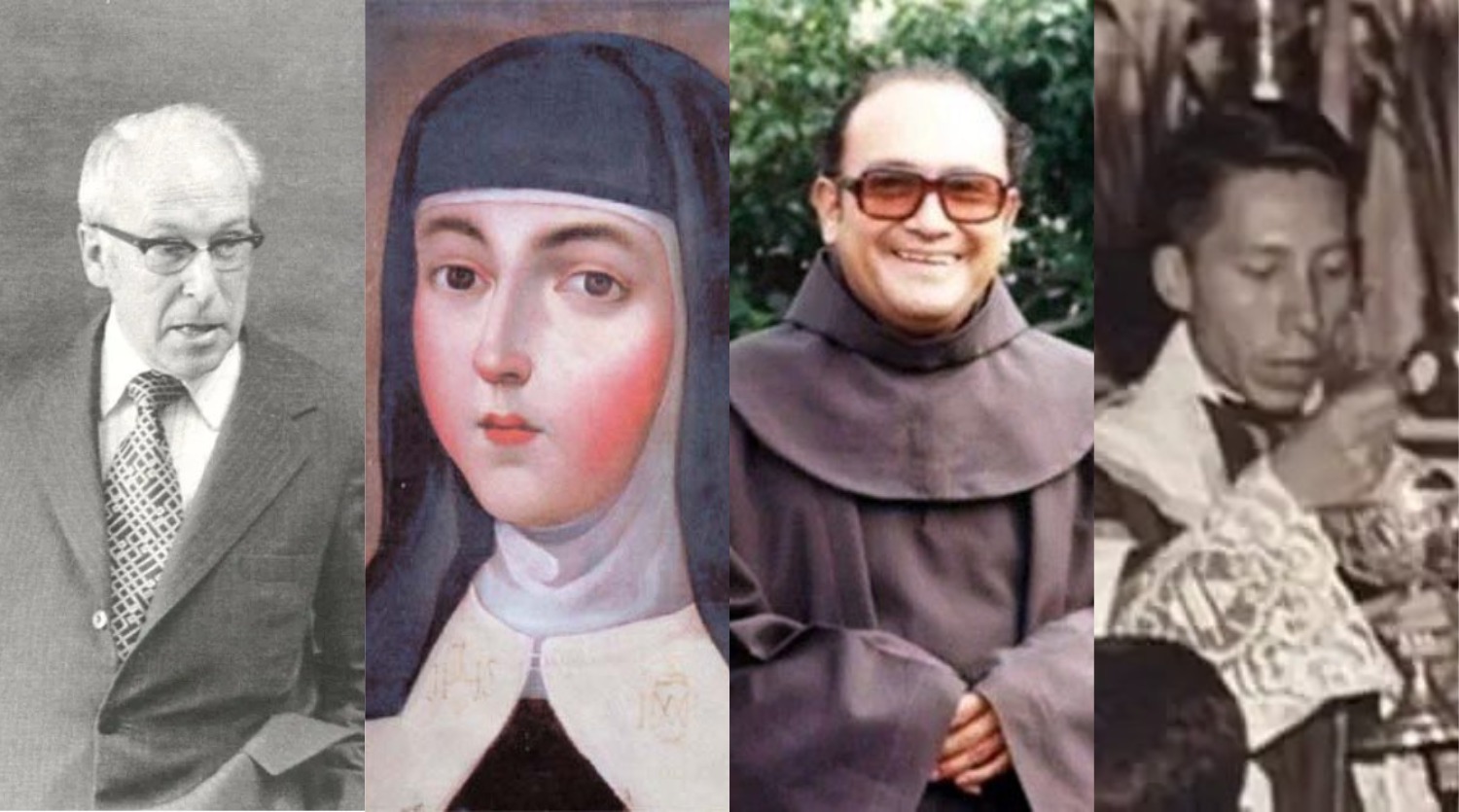
There are several open causes for beatifications in Guatemala, among which those of Brother Augusto Rafael Ramírez Monasteryfrom the father Hermogenes López Coarchitafrom the doctor Ernesto Cofiño and of Maria Teresa of the Holy Trinity.
The time to name them blessed depends on several factors. One of them is the number of devotees; When there is greater devotion, the process is speeded up in the Vatican. The work of specialists—lawyers, theologians, psychologists—also influences, which requires time and resources.
What is expected is that the blessed become saints; that is the natural path. However, some remain blessed because a second miracle is not recognized, explains priest Luis René Sandoval, director of Communication of the Archbishopric of Santiago de Guatemala.
To be blessed you need one miracle, and to be holy, two. In several cases, the diocesan phase has already concluded and they are in the Roman stage. For example, Father Hermógenes López Coarchita and Dr. Ernesto Cofiño have already advanced in the diocesan, and Brother Augusto has already finished the Roman phase, and the next beatification is expected.
As faithful, what corresponds is to pray and ask for their intercession so that the Church recognizes the path to its holiness, says Sandoval.
For example, Saint John Paul II, who died in 2005, was beatified on May 1, 2011 by Pope Benedict XVI and canonized on April 27, 2014, due to the great devotion to him that existed from the beginning, known as “santo súbito.”
“Several congregations and communities are promoting new causes through the ecclesiastical court. This also conveys an important message: that it is possible to be a saint today. Even in today’s world, there are examples of life that inspire. Every sinner can become a saint,” comments Sandoval.
Ernesto Cofiño
The life and legacy of Guatemalan doctor Ernesto Cofiño took a step towards sainthood after Pope Francis recognized his heroic virtues.
On December 14, 2023, Francis signed the decree recognizing the “heroic virtues” of the Guatemalan doctor Ernesto Cofiño (1899-1991), which represents the first step for the cause of beatification to continue.
This layman, belonging to Opus Dei, He was born on June 5, 1899, in Guatemala City, and died in this same place on October 17, 1991.
According to the biography on the Opus Dei website, Cofiño, who studied medicine in Paris, France, is considered “the father of pediatrics in Guatemala.” She married in 1933 and had five children. He worked for the most needy people, trained thousands of university students and was recognized for his scientific contributions.
In 1956 he discovered his vocation in Opus Dei. From 1951 to 1955 he was director of the Educational Assistance Center (former National Hospice). He also directed the Child Protection Society (1940-1946) and the National Fight against Tuberculosis (1945-1946).
In 2014, priest Santiago Callejo, who postulated Cofiño’s cause, said in an interview that he highlighted the doctor’s generosity of life. “Ernesto was a good husband and father, and he wanted to be a good doctor because he knew that work was his way to serve others, to change the part of the world that God had entrusted to him. He shows us that work and family are the places where we are called to behave as Jesus would. He committed himself with all his heart to the service of others. He cared about cultivating his own Christian experience and stimulated the spiritual life of those who approached him.” He added that Cofiño “will be a very close inspiration for the Church in Guatemala” and added that his reputation for holiness has spread widely in recent years: “We receive daily stories from very diverse places to the postulation, although people from his homeland predominate and also those who ask for his intercession to recover their health, since he was a doctor.”
“He is a very current figure, and not only because he lived until the end of the 20th century and his death is relatively recent. I think that many people can reflect on him: he was, among other things, a family man, grandfather, friend, student, doctor and professor. He had to live through difficult circumstances, such as the death of his wife at a relatively young age, when his last child was just 7 years old. He also had to face numerous complicated social and professional situations.”
María Teresa Aycinena y Piñol
He was born on April 15, 1784, into a family of influential merchants of the Captaincy General of Guatemala.
As was customary at the time, her mother was María Teresa’s main educator in the home, and an important part of that training dealt with the topic of “good manners” and religiosity. Home training was reinforced in the Presentation semi-boarding school.
From the age of 13 she wanted to consecrate herself to the Lord, but she was not yet old enough to enter the convent; In addition, for years he suffered illnesses and all kinds of health tests.
Between the years 1815-1821, María Teresa experienced a series of mystical phenomena: the stigmata of the Passion appeared on her body, in addition to ecstasies, visions, abductions, suspensions and other events, according to the official website that promotes the cause.
On December 16, 1826, the last election of prioress was made in Mother María Teresa, who had had to leave the priory of the previous election, since the Assembly of the Nation declared it null, and in its place put a substitute to govern the convent.
On November 29, 1841, he died, at the age of 57, in his hometown, Nueva Guatemala de la Asunción.
On November 12, 2006, the Mother María Teresa Aycinena Pro-Beatification Association named priest Jesús María Sarasa, a native of Navarra, as postulator for the diocesan phase. The appointment had the approval of Archbishop Rodolfo Cardenal Quezada Toruño on November 13, 2006.
A year later, on December 12, 2007, Sarasa delivered a letter of request for the start of the cause to the then Metropolitan Archbishop, Monsignor Rodolfo Cardenal Quezada Toruño.
On January 6, 2016, priest Romano Gambalunga, OCD, general postulator of the Discalced Carmelites, based in Rome, was appointed postulator of the cause.
On January 19, 2018, in an ordinary congress, the Congregation for the Causes of Saints granted an affirmative vote on the validity of the Diocesan Investigation of the Canonization Process. On May 3, 2018, priest Luis David Pérez, OCD, vice postulator of the cause, was notified of the appointment of Monsignor José Jaime Brosel Gavila as rapporteur of the Cause of Mother María Teresa. The Positio was prepared, which must be presented to the Congregation for the Causes of Saints.vvvv
Fray Augusto Ramírez Monastery
On January 22, 2026, Pope Leo XIV authorized Cardinal Marcello Semeraro, prefect of the Dicastery for the Causes of Saints, to promulgate the decree that recognizes the martyrdom of the Guatemalan Franciscan priest. Brother Augusto Rafael Ramírez Monasteryof the Order of Friars Minor.
With this approval, Brother Augustus goes from being a servant of God to venerable, the second step on the path to beatification. The decree officially recognizes his martyrdom during the internal armed conflict in Guatemala.
Fray Augusto, as he was known, traveled to Spain to be ordained a priest and then returned to Guatemala to carry out his pastoral work. In 1975 he was assigned to the Cristo Rey church, in zone 15 of the capital. Later he was named superior father of the temple of San Francisco El Grande, in Antigua Guatemala, where he also participated in the process of sanctification of Brother Pedro.
He exercised his ministry until November 7, 1983, when he was assassinated. “Our family has been deeply Catholic. My grandparents always had the desire for one of their children to be a priest,” recalls Gerardo Villamar Ramírez, nephew of the religious, and relates that they found out about the recognition through Ana Judith Morales Ramírez, a historian who for years compiled documents and wrote the file. “As a family, we feel deeply grateful and committed. We know that this recognition also implies a responsibility: to promote devotion and make their testimony known. Notes like this motivate that future devotion,” says Villamar.
On January 25, the family of the future blessed met at the temple of San Francisco El Grande, to learn about the processes to come.
Luis René Sandoval, director of Communication of the Archbishopric of Santiago de Guatemala, explained: “The word blessed means happy, and he who follows Christ to the last consequences is happy. This beatification will be an example of life.”
For his part, Fray Edwin Alvarado, rector of the temple of San Francisco El Grande, said: “They called me at 5 in the morning from the General Curia. Receiving such great news by phone was very exciting. I immediately shared it with the Fraternity.”
Alvarado said that the Pope’s approval allowed the information to be made public: “The cause was presented by Cardinal Semeraro and approved immediately. Then, the General Curia published it and it was officially disseminated through Vatican media.”
“Since that day I have received congratulatory messages. There are people who knew Father Augusto, even children who are adults today and who were his music students.”
Hermogenes López Coarchita
Guatemala is awaiting the response on the cause of beatification of priest Eufemio Hermógenes López Coarchita, which is being analyzed by the theological consultants of the Dicastery of Saints, in Rome.
Father Hermógenes López Coarchita was born in Ciudad Vieja, Sacatepéquez, on September 16, 1928, and was the third of eight siblings. At the age of 15 he entered the Conciliar Seminary of the Archdiocese, and on November 7, 1954 he was ordained a priest.
He arrived in San José Pinula on November 28, 1966, where he accompanied and served the people for 12 years, until June 30, 1978, when he was murdered while returning from visiting a sick person.
In 2006, the Congregation for the Causes of Saints was asked to introduce the petition for beatification.
López Coarchita spoke out against the forced military recruitment of young people and opposed a project to transfer water from San José Pinula to the capital. On June 29, 1978, he sent a letter to President Kjell Eugenio Laugerud García, in which he asked for the “suppression of the National Army.”
The next day, armed men ambushed him on the road from the village of San Luis to San José Pinula and killed him. His case is part of the report of the Historical Clarification Commission of Guatemala.
The parishioners of San José Pinula, whom he affectionately called “my pinulas,” are eagerly waiting for the response to be positive and thus be able to see their former parish priest advance on the path to the altars.
“We already have the machine gun purchased. In my house we await with great hope and faith the response from the Vatican, so that his well-deserved promotion to the altars will soon take place. Father Hermógenes has always been present in our families and in the life of faith of our people, since we were children. He is an example of Christian life, humility and service to others,” says Graciela García.
While his cause for beatification and canonization is analyzed in Rome, the Catholic people of Guatemala hope that the process will advance in the coming days.