

The president of the United States, Donald Trump, imposed a 10% tariff on the products that the United States imports, with even higher rates for the countries that he considers the “worst offenders.”
But how were these tariffs calculated (in essence, import taxes)?
BBC Verify has analyzed the calculations that support the figures.
When Trump presented at the White House on Wednesday a giant cardboard chart in which the tariffs were detailed, it was initially assumed that the encumbrances were based on a combination of existing tariffs and other commercial barriers (such as regulations).
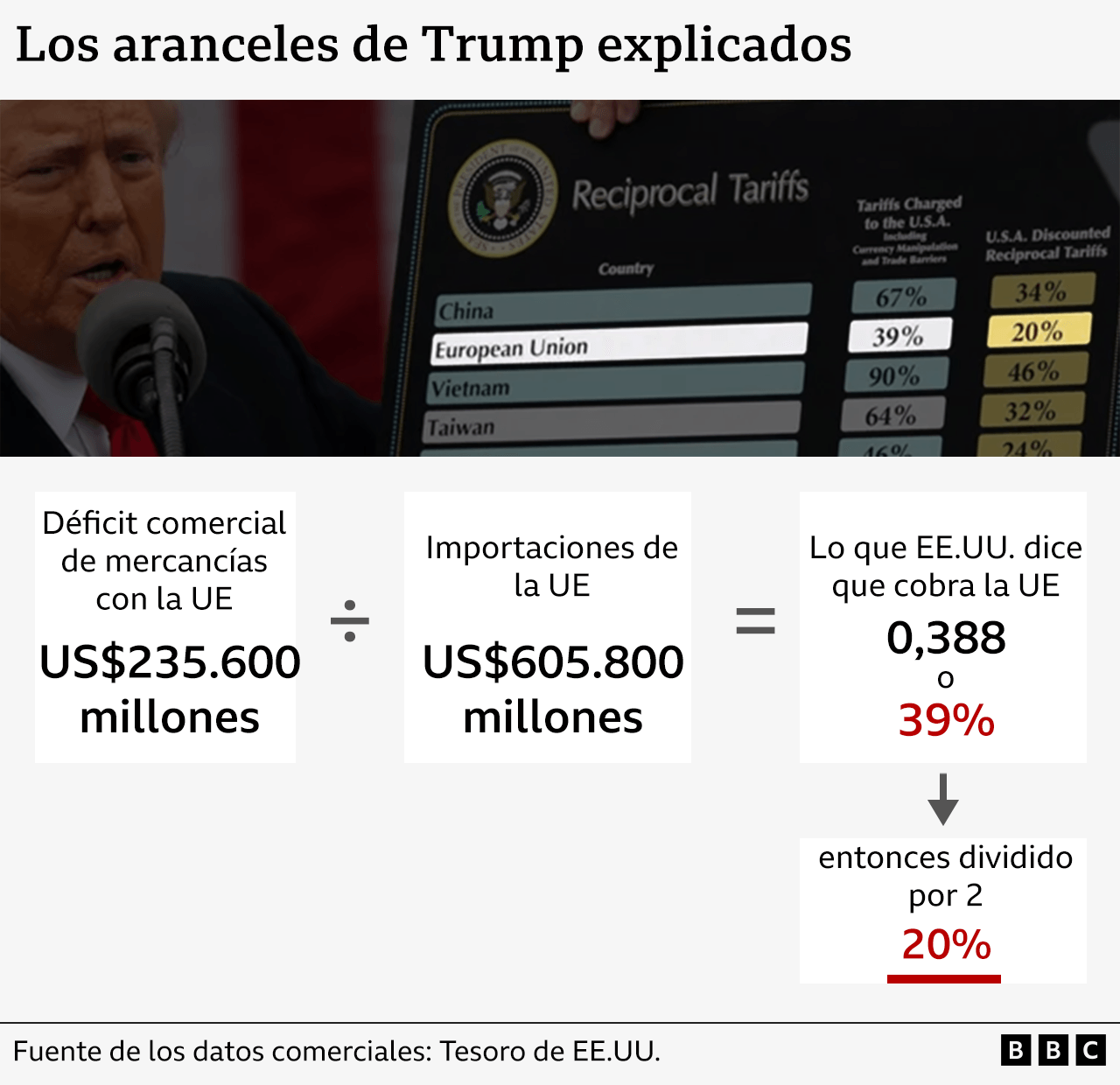
But, later, the White House published what might seem a complicated mathematical formula (see image above).
But the exercise itself was reduced to a simple mathematical operation: take the commercial deficit of US goods with a specific country and divide it by the total import imports of that country.
Next, that figure, which would be the final tariff, is divided by two because Trump said he was being “friendly.”
A commercial deficit occurs when a country buys (imports) more physical products from other countries than it sells (export).
For example, the United States buys more products from China than it sells: there is a deficit of US $ 295,000 million. The total assets you buy from China is US $ 440,000 million.
Dividing 295 between 440 67%are obtained, which is divided by two and is rounded. Therefore, the tariff imposed on China is 34%.
Similarly, when applied to the European Union, the White House formula resulted in a 20%tariff.
Keep in mind that in the figures offered by the White House, the commercial deficit of goods is being calculated. It does not count the services trade, where the United States has a great surplus with the world.
For James Surowiecki, an American journalist specialized in economics, calculating a tariff is a “tremendous nonsense,” he published on the social network X.
“I can’t believe they would say ‘we will simply divide the commercial deficit by imports and tell people that this is the tariff rate.’
Are Trump tariffs “reciprocal”?
Many analysts have pointed out that these tariffs are not reciprocal.
Reciprocos would mean that they are based on what countries already charge the US in the form of existing tariffs, plus non -tariff barriers (things such as regulations that end up increasing costs).
But the document on the official White House methodology makes it clear that this has not been calculated for all countries to which they have imposed tariffs.
Instead, the tariff rate was calculated with the argument that it would eliminate the commercial deficit of US goods with each country.
In fact, Trump has unmarked the formula by imposing tariffs on countries that buy more US products than they sell.
For example, the United States does not currently have a commercial deficit with the United Kingdom. However, a 10%tariff has been imposed.
In total, more than 100 countries have been affected by the new tariff regime.
Broader repercussions
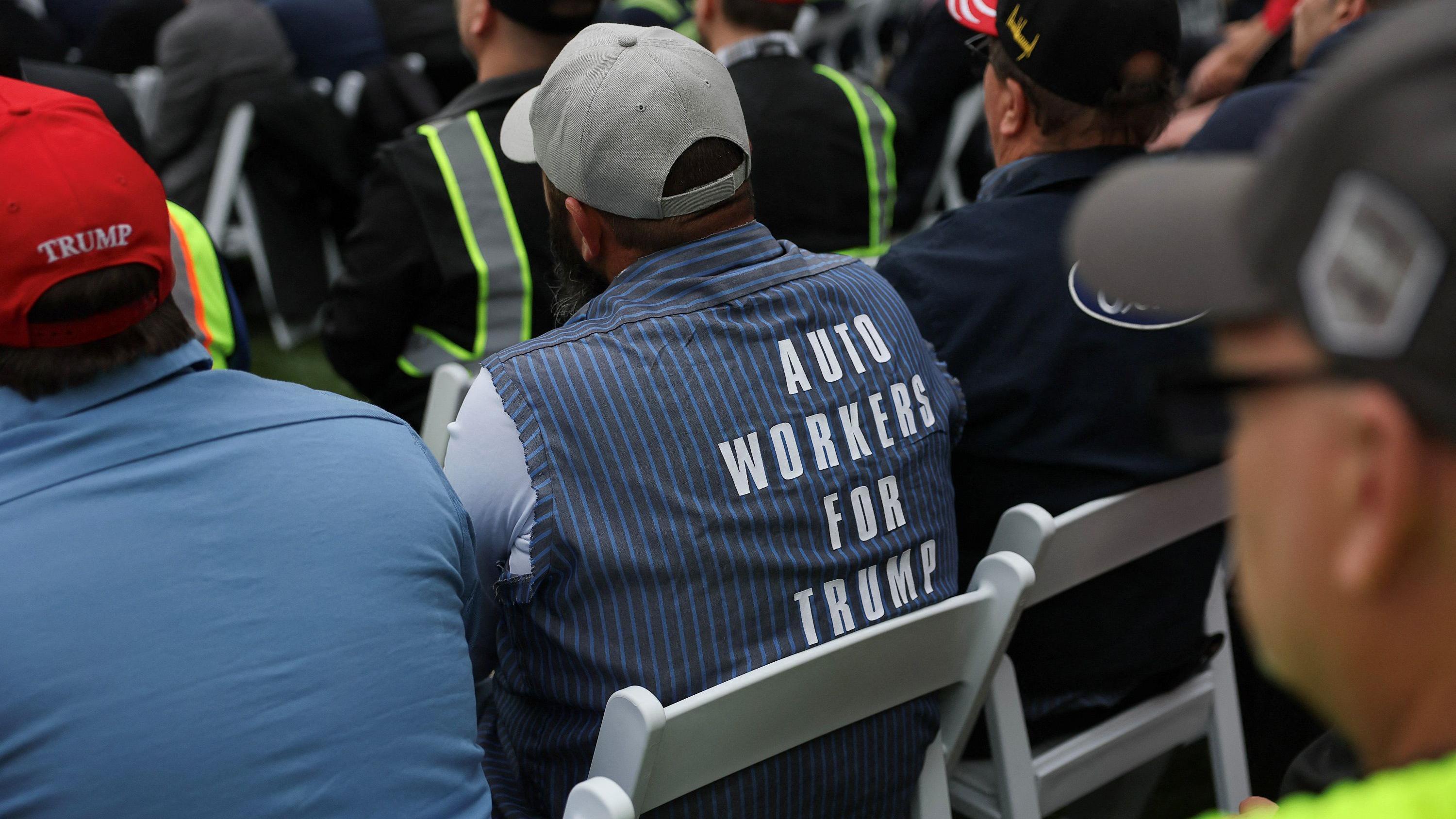
Trump believes that the United States is leaving badly in world trade. In his opinion, other countries flood US markets with cheap products, which harms the companies in the country and destroys jobs. At the same time, these countries put barriers that make US products less competitive abroad.
So, using tariffs to eliminate commercial deficits, Trump expects to reactivate the American manufacturing industry and protect employment.
But will this new tariff regime achieve the desired result?
BBC Verify has spoken with several economists. The majority opinion is that, although tariffs could reduce the merchandise deficit between the US and specific countries, they will not reduce the global deficit between the US and the rest of the world.
“Yes, it will reduce bilateral commercial deficits between the United States and those countries. But obviously there will be many broader effects that are not reflected in the calculation,” says Professor Jonathan Portes, of King’s College in London.
This is because the current global US deficit is not only due to commercial barriers, but to the functioning of the US economy.
On the one hand, Americans spend and invest more than they earn, and that difference means that the United States buys the world more than it sells. While this continues, the US will continue to register a deficit despite the increase in tariffs with their commercial partners.
Some commercial deficits may be due to legitimate reasons, not just tariffs. For example, buy foods that are easier or cheaper to produce in the climates of other countries.
According to Thomas Sampson, of the London School of Economics: “The formula is reverse engineering to rationalize the collection of tariffs to countries with which the United States has commercial deficit. There is no economic reason to do so and it will cost the world economy expensive.”
*With Ben Chu and Tom Edgington reports of BBC Verify.

Click here To read more BBC News World Stories.
Subscribe here To our new newsletter to receive every Friday a selection of our best content of the week.
You can also follow us in YouTube, Instagram, Tiktok, X, Facebook and in our WhatsApp channel.
And remember that you can receive notifications in our app. Download the latest version and act.