
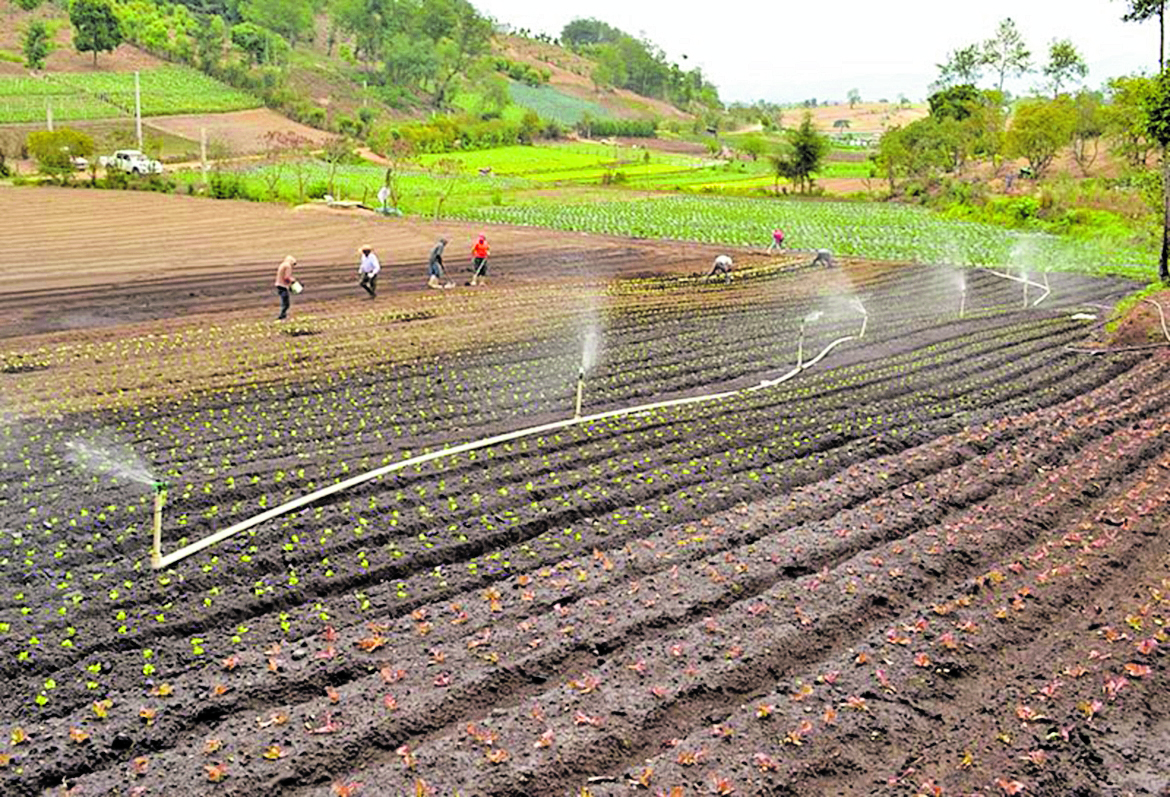
The chances of the El Niño phenomenon in Guatemala They are high. The National Institute of Seismology, Volcanology and Hydrology (Insivumeh) indicates that there is a 78% probability to develop, so the rains are expected to be irregular and the dog days would be longer. This will have an impact on agriculture, by increasing the need for irrigation.
The Insivumeh has indicated that this year’s climatic behavior is atypical and it is expected that the rainy season will come earlier and begin before the end of April in regions such as the bocacosta and the west; From there there will be a gradual progression to the rest of the country.
Although the first rains are expected to occur under normal conditions, Starting in June there will be a “significant decrease”, with a greater impact in July and August during the dog days, according to the forecast. The regions that will see this deficit are the bocacosta, eastern valleys, northern transverse strip and central highlands.
Although conditions are expected to improve in September, On average this year the rainfall would be less than what is normally recorded in the seasonaccording to the Insivumeh.
Alex Guerra, general director of the Private Institute for Climate Change Research (ICC), indicates that in Central America El Niño causes a reduction in rainfall and can cause droughts. The phenomenon occurs every three years, but occurs with greater intensity every eight years.
In the last dry season, cold fronts caused drizzle; However, with the appearance of the phenomenon this can change and cause stress in the crops due to lack of water, he adds.
According to the US National Oceanic and Atmospheric Administration (NOAA), The phenomenon could extend until the end of this year.
For its part, the World Meteorological Organization (WMO) announced on April 24 that climate models point to the formation of El Niño with temperatures above normal and with global reach. Wilfran Moufouma Okia, head of the international entity, pointed out that It will be a “strong” episode.
Fires and impact on crops
The implications for Guatemala are mainly a Canicula —period in which rainfall is reduced— longest between July and August, with a deficit of rain and high temperatures; less precipitation from July to October, in addition to the risk of forest fires increases starting in November.
Alberto Cano, from the Institute of Research in Natural Sciences and Technology (Iarna), indicates that this reduction in rainfall will affect crops such as corn and beansessential for food security.
During April and August, in many areas of the country, the planting of crops begins to take advantage of the rains. By harvesting crops, households have food availability and store grains for the next year. But with El Niño this cycle is interrupted, and the consequences for families translate into less food on the table.
In 2027 there will be a decrease in levels in rivers, lagoons and wells during the dry season, and with less rain there will be less water recharge. There will be greater need for irrigation for crops.
Guerra mentions that in Guatemala Most agriculture depends on rain, due to the lack of irrigation systems, which is why farmers take advantage of the rainy season to plant crops..
“With the effects of El Niño, it is expected that the dog days will be more extensive and stronger, and that the lack of water will be greater and with more heat,” he points out. He adds that, as has happened in previous years, there will be crop losses.
In some areas of the country, mainly in the dry corridor, farmers can lose or produce less on their plots, and for families that subsist on what they grow this means not having enough to cover their food needs.
Actions: irrigation, reservoirs and soil coverage
According to Guerra, among the measures to counteract the effects of El Niño on crops is have irrigation systems —the ideal— and store water in reservoirs for use during low rainfall. Another alternative is to implement soil cover to prevent evaporation—vegetation helps maintain humidity.
Providing family farming producers at all strata with efficient irrigation systems is a necessary strategy, but it is only part of the solution. Cano indicates that broader, comprehensive and medium-term strategies are required, with a territorial approach, to address the situation, since climate variability will continue to affect year after year.
“Strategies are required that go beyond orthodox approaches; approaches such as those proposed by regenerative agriculture, for example, are needed. More sustainable techniques, adapted to the local environment,” says Cano.
“Irrigation is necessary, but it constitutes a small portion of the solution to the problem. Surface and subsurface water reserves are depleted and, given the irregularity of rains, having irrigation will be more difficult,” he adds.
The cost of implementing irrigation systems is high and for subsistence and subsistence farmers it is difficult to cover it. Therefore, it requires state intervention with long-term policies and strategies. Otherwise, the populations are left unattended and without the capacity to cover the maintenance or installation of irrigation systems, which affects their crops and impacts the food availability.
The Ministry of Agriculture and Food The Ministry of Agriculture, Livestock and Food (Maga) indicates that to serve small farmers in the face of a season of low rainfall, an institutional plan is implemented, through the Emergency Committee, which covers agroclimatic monitoring and information, food assistance, plant and animal health actions, as well as productive strengthening and resilience.
The greatest vulnerability due to a possible decrease in precipitation will be seen mainly in the dry corridor. Monitoring will focus on Zacapa, Chiquimula, El Progreso, Jalapa, Jutiapa, Baja Verapaz and Quiché, according to Maga.
Under what conditions would the prolonged heat wave arrive?
According to the latest analysis of the Integrated Food Security Classification in Phases (CIF), in the country, last May, around 2.8 million Guatemalans They were in critical stages. The figure could be higher, since no new measurement has been made.
Anticipating the repercussions, Guerra mentions that the Government must act as a facilitator and regulator of water resources, and ensure the provision of services to the population. It should also provide financing for water infrastructure.
The El Niño phenomenon does not follow a regular pattern; However, its most intense effects in the country were recorded in 2014 and 2015. The climatic event also manifested itself in previous periods, such as 1972-1973, 1982-1983 and 1997-1998.