
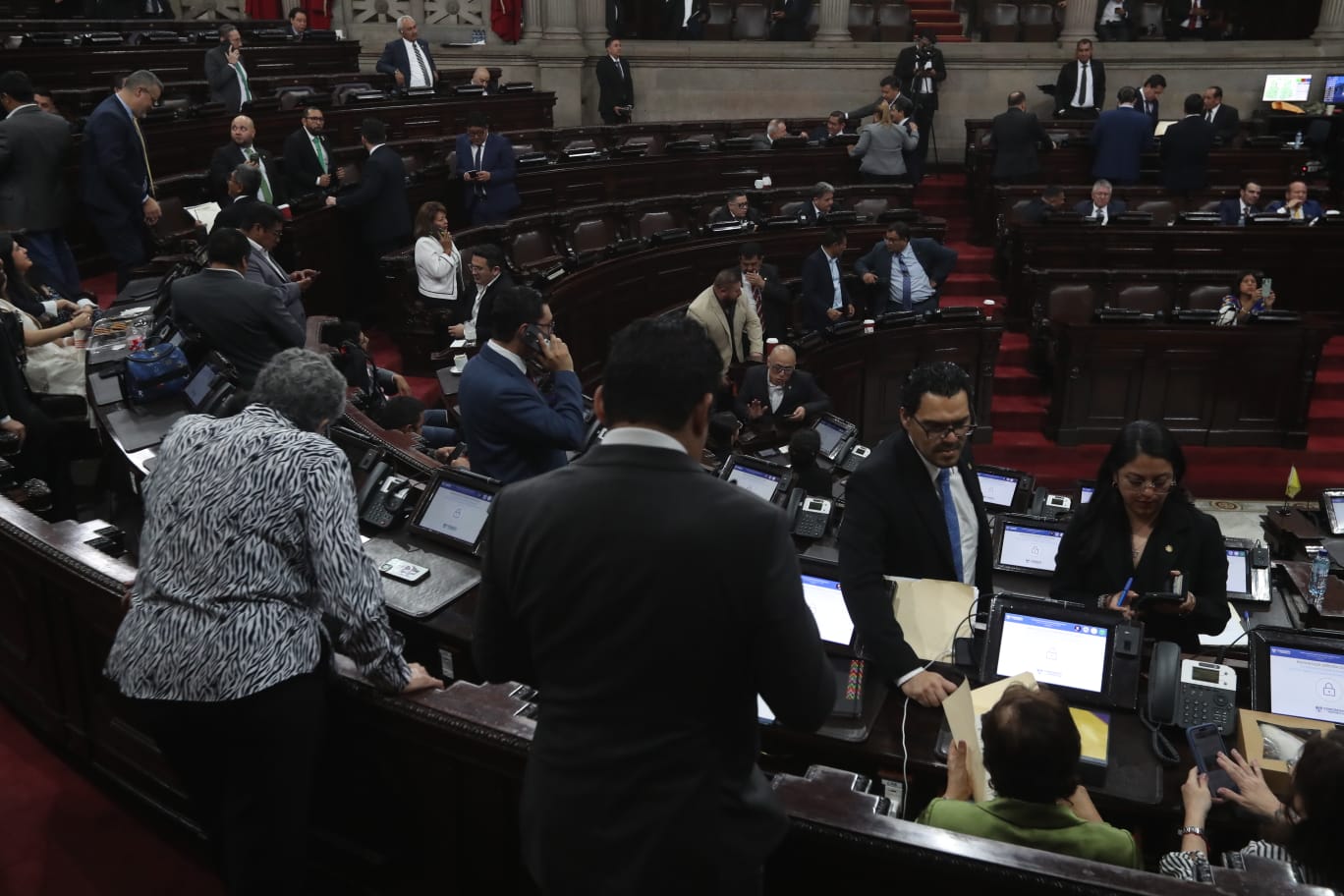
As a social benefit and support for Guatemalans looking to acquire a home The deputies of different legislative blocks qualify the modifications to the Law of the Single Tax on Real Estate (IUSI), which were already known in their first reading within the Legislative chamber.
The opinion of initiative 6709, which proposes reforms to the IUSI Law, It was issued favorably by the Social Security and Social Security Commission in March of this year.
In this several main points are proposed, such as the reduction of the rate from 9 to 3 per thousand for all owners; the temporary exemption from the IUSI for the first home that is still in the payment process, with the aim of alleviating the economic burden of families; the exemption from paying said tax for taxpayers who have paid the tax for 20 years, this in recognition of their responsibility and permanence within the system; and, finally, the exemption from payment to all those over 60 years of age and retirees, prioritizing the protection of family assets.
“unfair” tax
Deputy Christian Álvarez, president of the aforementioned legislative commission, indicated that said tax, created in 1998 during the government of Álvaro Arzú, originally had an amount determined by a “fiscal value” much lower than the real value of the property, which made this tax much more “bearable.” However, over the years, banks and transactions forced owners to declare the real value of their properties, something very different from the tax value, which made the amounts for said tax more expensive.
“No one, no one in ’98, and I would dare say that even before 2010 perhaps, put the real value of their properties to pay the single tax on real estate. What’s more, even when one made property transactions and a concept of improvements was accepted, that is, that one could put part of what the property costs and another part a concept of improvements, what it did was reduce the value at which the IUSI was assessed. That has been disappearing, above all in those who buy their property financed,” he stated.
As he said, This situation has currently made said tax “disproportionate and unfair.”since the current rate is 9 per thousand, almost 1% of the value of the property. In this sense, it states that, in some areas of the capital, such as zone 15, an apartment pays much more in IUSI than a house, without clear criteria as to why it has a higher value. While in other areas such as Villa Canales, Fraijanes or Santa Catarina Pinula, an apartment pays less than other properties. “That ended up being the nature of this tax, which is unfair,” he added.
According to Álvarez, The opposition to this initiative comes from mayors and deputies who defend their own financial interests and not those of the neighbors.
They support proposal
Deputy Allan Rodríguez, head of the Vamos benchcommented that on their part they are in favor of making the modifications to the IUSI, taking into account that those who have properties with a higher value pay more than those people who are paying for their first home.
“Our position is in favor of modifying the IUSI. We are in a position that, just as it is the toad, it is the stone, and whoever has higher-cost properties should pay 9 per thousand, but those who do not have the capacity, those who have their first home should not have to pay the IUSI, and if the house is of a certain cost, they can pay 3 per thousand and if it is of a certain amount, 5, but that it be a percentage, that it be gradual,” Rodríguez stated.
The congressman indicated that he and the members of his caucus have done the analysis and that They will propose the respective modifications, since they are in favor of approving the reform.
Deputy Inés Castillo, head of the National Unity of Hope (UNE) bloc, He also assured that for people who pay for their first home, as well as for retirees, it is “unsustainable” for them to pay such a high tax.
“I really don’t know what the fear of reducing the tax is, they don’t want to give up the money, they don’t want to lower their income, that’s the truth, but the 9 per thousand tax for Guatemalans who buy their home with real values that carries the social content and those who have already retired, who left their lives working in the country, cannot continue paying such a high tax,” he asserted.
Castillo also announced that presented an amparo action before the Constitutional Court against the Board of Directors of Congress, so that the approval of the modifications to the IUSI is carried out with 81 votes, and not with 107 as indicated by the president of the Legislature, Luis Contreras.
“We consider that this reform corresponds to an ordinary law that must be approved with 81 votes. That is why we have asked the Constitutional Court, we have presented this amparo action against Congress, the Board of Directors, so that the Court can establish order in that sense,” said Castillo.
For his part, deputy Jairo Flores, head of the Will Opportunity and Solidarity (VOS) bloc, He believed that the main problem of the IUSI is that citizens do not see any improvement or concrete benefit in public services that arise from it on the part of the municipalities.
“This is being seen as a punishment for people who manage to build their first home. It becomes a punishment for young people, for newlyweds who struggle to build a decent property to live in and encounter a tax that is abusive, that does not give respite and that can also mean enormous debts,” says Flores.
Update, but not delete
The president of the National Association of Municipalities of Guatemala (Anam) and mayor of Santa Catarina Pinula, Sebastián Siero, stated that They agree with making an “update” to the IUSI law, since this dates back more than 25 years. However, he indicated that he does not agree with eliminating the tax, as proposed by some deputies, since this would put the finances of the communities at risk.
“We recognize that the IUSI law deserves an update, it is a law that is more or less 25 years old and deserves to be updated. But from that to moving to populist or electoral proposals of wanting to eliminate it, there is a big difference. Actually the people who are being affected right now with the IUSI are the people who comply with the law and who take out their credits with the FHA because they register the value of their properties at the real value. And they are the ones who are being affected and those types of people are the “They deserve an update to the IUSI law to be able to solve this problem,” Siero added.
According to the president of Anam, an elimination of the tax would be well received by the population; however, This would put the municipalities in difficulties, since the collection of the IUSI It is also used to carry out works by the communes.
“Logically, among the population, eliminating taxes is going to be something well accepted. But we have to remember that the municipalities are the only ones that have managed to go out and carry out works and move Guatemala forward in recent years. So if they want to remove taxes, they should remove taxes from the Executive that is not doing anything, but they should not punish the municipalities that are the ones that are really working,” Siero assured.
IUSI collection exceeds Q1,800 million annually
According to the IUSI Collection Income Report, published on the portal of the Ministry of Public Finance (Minfin), the collection of this tax reached Q1,853.7 million in the 22 departments of the country in 2025.
The departments with the highest income were:
- Guatemala: Q1 thousand 432.5 million
- Escuintla: Q91.8 million
- Sacatepéquez: Q73.3 million
At the municipal level, Guatemala City, Mixco and Villa Nueva stand out as the main recipients of these funds.
Municipalities throughout the country distribute the funds collected from the IUSI in the following way:
- The 2 per thousand is allocated entirely to the communes
- In the sections of 6 and 9 per thousand, 75% corresponds to municipalities and 25% to the State
Furthermore, the law establishes that at least 70% of these resources must be invested in basic services and infrastructure, which could be compromised if revenue decreases.