

In a world marked by immediacy and digital hyperconnection, kitchen emerges as one of the last shelters where authentic coexistence still has a flavor. It is rightly said that you learn to work as a team. It is no accident that it is one of the home spaces where the family meets the most and also where you learn most about it.
Cooking as a family not only satisfies appetite: strengthens links, transmits values and generates memories that last. Through aromas, textures and flavors, the senses are awaken and emotions that shape affective memory are activated. In the kitchen, it is conversed, heard, shared and learned.
In addition, this space has a deep pedagogical dimension: it allows to inherit knowledge from generation to generation and cultivate essential skills for adult life. From a traditional recipe to a technique learned by observation, all culinary knowledge becomes a tool for survival and autonomy.
Even in solitude, cooking can become an act of introspection. Acting the senses while preparing a dish helps clarify ideas and release tensions. Thus, more than a domestic task, Kitchen is also an exercise of emotional well -being and human connection.
The kitchen as a legacy and a family bond
Ximena Fuentes Molina, clinical psychologist, family and conjugal therapist, details that cooking is a deeply significant activity that not only satisfies a basic need, but strengthens the emotional bond between parents, children and complete generations.
The act of sharing with family in the kitchen is very important, Fuentes details, since this daily act can become a powerful emotional, educational and spiritual tool for each family member.
Cooking as a family has great psychological value, Fuentes explains: “We not only feed the body, but we strengthen the family bond. Sharing this activity, quality moments are generated, you learn to collaborate, common objectives are built and affective ties are strengthened.”
“This practice allows children to acquire skills, understand the importance of teamwork and feel an active part of their environment,” adds the psychologist.
Cooking with family strengthens the affective bond between parents, children and complete generations. (Photo: Free Press /Shuttersock)
A space to create ties
Diego Jarquín, executive chef of the Kábel Convention Center, points out that many of the deepest memories of a person are linked to the kitchen. For example, where appropriate, “every time I prepare for my grandmother and my aunts, it is to meet my roots. Cooking is to share, teach, learn and remember,” he says.
This activity, in addition to strengthening family ties, helps build identity, details Jarquín: “Cooking with family generates emotional memories, gives us belonging. Knowing how to prepare an inherited recipe is also to take part of our history on each dish.” This act maintains the family legacy and exalts good times among family members.
The kitchen educates the new generations
For sources, cooking as a family can represent a great opportunity to transmit a legacy. Psychology details that, from an early age, children learn that each ingredient has a function and that, when combined, they can create something new.
“It is a way of teaching autonomy. Knowing how to cook is also a survival tool. It teaches responsibility, organization and contributes to the construction of an individual and collective identity,” adds the expert.
To educate from these spaces, Diego Jarquín recommends starting with simple tasks that generate sensations of achievement in children and young people. This process must be done with love and in a calm way, to create a family bond and instill the value of responsibility.
“Beating eggs, grease a mold, mix ingredients: they are activities that allow the little ones to feel useful and proud. We must not frustrate them with complex recipes, but motivate them with small successes that build trust.”
Kabel’s chef Bleu recommends allowing children to participate in menu planning, purchases and make decisions about what they want to eat. “It is a democratic and affective form of including them in family dynamics.” Along with this, he points out the importance of letting them experience and make mistakes in the kitchen, because this helps them process their frustration when things do not come out as planned.

“Cooking as a family generates affective memories and gives a sense of belonging to the children (Photo: Free Press /Shuttersock)
The kitchen transmits culture and gives identity to people
The kitchen is also a space of cultural transmission, sources details: “Through the inherited family recipes – like the Christmas turkey or turkey – we build identity. We know who we are, where we have already come from who we belong.”
Jarquín points out that a person’s best memories are the ones he shared with his relatives in childhood. Being able to help or be useful in a task that does an adult provides confidence to children, which in adulthood seeks to transmit to other generations, creating important cultural ties in humanity.
Preparing food with our loved ones becomes an emotional and cultural legacy. “It is an act of transcendence. What we learned from our parents taught our children. Cooking is to transmit wisdom, strengthen roots and ensure that these family traditions last,” says the psychologist.
They have a sensory development effect
Eating and preparing food is a sensory act, says Fuentes, since this process involves touch, smell, taste, sight and even ear. Therefore, it helps the development of motor skills in children and the exploration of the senses.
“Cooking as a family and sharing around the table generates well -being, comfort and joy,” he explains. In moments of sadness or celebration, food becomes a symbol of affection, accompaniment and care. That is why this act is so relevant in family spaces, where sharing can give way to better communication between its members.
Cook to heal stress
For Jarquín, the kitchen has also been a shelter. In his adolescence, when the attention deficit hindered his studies, he discovered that cooking helped him to concentrate and relax. “When I felt I could not continue studying, I cooked to dismiss myself. That’s where I found my vocation.”
Cooking is not only therapeutic, it is also a source of immediate satisfaction. “Seeing a finished dish and knowing that it was good, that people liked people, that there was silence because everyone was eating happy, it is priceless. It is rewarding instantly.”
For its part, Fuentes details that this activity has the power to relieve stress levels in people, even calming certain discomfort. This is because the mind focuses on other processes and moves away from concerns, allowing clarity and new perspectives to face problems.
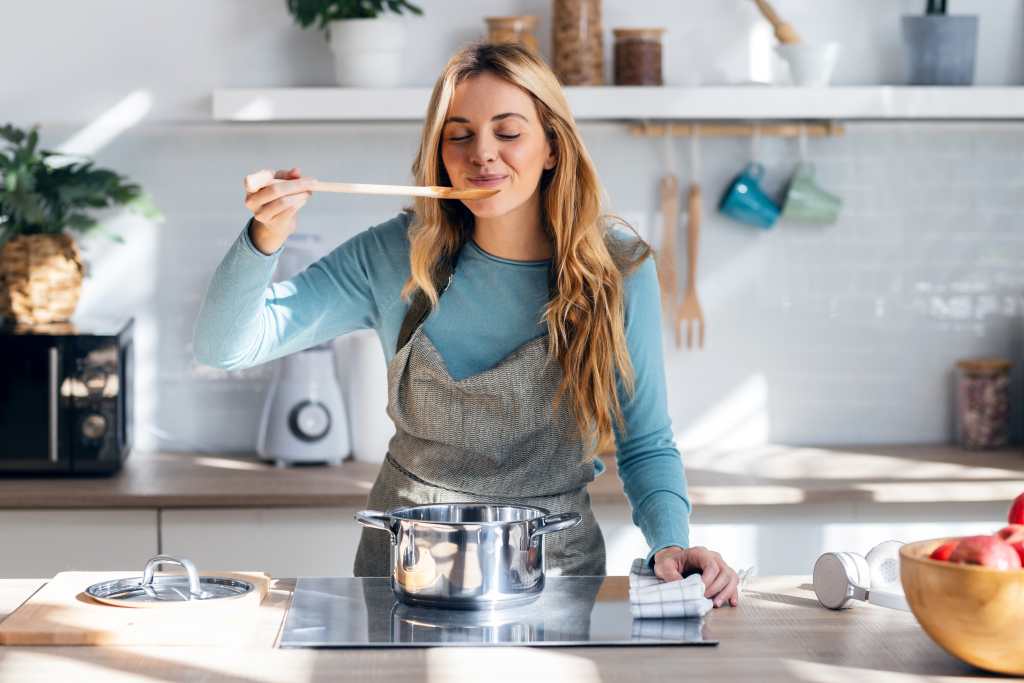
The kitchen has the power to relieve stress levels in people. (Photo: Free Press /Shuttersock)