
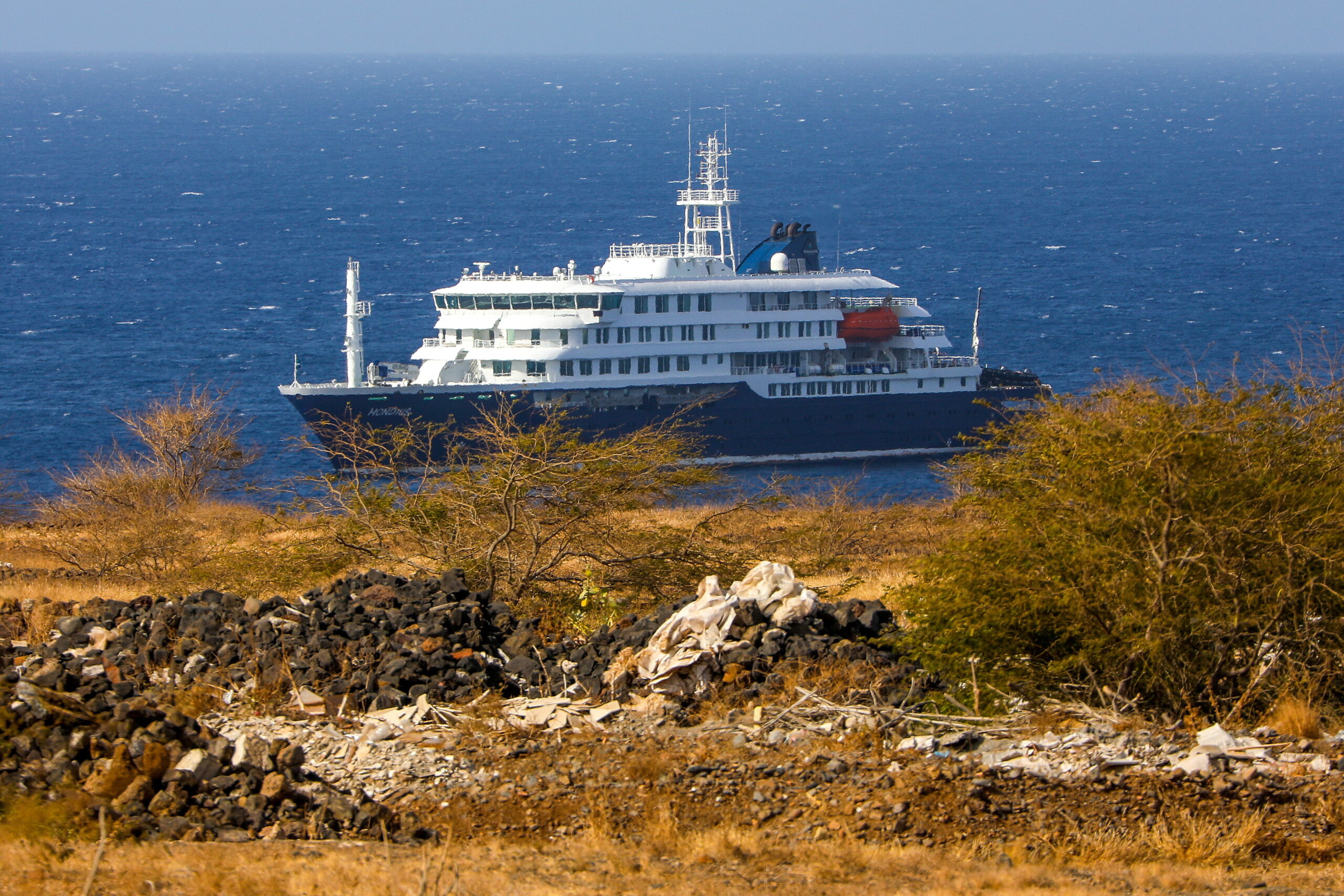
Dutch ornithologist and biologist Leo Schilperoord, 70, traveled with his wife, Mirjam Schilperoord-Huisman, 69, from April 1 to aboard the MV Hondius cruise shipfrom the port of Ushuaia, Argentina, towards Cape Verde.
According to the international press, Leo began to feel bad with fever, headache and diarrhea. In turn, the ship sailed through the Atlantic Ocean with 88 passengers and 59 crew members, one of them from Guatemalan nationality.
He April 11 He suffered respiratory problems and died that same day on the ship.
He body remained on board for almost two weeksuntil it could be landed on April 24 in Saint Helena, a British island located in the middle of the Atlantic.
Then, Mirjam left the boat along with her spouse’s body. Shortly afterward he also began to feel unwell.
she suffered gastrointestinal problems in Saint Helena and, due to the deterioration of her health, she was transferred after April 25 to Johannesburg, South Africa. mirjam he fainted at the airport international OR Tambo from that city, when he was trying to return to his country after Leo’s death. He died upon arriving at the hospital.
A second woman, of German nationality, died on May 2four days after starting to show signs of pneumonia.
A British man was also admitted to a medical center from Johannesburg, where he was transferred after falling ill while the cruise ship was traveling from Saint Helena Island to Ascension Island.
The South African Ministry of Health confirmed that the two cases – Mirjam and the British man – of the hantavirus outbreak detected on the cruise ship They belong to the Andes strainthe only one for which transmission between humans has been documented.
In the case of Leo Schilperoord never had a diagnostic test performedalthough the World Health Organization suspects that he also died as a result of the virus.
The Ministry of Health of Argentina revealed that the Dutch couple entered that country on November 27, 2025 and traveled by vehicle for 40 days and then crossed into Chile on January 7.
He added that the couple continued their journey in vehicles for 24 more days and returned to Argentina on January 31. Then he made a new visit to Chile 12 days later.
Later they traveled by road again for 20 days and the March 13 they crossed by land into Uruguay. Finally, on March 27 they returned to Argentina to go to the port where they boarded the cruise ship on April 1.
The Government of Chile assured that The Dutch would not have been infected in Chilean territory.
Who were Leo and Mirjam Schilperoord?
The Dutch newspaper Telegraaf reported that both were well known in the town of Haulerwijka small town with just over three thousand inhabitants. They are remembered for opposing the construction of a new residential area.
Leo is described as a scientific researcher and active member of the community.
They also point out that he studied at the universities of Amsterdam and Groningen. The Dutch press stated that initially The full names of the victims were not released “due to the family’s wishes.”
The Dutch retired couple had a extensive academic activity and publications related to ornithology.
Both Leo and Mirjam had been linked to the study and observation of migratory birds and arctic fauna. Their names appear in various scientific articles and publications specialized in ornithology in the Netherlands on species such as the short-billed goose, the migratory patterns of Arctic birds or the impact of human activity on wild geese colonies.
Some of this research was published in the 1980s in leading Dutch scientific journals and later cited in international academic works on migratory birds.
Among the Dutch media, this activity is mentioned as the possible original source of contagion, in accordance with one of the epidemiological hypotheses used by Dutch researchers: that The couple could have been infected before boarding the MV Hondius, during a bird watching trip in Argentina.
“The beautiful journey they shared together has been abruptly and definitively cut short,” the family announced in a press release. “We still cannot understand how much we will miss them. We wish to bring them home and remember them in peace and privacy,” he quoted Telegraaf.
The outbreak detected on the cruise ship leaves at least six confirmed infections and three deaths.
The obituaries released after the death of the couple describe Leo and Mirjam as a couple closely linked to their environment. In one of them you can read: “It is with great sadness that we have had to say goodbye to Leo and Mirjam,” while another remembers both of them as “very dear people” and thanks “all the expressions of support and condolences in these difficult times.”
According to the Dutch Chancellery, there were at least 10 Dutch citizens on board.
Infectologist Roberto Debbag, vice president of the Latin American Society of Vaccinology, explained to CNN that, if the couple had arrived in Ushuaia directly by air without having traveled to other parts of Argentina and the region, the main hypothesis would be that of an infection on board the cruise ship, either due to presence of rodents or material contaminated with feces or urine. However, the extensive travel of the tourists opens the possibility that the initial infection occurred during their previous trips.
The WHO raised this May 9 to six confirmed cases of hantavirus after the outbreak declared on the MV Hondius cruise ship.
According to the latest WHO bulletin, one of the suspected cases tested positive in the PCR test.
The WHO carries out additional investigations into possible exposure of the first case and the origin of the outbreak, in collaboration with Argentina and Chile.
Tedros Adhanom, director general of the WHO, stated in X that “this is not another covid” and added: “The current public health risk from hantavirus remains low.”