
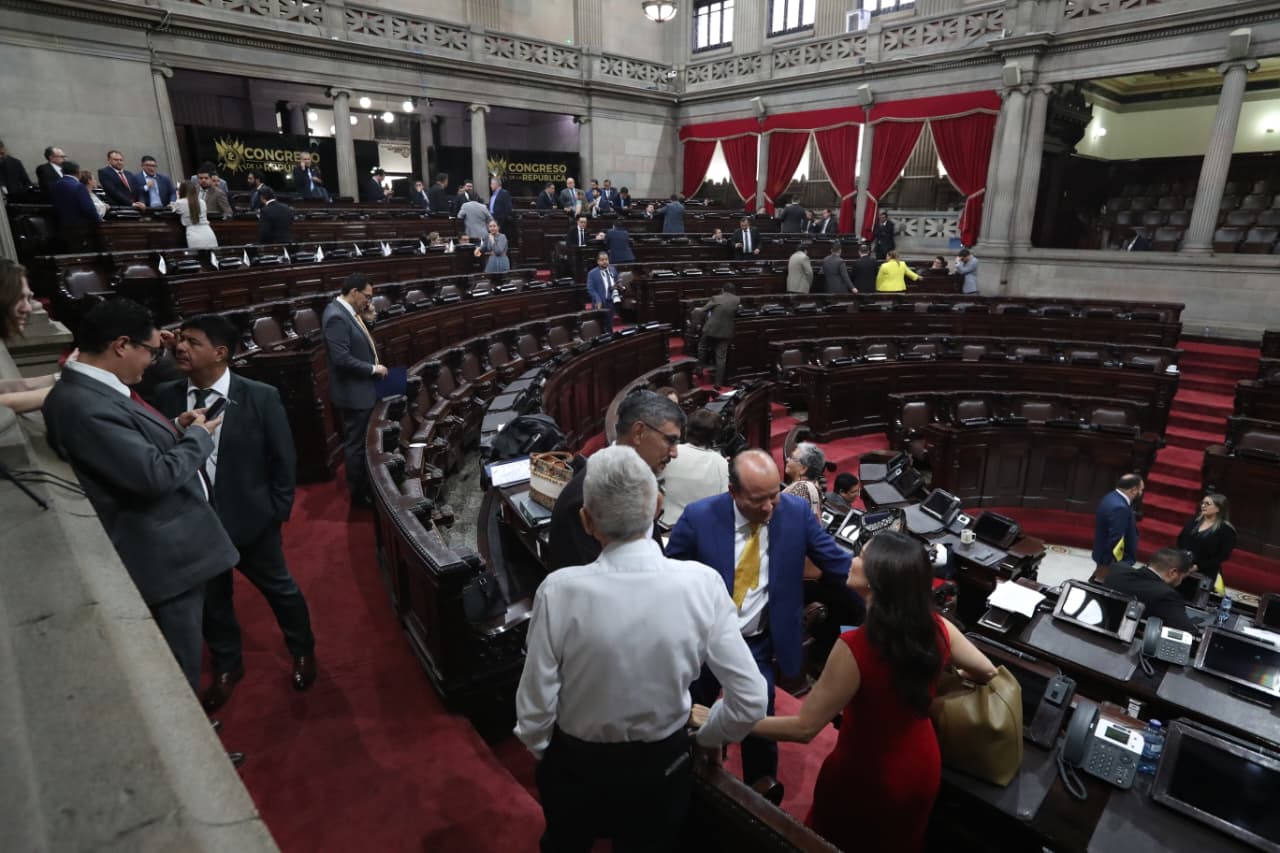
This Friday concludes the first regular period of sessions in Congress, and leaves as pending matter the approval of the Law against Money Laundering or Other Assets and the Financing of Terrorism.
The president of Congress, Luis Contreras, affirmed that there was consensus between the legislative blocks so that the law was approved during Tuesday’s session, which lasted almost five hours and was suspended by Contreras after it became known that some opposition groups were seeking to approve several last-minute amendments.
However, the point that set off the alarms and was the main reason why the Board of Directors decided to suspend the session was an amendment by adding a new article on the conditional origin of asset forfeiture, through which it seeks to modify the Law on Asset Forfeiture, mainly in relation to the crime of money laundering.
What does the amendment seek?
The amendment, to which Prensa Libre had access, establishes a new article in the law against money laundering, number 123, which modifies the application of the Asset Forfeiture Law contained in Decree 55-2010 for the crimes provided for in this new law.
The proposal establishes that the forfeiture of ownership, in crimes related to the anti-money laundering law, could only be applied when there is a final criminal sentence against the owner, possessor or real beneficiary of the asset – money, real estate or others.
That is, the crime would first have to be proven in a criminal trial and there be a final conviction to begin the process of extinction of ownership in favor of the State.
It also stipulates that the possibility of initiating the extinction action “without prior criminal proceedings” is excluded, as established in article 5 of the Law on Domain Forfeiture.
Furthermore, it establishes that the extinction action may be exercised, without a final criminal sentence, only in the following cases:
- to. Rebellion of the union for at least two years from its firm declaration
- b. Death of the accused, prosecuted or convicted (registered)
- c. Prescription of criminal action declared by final resolution
- d. Impossibility of identifying the accused, declared judicially after exhausting investigations
- and. Final criminal conviction abroad for equivalent crimes, recognized in Guatemala
This amendment also stipulates that in the above cases the “standard” of clear and convincing proof of the illicit origin of the goods, an objective link with the criminal activity classified in the anti-money laundering law and the lack of rights of “good faith” third parties will be applied. Likewise, it establishes that the standard of preponderance of evidence or balance of probabilities currently established in article 25, paragraph 14, of the Asset Forfeiture Law will not be applied.
Elimination of legal presumptions
According to this new article, the legal presumption contained in article 6 of the Domain Forfeiture Law It will not be applicable to actions regarding extinction that are exercised based on crimes under the anti-money laundering law. In addition, the Public Prosecutor’s Office (MP) must directly prove, with sufficient direct or indicative evidence, the existence of the criminal activity, the objective link between the crime and the property, as well as a temporal parameter in accordance with the general rules of prescription and evidentiary connection.
Prevalence over other standards
Finally, the new article that is sought to be incorporated establishes that it “prevails” only for the crimes established in the law against money laundering “over any norm of equal or lower hierarchy that contradicts it”, expressly including articles 5 – second paragraph -, 6, 14 and 25 – section 14 – of the Asset Forfeiture Law, as well as article 17 Bis of Decree 67-2001, which contains the Law against Money Laundering current.
In addition, it stipulates that the rules of the Domain Forfeiture Law “not modified” by this new article will remain in force and will be applicable, as long as they do not oppose the provisions of this new regulation.
It will depend on the consensus
According to some deputies, the Cabal bloc would be promoting the inclusion of this new article. In this regard, Deputy Luis Aguirre, head of the Cabal bloc, stated that “they are not promoting” this modification, but its inclusion will depend on the consensus reached with the other legislative blocks.
“We are not promoting, if consensus exists at the right time and if not, it is not a condition for the money laundering law. In theory yes, but the plenary session is variable. It was socialized with the entire plenary session and everyone agreed,” said the congressman.
He also assured that the Cabal bloc proposed that the same text contained in the anti-money laundering law that is in force be maintained and enforce the presumption of innocence.
“In the money laundering law there is an article where assets are extinguished at the time of being defeated in court, and our proposal was that this same text be used for all crimes, enforcing the Constitution and the presumption of innocence. And it has consensus; but it is not a condition, it is because we are talking about those issues and it is time. Several countries used that law for the war against drug trafficking and organized crime and have already changed it; we are the only country where it is still in force. And more than being a condition, it is the moment of the conversation since we are talking about money laundering,” said the congressman, who assured that the modifications promoted by Vamos and the UNE aimed at exempting the lawyers’ union from responsibilities are not viable.
Modification will render the Extinction Law useless
The Minister of the Interior, Marco Antonio Villeda, who also served as a judge of Forfeiture of Domain, He stated that this modification that is intended to be made to the anti-money laundering law is a “total disproportion,” since the action of asset forfeiture is eminently patrimonial and not a personal action.
“This has worked precisely because we have separated the action of forfeiture of ownership from criminal liability, on the understanding that we have understood that it is not a personal action, but rather an eminently patrimonial action. Trying to link the action of forfeiture of ownership to the previous criminal conviction is a total nonsense that will render this regulation useless.“said the official, after a summons in Congress with deputies from the Vos bloc.
Villeda also assured that many of the properties that have been extinguished belong to people who have not been involved in crimes, but they have lent their name to assume the “apparent” ownership of this heritage, which is also often in the name of corporations, legal entities that are not necessarily linked to the commission of the criminal act that gave rise to them, so said modification will render the law on extinction useless.
They didn’t know about amendments
Deputy Orlando Blanco, fourth secretary of Congressconfirmed that the quorum was indeed broken from the Board of Directors, with the aim of preventing the inclusion of amendments that they were not aware of, including the elimination of fines for lawyers and other responsibilities for this union, as well as the modification to the Asset Forfeiture Law.
“We broke quorum from the Board of Directors, the secretaries of the Board of Directors, for several reasons. One, out of respect for the population and two, to protect the law against money laundering. It is not healthy to want to surprise Congress. A group of deputies went to lock themselves in an office to agree on some amendments, among themselves, and that no one knew about; we did not know them and not many people knew them, and around seven thirty at night they showed up saying that they already had the amendments,” said Blanco, who also He commented that with this action it becomes clear who are the blocks that oppose and “want to file the teeth of the law.”
They reject accusations
For their part, deputies from the Unionista and Todos blocs rejected the statements made by deputy Samuel Pérez, who at the end of Tuesday’s session assured that together with the Vamos and UNE blocs they were also seeking to approve the amendments to the anti-money laundering law.
Álvaro Arzú Escobar, from the Unionist bloc, He sent a message to Pérez on his social networks indicating that “as always” the official deputy is “deceiving with lies” and ruled out having participated in any meeting to agree on amendments or modify any law.
“I was not in any meeting or presented amendments yesterday – on Tuesday – and much less did I do anything to delay the approval of the law. On the contrary, we were in the plenary session from the beginning and I learned about the new amendments at the same time that you learned about them, at the end of the session and in the middle of the chamber. What I did do was go to the sessions of the Economy Commission for several consecutive weeks to discuss and sign the amendments that have the consensus and signature of the majority of the members of the Commission, including members of your group, cult or whatever their name is,” he said.
He also indicated that they have been willing to approve the law and assured that any accusation that Pérez has against him it is better that “he has the evidence to support it.”
Likewise, the head of the Todos bench, Byron Rodríguez, He affirmed that they are completely willing to approve the law and rejected Samuel Pérez’s accusations, stating that they did not know or agree on any amendment.
“To the Raíces bloc that comes out saying that we have to do with this, we never at any time arrived at the session that afternoon, we did not approve any amendment, it is necessary that the money laundering law be approved in Guatemala. Guatemala is on a gray side, as a tax haven for money laundering. What do they seem to be defending? What are they protecting here? Narcoterrorists, terrorists, their financiers of many deputies and many legislative blocs and it is really painful to see how “They closed the quorum of the Board of Directors, I don’t understand, they make the president of Congress look very bad,” said Rodríguez.
Deputy, there was talk that these last-minute amendments proposed by these blocs had also been agreed upon by the Cabal bloc. How do you respond to the accusations, mainly from the ruling bloc?
There is talk of new amendments that were going to be presented last night in the session by the Vamos and UNE blocs, they even mentioned the Cabal bloc, and that they would be presented without any consensus with other legislative blocs.
Do you think it will be possible that this law canFirst purchase competitionto be approved as soon as possible in Congress or is there still reluctance on the part of some blocks for the law to be approved, Congressman?
Law will strengthen the legal and institutional framework of the country
Through a statement, the Guatemalan-American Chamber of Commerce (AmCham) indicated that the approval in the third debate of initiative 6593 for the creation of the Law against Money Laundering or Other Assets and the Fight against Terrorism is of utmost importance for strengthening the legal and institutional framework of the country.
As indicated, this standard is aligned with international standards and contributes to protecting the financial system and strengthening the fight against illicit activities. Accordingly, it urges Congress to continue with the corresponding legislative process and advance in the approval by articles and final drafting of the regulations.