
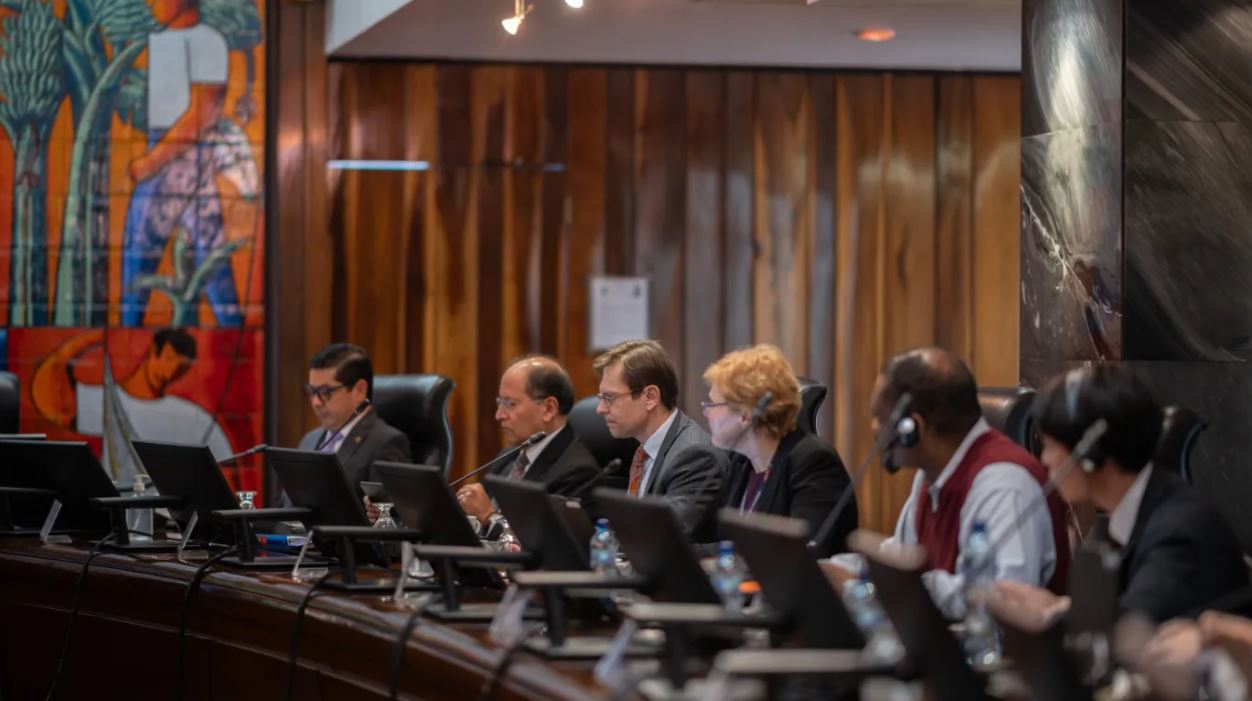
The president of the Bank of Guatemala (Banguat), Álvaro González Ricci, explained that all member countries of the IMF are subject to said consultation within the framework of article IV of its Constitutive Agreement.
This refers to a evaluation of the macroeconomic situation of the country, the conduct of monetary and fiscal policies, the economic reforms carried out, as well as aspects of an institutional nature, such as the progress that the country has made in this area, the official added.
This annual process evaluates the main macroeconomic and fiscal indicators, as well as the soundness of the financial system. Additionally, upon completion, the IMF issues recommendations and observations to guide the country’s economic policy, the Ministry of Finance reported in a bulletin after a preliminary visit received in February.
Juan Carlos Zapata, executive director of the Foundation for the Development of Guatemala (Fundesa), explained that “It is not a minor routine visit”but rather it is a determining examination of the macroeconomic policies, monetary stability and financial resilience of the country.
In addition, the evaluation is crucial for risk rating agencies to validate the health of the nation and Guatemala to advance towards investment grade, the executive explained.
Attention to laws and other points
Zapata considers that The visit will be key to evaluate the implementation of laws such as the Priority Road Infrastructure Law (Decree 29-2024) and the reform of the Public-Private Partnerships Law (APP)carried out with Decree 21-2025 in November of last year.
González Ricci announced in February that, during said visit, in addition to the performance of the economy, the delegates showed interest in the advancement of regulations approved by Congress, such as the Priority Road Infrastructure Law, the operation of the Competition Superintendency and the reforms to the PPP Law.
In addition, the February visit also addressed the progress of the initiative that contains reforms to the Comprehensive Law against Money Laundering u Other Assets and the Financing of Terrorism.
CONTENT FOR SUBSCRIBERS
Zapata said, however, that there are other pending points. He described the execution of the budget of the Ministry of Communications as a worrying aspect, since as of April of this year it was only recorded at 12%.
He explained that multilateral organizations are also beginning to be concerned about “the indolence of the authorities to implement the road infrastructure law.” In his opinion, this could be the issue that will stand out the most in the next meetings due to the little existing public investment, 1.6% of GDP.
Positive indicators
Zapata He believed that the country’s macroeconomic indicators are very good and that, in the preliminary visit last February, the IMF delegation validated economic growth above potential, controlled inflation and progress in fiscal transparency reforms.
In fiscal matters, tax collection has improved in the last year, a result of technological modernization and greater efficiency in inspection, he added.
On that occasion, during the visit, different meetings were held to learn about the closing of the economic performance for 2025, as well as the prospects for this year, information that will be used in the evaluation of article IV.
The visit took place before the escalation of the Middle East conflict, which has had various impacts on oil, fuel and inflation prices.
To date, the Monetary Board maintains the economic growth projection of 4.1% for 2026, although risk scenarios have also been analyzed if the conflict is prolonged. Meanwhile, the Monthly Index of Economic Activity (IMAE) in the first quarter of this year registered a positive behavior of 4.4%, while that of March stood at 4.6%.