
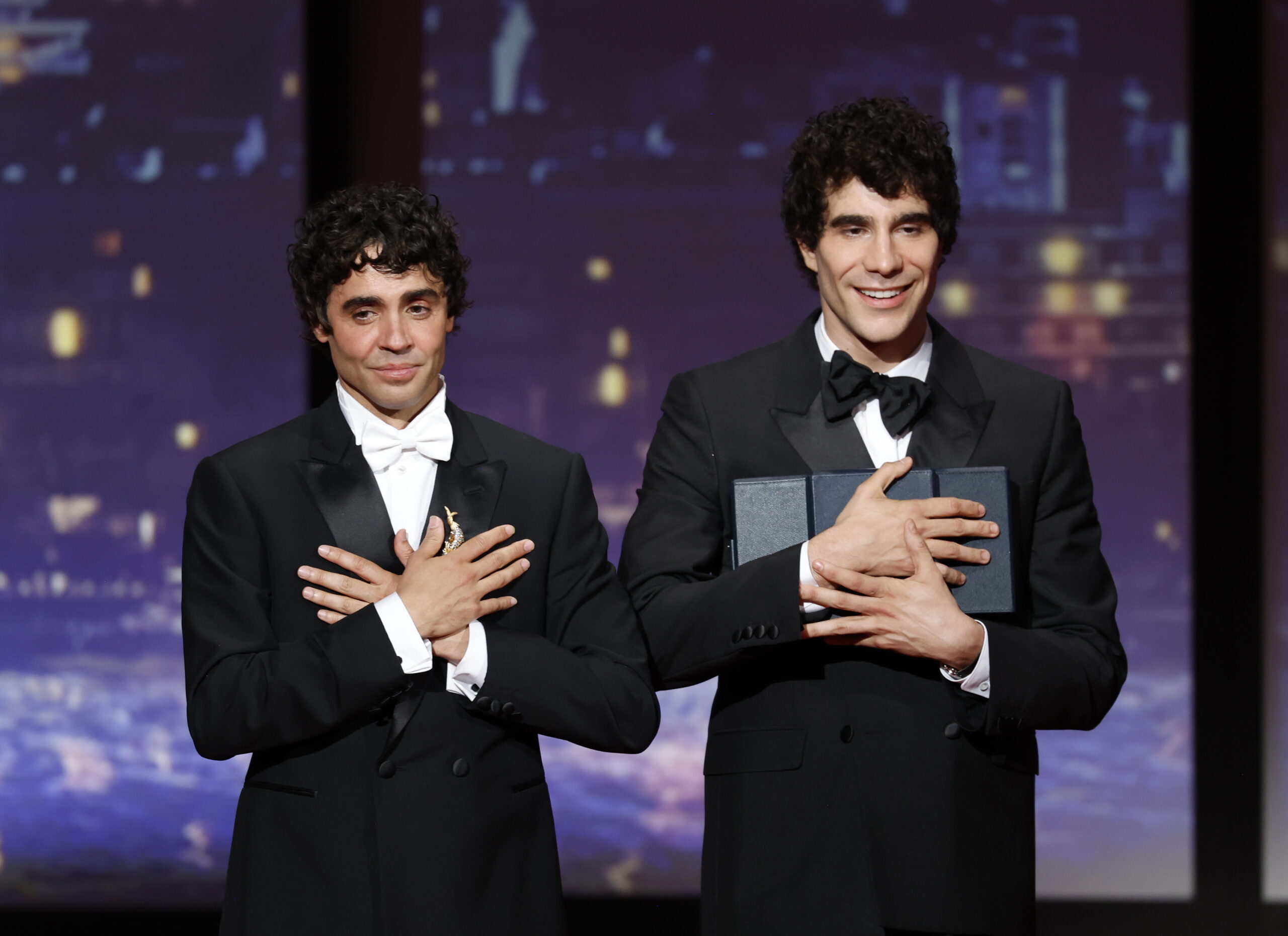
This Saturday, the Cannes Festival supported the films of Javier Ambrossi and Javier Calvo, with the Direction Award for ‘The black ball’, a proposal highly valued by the jury chaired by filmmaker Park Chan-Wook, who awarded his second Palme d’Or to Romanian Cristian Mungiu, this time for ‘Fjord’.
The Grand Jury Prize went to the favorite of the 79th edition of the festival, the Russian ‘Minotaur’, by Russian filmmaker Andrei Zviaguintsev, who took advantage of his presence on stage to send a message to the president of Russia, Vladimir Putin, to put an end to the “carnage” in Ukraine once and for all.
Mungiu was also political, who when collecting the Palme d’Or for his film, starring Sebastian Stan and Renate Reinsve, which forces us to reflect deeply on today’s world, said that with this film they have “taken a risk”, that of “raising our voices” in the face of the dangers to which we are exposed as a society.
The confrontation that the film raises, between one part of progressive society and another more conservative, shows that “societies today are fractured, radicalized.” “This film is a commitment against all forms of fundamentalism, it is a message of tolerance, inclusion, empathy. They are wonderful words that we all like, but we must apply them more often,” considered the Romanian filmmaker.
While the award for best screenplay went to the Frenchman Emmanuel Marre, for ‘Notre Salut’; that of the Jury for ‘Das Geträumte Abenteuer’ (‘The Dreamed Adventure’), by Valeska Grisebach; and the female interpretation for the Franco-Belgian Virginie Efira and the Japanese Tao Okamoto, for ‘Soudain’, by Rysuke Hamaguchi.
The honors of the official section were completed with the award for best actor for Emmanuel Machia and Valentin Campagne, for ‘Coward’, in a category that everyone had taken for granted the victory of Javier Bardem, due to his superb performance in ‘The loved one’.
But the night, with Mungiu’s permission and his intense reflection on the lack of respect in today’s society, was the triumph of ‘the Javis’, two Spanish directors who, in their first participation in Cannes, won the Directing Prize, considered the third most important of the festival, after the Palme d’Or and the Grand Jury Prize.
Ambrossi and Calvo share the award with an already established name, that of the Polish Pavel Pawlikowski, who won it for ‘Fatherland’, a beautiful and harsh black and white portrait of Germany after the Second World War through the figure of the writer Thomas Mann.
Both, excited, stated that they could not believe this recognition and Calvo remembered the other two Spanish directors in competition for the Palme d’Or, Pedro Almodóvar (‘Bitter Christmas’) and Rodrigo Sorogoyen (‘The loved one’), whom he called teachers and companions on the road.
“Art is a vehicle for empathy. The film speaks of humanity, of seeing the other as a human being, of understanding them, comprehending them, loving them,” he reflected, and hoped that what is the second feature film by this duo of filmmakers will serve to change people for the better.
The film starts from ‘The black ball’, unfinished work of Federico García Lorca, of which only four pages remain and which was to be his first work with a homosexual protagonist.
The Javis film stars the musician Guitarricadelafuente, in his debut as an actor, Carlos González and Milo Quifes.
And it also has Miguel Bernardeau, Lola Dueñas, Glenn Close and Penélope Cruz, whose support the directors acknowledged throughout this entire process, which has allowed them to make the big film they dreamed of, as they noted in subsequent statements to the press.