
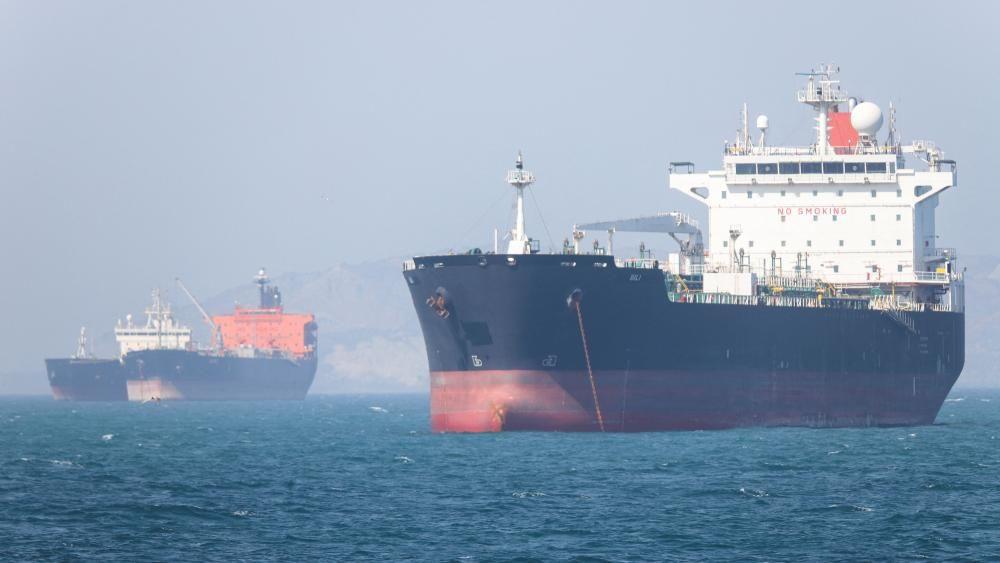
As the ceasefire between the United States and Iran eases global tension, the Strait of Hormuz remains the center of global energy.
20% of the oil and liquefied natural gas consumed in the world circulates through this narrow sea route., and its intermittent blockages have made crude oil more expensive until it stabilizes at around US$100 per barrel. However, the question arises: How long will this calm last?
In Latin America, which is geographically distant from the site of the conflict, the direct impact is felt: Fuel and food prices skyrocket. But in the midst of the crisis, some countries in the region could find opportunities.
These are not “winners” in the strict sense, specialists warn, but rather nations that, due to their resources, can reap temporary or structural benefits. The world, driven by fear of a complete shutdown of Hormuz, is seeking to diversify its energy supply.
It is in this area where South America appears. According to an analysis by Rystad Energy, with a barrel at US$100 the region could add 2.1 million barrels per day by 2035.
However, the International Monetary Fund (IMF) warns that if the conflict continues, it could lead the world into a recession.
The case of Guyana
In Guyana, before the start of the conflict, its weekly oil income was US$370 million and today it exceeds US$623 million. Its economy grew 43.6% in 2024, the fifth consecutive year of double-digit expansion. According to Will Freeman of the Council on Foreign Relations, the problem is not the amount of money, but how it is distributed.
The country continues to have high poverty rates and inconsistent governance. Miriam Grunstein of Brilliant Energy Consulting says that “with its very low rule of law, it is doubtful to say that Guyana is a truly winning country.” The discovery of 11 billion barrels by ExxonMobil in 2015 was the beginning of the story, but the real challenge of managing that wealth without falling into the resource curse remains open.
In Argentina
In Argentina, the Vaca Muerta formation in Neuquén attracts attention. Considered the most dynamic shale field outside of North America, it has opened 15 new exploration blocks.
Jai Singh, from Rystad Energy, highlights that Argentina adds a plus: “the incentives of Javier Milei’s government to deregulate the economy.” However, the rise in fuel prices hits Argentine households, which already suffer from chronic inflation, and the transfer to retail prices could deepen. Argentina may win as an investment destination, but its citizens continue to lose in the supermarket.
Mexico, Venezuela and Brazil
As for Mexico, Its oil mix reached record prices, but the country imports 75% of its liquefied gas and half of its gasoline from the United States. President Claudia Sheinbaum applies subsidies to moderate the increases, but the equation is bad: what is gained by exporting crude oil is lost by importing derivatives. In addition, Mexico is no longer the export power it was in previous years, and there is a political factor: prolonged economic suffering could erode the popularity of the ruling party.
Venezuela, after the capture of Nicolás Maduro and the establishment of an interim government led by Delcy Rodríguez, attempts to rewrite its history. The reestablishment of relations with the United States and the lifting of sanctions opens a window for improvement.
According to Rystad Energy, it is estimated that, with a barrel at US$100, Venezuela could add 910 thousand barrels per day by 2035. But the country is emerging from a depression so deep that any improvement is positive, although reconstruction will take years.
Brazil, on the other hand, appears protected by its large oil production. However, its agricultural sector—one of its driving forces—depends on fertilizers that transit through Hormuz.
A prolonged closure of the strait could affect crops. Inflation is around 4.4%, but social discontent is already perceived. “Brazilians do not have the patience to endure more difficulties,” warns Freeman.
The conflict in the Middle East has exposed an uncomfortable truth: Concentrating energy supply at a single point is unsustainable.
The world needs to diversify, and Latin America can be part of the solution. But it is also a litmus test for the region, since windfall oil revenues can be a blessing or a curse, depending on how they are administered.
Guyana, Argentina, Mexico, Venezuela and Brazil have the opportunity to build more resilient economies, But they face the risk of repeating past mistakes, such as waste, corruption and lack of planning.
Meanwhile, the average citizen continues to pay more for gas and food. The conflict shows no signs of being resolved soon. Its effects are probably here to stay.