
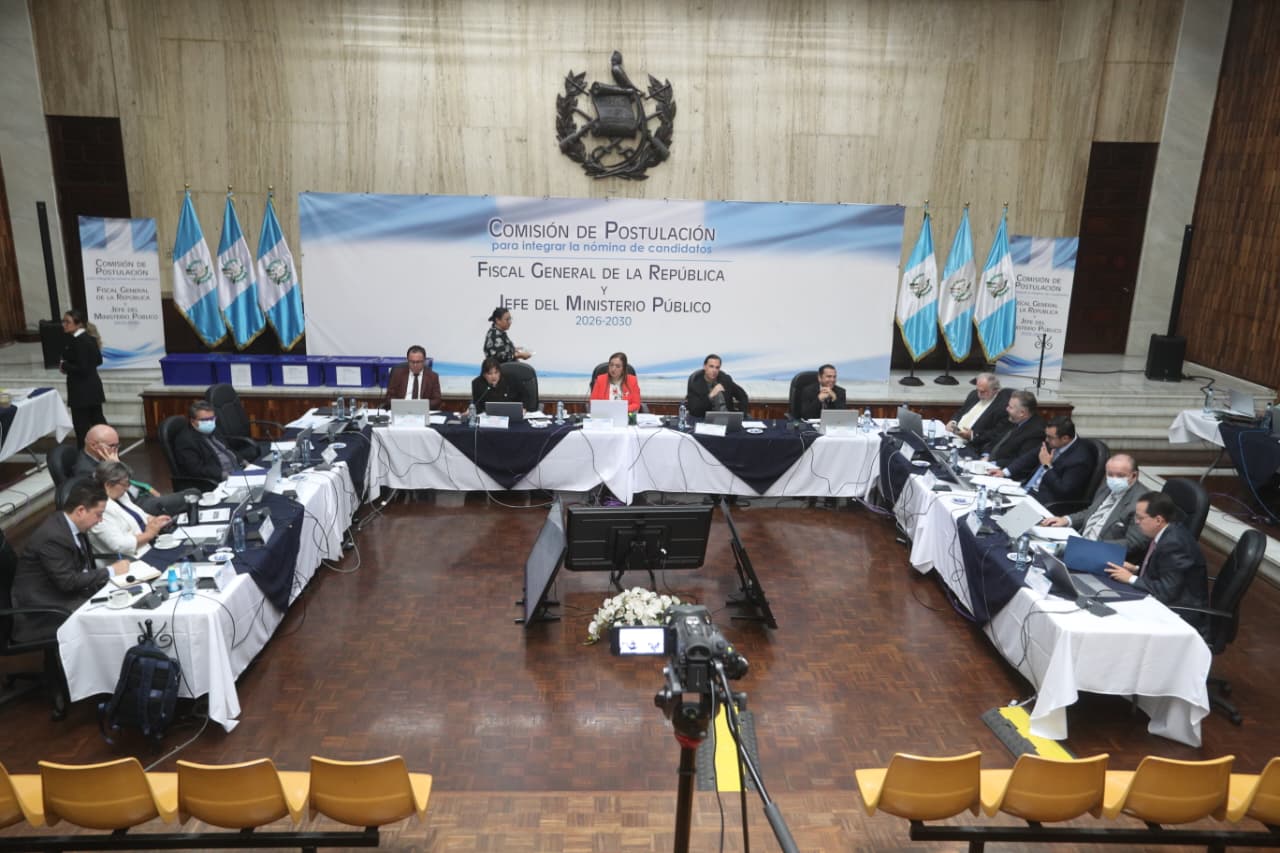
The institutional renewal of 2026 has pending the process of changing authorities in the Comptroller General of Accounts (CGC), But the other three institutions that have already undergone a renovation set off alarms in the observation processes of international missions.
This Wednesday, June 10, a group of experts talked about the renewal process in the Supreme Electoral Tribunal (TSE); the Constitutional Court (CC); and the renewal of the attorney general of the Public Ministry (MP).
The common denominator they detected in each of the processes was an unusual use of amparo actions, with which, they claim, they sought to bias the course of each of the second-degree elections.
The panelists met at a virtual event organized by Impunity Watch; Foundation for Due Process; and the Center for Justice and International Law, which brought together international observers who monitored the country’s institutional renovations.
“Various observers pointed out concerns related to transparency, the evaluation of candidatures, processing of objections and complaints, the risk of conflicts of interest and attempts to influence appointment procedures through litigation and other forms of pressure,” explained Margaret Satterthwaite, rapporteur for Judicial Independence.
Furthermore, they stated that in this renewal process there were actors who stood out for apparent links to powerful groups, among them Walter Mazariegos, as president of the TSE candidate; and Claudia Paredes; president of the Supreme Court of Justice (CSJ) who led the MP nomination commission.
Other actors that stood out, according to the panelists, for their independent role, was the College of Lawyers and Notaries of Guatemala (Cang), which participated in the three elections.
Many protections
Although they do not have an exact number of how many legal resources were invaded by each of the second-degree elections, international observers highlighted that there was a high number of protections during the three renewal processes.
“A central obstacle is the abuse of protections, amparitis. Everything is intended to be blocked with protections that have no basis, and from there actions are taken that block a free and transparent election,” said José Ugaz, observer of the Panel of Independent People (PEI-GT).
These types of actions, he indicates, sought to limit the participation of good candidates, giving as an example how, with protections, professionals in related sciences were limited to voting in the Cang for the election of magistrates; and as always, due to a protection, the judges were excluded from the election of attorney general.
“On the negative side, there has been a lack of transparency and attempts until the end to try to manipulate the processes, it is impressive how until the last day there was that feeling that everything could fall,” added Ugaz.
For his part, Carlos Ayala, from the Observation Mission of the Organization of American States (OAS), reflected on the key votes in the candidates.
He indicated that in some of them vital aspects for the positions that were at stake were left aside. “To reach the list that was going to run, we saw this in different positions, there was a vote with a motivation without taking into account elements such as honorability, capacity, independence and commitment to values,” he added.
Citizen surveillance
But not everything was bad in the 2026 second-degree elections, according to the reading of Claudia Paz y Paz, former attorney general of Guatemala and current director of the Center for Justice and International Law (Cejil) for Mesoamerica.
“I believe that, despite everything, if we see where we started, with an absolutely co-opted system, we moved forward. I cannot help but see that there was progress in rescuing the institutions,” he said.
Paz y Paz considers that something that stands out about the country is how indigenous groups, students, social organizations, independent media and citizens in general, were concerned with ensuring that each election was developed objectively for the country.
“There are key factors that helped in this progress, we work in the Americas, and I can affirm that there is no other country in the region where citizens have that level of coordination to monitor the election of high authorities,” he indicated.
Some observation missions have not yet prepared final reports on their work in Guatemala, since they will also be monitoring the CGC renewal process.