The Lent It is the liturgical period that precedes Easter week And the Ash Wednesday. This time It is a stage of preparation and, biblically, refers to the 40 days that Jesus spent in the desert before being sentenced to death.
For Catholics, This is a time of reflection, austerity, abstinence, fasting and prayer. In addition, there are many traditions around this period, such as the practice of not eating red meat or the viacrucis prayer.
But why is it so important to pray viacrucis and what is its true meaning?
What is viacrucis?
Viacrucis is an essential part of the rite of the passion of Christ in the Catholic religion. According to the Benedictine monk, Father Gabriel Ola, this tradition originated in the fourth century, from the experience of Santa Elena, who sought the true cross of Christ in Calvary.
According to Ola, when the tradition began, many pilgrims arrived in the Holy Land to honor and venerate the places that Jesus toured. With the passage of time, the stations began to formalize in that place “to be able to recall the path that the Lord suffered towards the cross,” explains the priest.
In addition, according to the portal National Geographicfrom the seventeenth century, The practice of showing one’s faith touring the 14 points of the viacrucis spread and reached various Christian communities worldwide.
To this, the site Vatican News He adds that It was San Bernardo de Claraval, San Francisco de Asís and San Buenaventura de Bagnoregio who prepared the land for this rite.
“In its current form, with the same fourteen stations arranged in the same order, the viacrucis developed with the impulse of the Franciscans in Spain in the first half of the 17th century,” says the Catholic portal.
What is the meaning of viacrucis?
In addition to mentally or physically traveling the path that Jesus made taking the cross to the place of the crucifixion, according to Ola, Viacrucis should also serve as a space to “remember the sick, captives, who suffer and thus recall passion, but also keep in mind everything that the world and the church suffer.”
This tradition is a way of being aware of the path that Jesus suffered on the cross to save humanity from his sins, explains the priest.
Generally, viacrucis pray all Lent Fridaybut Ola mentions that “every Friday of the year they have a space for recalling the passion of the Lord”; Therefore, the viacrucis could pray every Friday.
What are the 14 viacrucis stations?
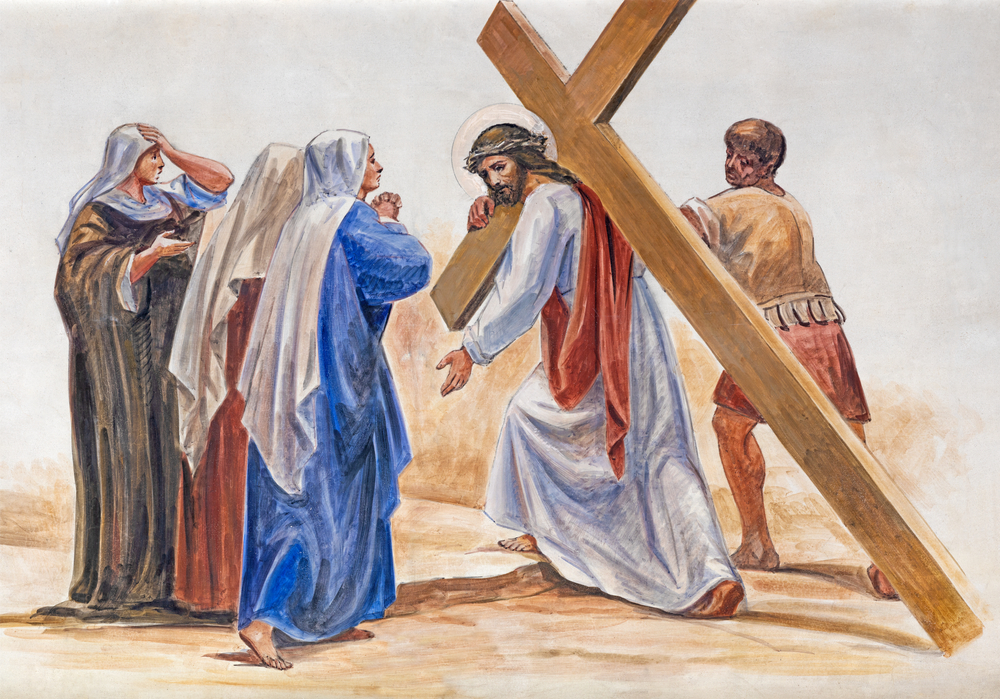
The Viacrucis path goes through 14 stations that travel through the last stretch of Jesus’ trip in his earthly life, to the place of Golgotha.
According to Ola, in different churches around the world, paintings are distributed to the parishioners who represent each station to carry out “this pious journey in the communities and keep the way to the cross.”
Thus, processions are carried out, whether small or large. In many communities, specifically the Good Fridayhe Viacrucis is represented theatrical, with organized groups that recreate the path of Jesus to the cross.
The 14 stations that are prayed in the viacrucis are:
- Jesus is sentenced to death.
- Jesus loads with the cross.
- Jesus falls for the first time.
- Jesus meets his mother.
- Jesus is helped by the Cyronian.
- The Veronica rins the face of Jesus.
- Jesus falls for the second time.
- Jesus meets the women of Jerusalem.
- Jesus falls for the third time.
- Jesus is stripped of his clothes.
- Jesus is nailed to the cross.
- Jesus dies forgiving his executioners.
- Jesus is deposed from the cross.
- Jesus is placed in the sepulcher.
In addition, if you have the opportunity to visit Holy Land, in Jerusalem you can follow the tour of the painful road, which crosses the 14 stations, from the place where, according to tradition, Jesus met with Poncio Pilate until the last four stations, located in the church of the Holy Sepulcher.