
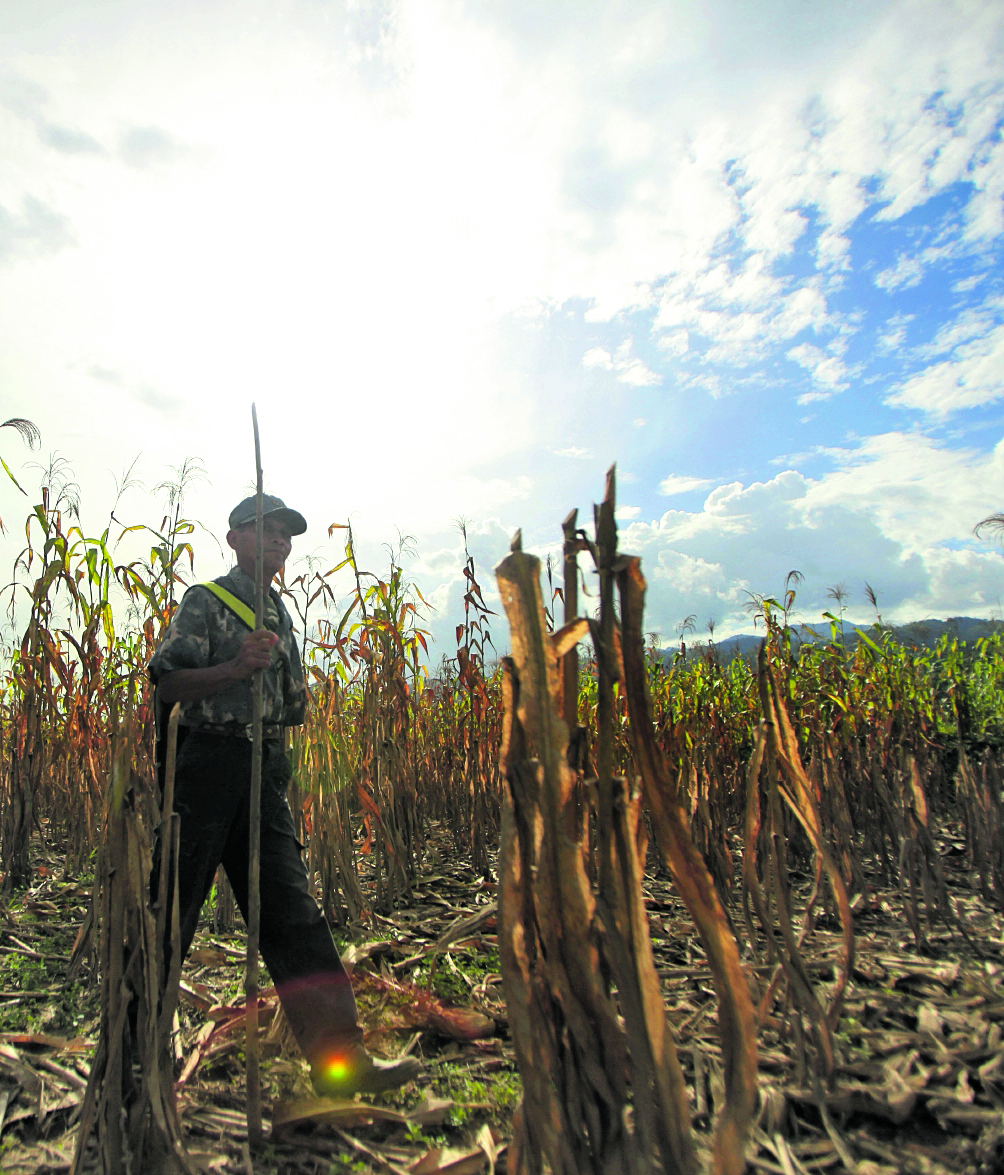
The National Institute of Seismology, Volcanology, Meteorology and Hydrology (Insivumeh) assures that Guatemala is in a process of transition towards El Niño phenomenon and that, when consolidated, its effects will reach the rainy season of 2027.
The impact is already seen with high temperatures and this year will have less precipitation. On average, it would reduce one-third of the accumulated rain that usually falls during the season.
During the La Ronda press conference, Edwin Rojas, director of Insivumeh, indicated that for the phenomenon to consolidate in the country, five quarters must pass with measurements greater than 0.5 degrees Celsius of the temperature surface of the Pacific Ocean.
At the beginning of June, an increase was already recorded, the first of five to show the conformation of the phenomenon. A more accurate reading could be obtained in September.according to the director of Insivumeh.
The Child It is a temperature variation, Rojas explained, and one of the three scales used to measure the warming of waters. La Niña and the neutral phase are the other two.
According to Insivumeh measurements, the phenomenon occurred in Guatemala during 2014-2015, 2018-2019 and, for the last time, in 2023, when it lasted until 2024 and became the hottest period recorded to date.
If El Niño consolidates in the country, the lack of rain will be evident in the short term and The greatest impact will be observed at the beginning of the rainy season in 2027which coincides with the forecast made by the Climate Change Institute (ICC).
“For this year, the shortage on average may be equivalent to a third of the accumulated precipitation. That is, if we were used to drinking three bottles of water during this rainy period, we will surely have availability of two of the three that we were used to,” said Rojas.
Climate change specialists have previously noted that this year the rainfall behavior will be irregularwhich will not only affect sectors such as agriculture, but also energy (hydroelectric), the availability of water for human consumption and the health of the population.
While the Insivumeh forecast indicates that Guatemala is in a transition period towards El Niño, on June 11 the National Oceanic and Atmospheric Administration of the United States (NOAA) indicated that the phenomenon had already been established at 98% and warned a 63% chance of reaching a very strong level —increase in temperature—between November of this year and January 2027. These conditions have not occurred for 76 years, in 1950, according to the historical record of the international entity.
Rojas mentioned that each country has its own conditions by which it measures the variation in temperature and that, in the case of Guatemala, the ONI index is used, which calculates the sea surface temperature anomaly with respect to a 30-year climate average.
On the other hand, during the first week of June, the National Coordinator for Disaster Reduction (Conred) proposed establishing an institutional alert regarding the possible effects of El Niño, which could occur in September, and a prolonged drought that will last between 40 and 50 days and whose impact will extend from January to March 2027.
less rain
María Fernanda Rivera, Minister of Agriculture, pointed out that during May high temperatures were recorded in areas such as Petén, Retalhuleu and Suchitepéquez. During June, July and August There will be a slight decrease, the behavior of which is associated with the climatic phenomena that affect the country.
During June, soil humidity is variable in the national territory and is maintained for above 25%, according to the Insivumeh measurement. The outlook changes for July and August, when below-normal rainfall is expected and few areas of the country will have excess water.
Given the projection of anomalies in rainfall for the coming months, Rivera pointed out that the MAGA is prepared for the risk of drought that may occur and that the Soil and Water for the Future Program It is part of the actions that will be implemented to conserve soils and retain rainwater, with the aim of generating producers more resilient to climate change.
Work is also being done on priority actions to protect the food security of vulnerable populations, such as subsistence farmers.
He said that MAGA has more than Q300 million for the management of food intended for the affected population, attention to agricultural pests and diseases, animal health emergencies and other complementary actions.
Rivera indicated that, if more food rations are needed to assist vulnerable families due to climatic conditions, it is easy to resort to agreements to support people and coordinate with the Ministry of Finance to obtain more resources.
Passage of Tropical Depression Cristina
Claudinne Ogaldes, secretary of Conred, reported that due to the passage of tropical depression Cristina, accumulated accumulations greater than 200 millimeters of rain in departments such as San Marcos, Escuintla and Petén, which generated damage and impacts in different communities.
Until June 15, the Conred had attended 437 emergencies related to rainsand the departments with the greatest problems are Alta Verapaz, Guatemala and Quiché. More than 6,800 people have been affected, of which 33% were evacuated.
Two shelters were set up in Cuilapa, Santa Rosa, and Cahabón, Alta Verapaz. Seven people have died in the rainy season.