
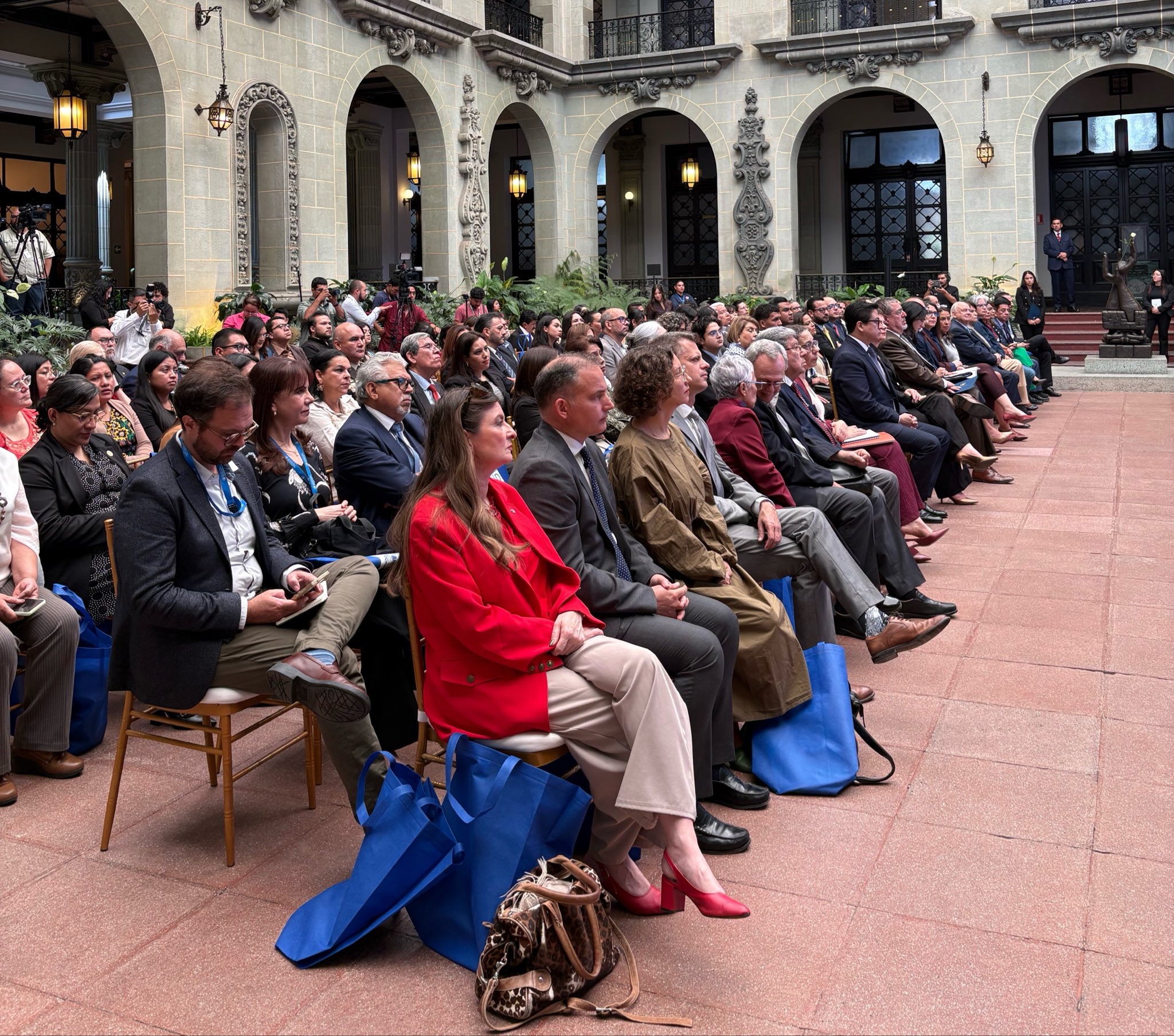
The presentation of the Report on Democracy and Development 2026 took place at the National Palace of Culturewhich is titled Democracies under pressure. Reimagining the futures of democracy and development in Latin America and the Caribbean.
The report was prepared by the United Nations Development Program (UNDP). Present at the launch werePresident Bernardo Arévalo and the regional director of the UNDP, Michelle Muschett.
The document is based on the premise that, although democracy continues to be the predominant political system in the region, citizens’ confidence in their ability to provide concrete responses is in decline. This gap between expectations and results constitutes the central axis of the report.
“Although democracy remains the preferred political system preferred by the majority of people in Latin America and the Caribbean, confidence in its ability to respond to citizen demands shows signs of erosion,” the report indicates.
An important fact, according to the publication made by the UNDP, is that more than four out of every five citizens of the region live in countries with democratically elected governments.
Main pressures and threats to democracy
The report also emphasizes that there are several factors that are testing the capacity of institutions to represent citizens and generate well-being. These factors are:
- Persistence of inequalities
- Political polarization
- Disinformation
- Insecurity
- Growing political influence of economic and media actors (both licit and illicit)
UNDP Regional Director Michelle Muschett He highlighted in the presentation the historical role of democracy in the region. Furthermore, he highlighted the following aspects:
“In Latin America and the Caribbean, democracy has been an engine for expanding rights and well-being, but pending tasks persist to translate these advances into more equitable and sustained results. Strengthening the capacity of institutions to respond to citizen expectations is essential to preserve public trust and build more resilient, inclusive and future-prepared societies,” he indicated.
This report identifies three structural characteristics that define the context of the region:
- Durable democracies with deficits in their quality and functioning.
- Advances in human development, with structural inequalities and vulnerabilities.
- States with unequal capacities and limited territorial presence.
During the presentation, President Bernardo ArévaloI highlight the fact that this report is presented at the regional level from Guatemala by the UNDP. I also highlight that the country is changing and correctly returning to democracy, according to the precepts established within the Political Constitution of the Republic.
“Guatemala, we as a country are changing, but we are changing in the context of a world that is also changing and for many years Latin America was presented as an example of democracy at risk, of low quality democracies, of half-hearted democracies and Guatemala in particular stood out because it had a political regime that seemed to be only formally democratic on paper and with a reality that did not do justice to what its constitutional framework said,” stated the president.
Specific situation of Guatemala
In the case of Guatemala, both its challenges and its strengths are recognized.
Among the strengths, the report highlights the recent completion of the processes of renewal of authorities in institutions important to democracy, such as the Constitutional Court (CC), the Supreme Electoral Tribunal (TSE) and the Public Ministry (MP). These processes, according to the report, are seen as opportunities to achieve improvements in institutions and democracy.
Among the challenges that still persist are the quality and functioning of the institutions; the reduction of structural inequalities that generate gaps in citizen participation, and the strengthening of the state’s capacity to respond to citizens.
Furthermore, it highlights an additional vulnerability: “high exposure” to extreme weather events, which deepen inequalities and generate new pressures on development and governance.
Polarization in the country
In this regard, the report highlights that, although political polarization in Guatemala is below the regional average, it has increased in the last decade, in a context of persistent mistrust and concern about misinformation, especially because a large part of the population consumes political information through social networks.
Solutions
According to the report, the solution to these situations on the continent is not in a list of reforms, but in a combination of two approaches: protect democracy and renew democracy.
Regarding protecting democracy, it proposes actions to safeguard the integrity and functioning of the democratic system, including preserving political competition and electoral integrity, as well as preventing economic interests, legal or illicit, from affecting democratic competition.
It also proposes to protect the integrity of the information ecosystem and political deliberation; Among these actions, the fight against disinformation stands out. Likewise, it proposes guaranteeing effective institutional counterweights that limit the concentration of power and recover the capacity and territorial presence of the State.
Regarding the renewal of democracy, it indicates that this must be understood as a sustained process.
“Democratic renewal must be understood as a sustained process of collective action – and not a specific event – that allows actors to be articulated, maintain agreement and promote concrete changes in contexts of high uncertainty and complexity,” the report indicates.