
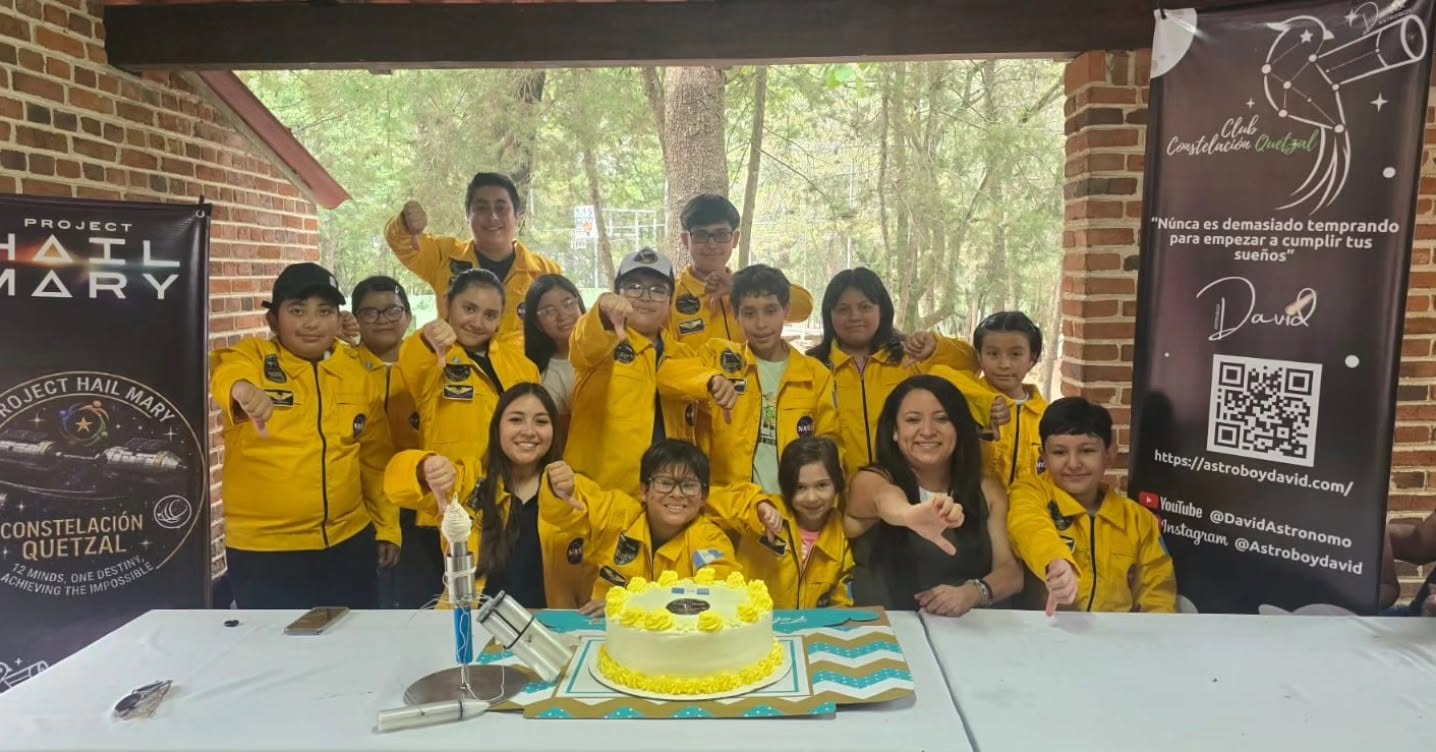
The Constellación Quetzal children’s club together with their teachers won the international challenge Hail Mary Project created by Space for Teachers.
In this dynamic, educators guide students as they design a small rotating space station based on the Hail Mary Project concept of artificial gravity.
The child prodigy David López explained on his social networks that after ten weeks of work, learning, tests and “a lot of emotion”, the Constellación Quetzal team was selected as one of the four winning teams.
“Students and teachers from six countries and sixteen states in the United States participated in the challenge, developing proposals inspired by real space exploration problems. This week, Space for Teachers officially announced the selected teams and we are excited to share that Guatemala is among them,” he described.
The project was developed by students Danny Ponce, Lincy Ramos, Sara Arango, Ana García, Natalia García, Daniel García, Diego González, Mateo Rodríguez, Fernando Cos, Renato García, Emilio Marroquín and David López-the child prodigy-, together with their teachers, who worked on the design and construction of an innovative prototype to face challenges related to space exploration.
As part of this recognition, the prototype will have the opportunity to be tested in microgravity conditions during a parabolic flight in Bordeaux, France. The flight will be carried out by the teacher and coordinator of Constellación Quetzal, Pamela López, who will represent the Guatemalan team in this important stage of the project.
The Guatemalan Association of Engineering and Space Sciences, AGICE, Geraldinn Cortez, Mario Gálvez, professors Edgar Castro, Carlos Ramos and Manuel Ixquiac, the NOC Guatemala of the International Astronomical Union (IAU) and the Howard Gardner School participate in the project.
Now they will work on perfecting the prototype and participating in the preparation activities organized by Space for Teachers.
Preparation
Participation arose through communication with Geraldine Cortés, who is the first analog astronaut from Guatemala. “She attended a conference for educators where this challenge was launched. Then she contacted us to invite a group of children from the club to participate,” explains Pamela López, who is one of the founders of the club, which currently has 180 participants.
The delivery included several components: the 3D model, a three-minute video in which the children explain the project, another video from the teachers, and a detailed report documenting the entire process, including activities such as exposing the project to others.
A key aspect of the program is that children not only learn, but are also able to teach what they have developed.
One of the main challenges has been coordination. 12 families participate, in addition to the teachers, which involves organizing schedules and joint efforts. The children have worked with great discipline: they meet on Tuesdays and Thursdays in virtual sessions from 7 to 8 p.m., and on Saturdays from 8 a.m. to work on their prototypes.