
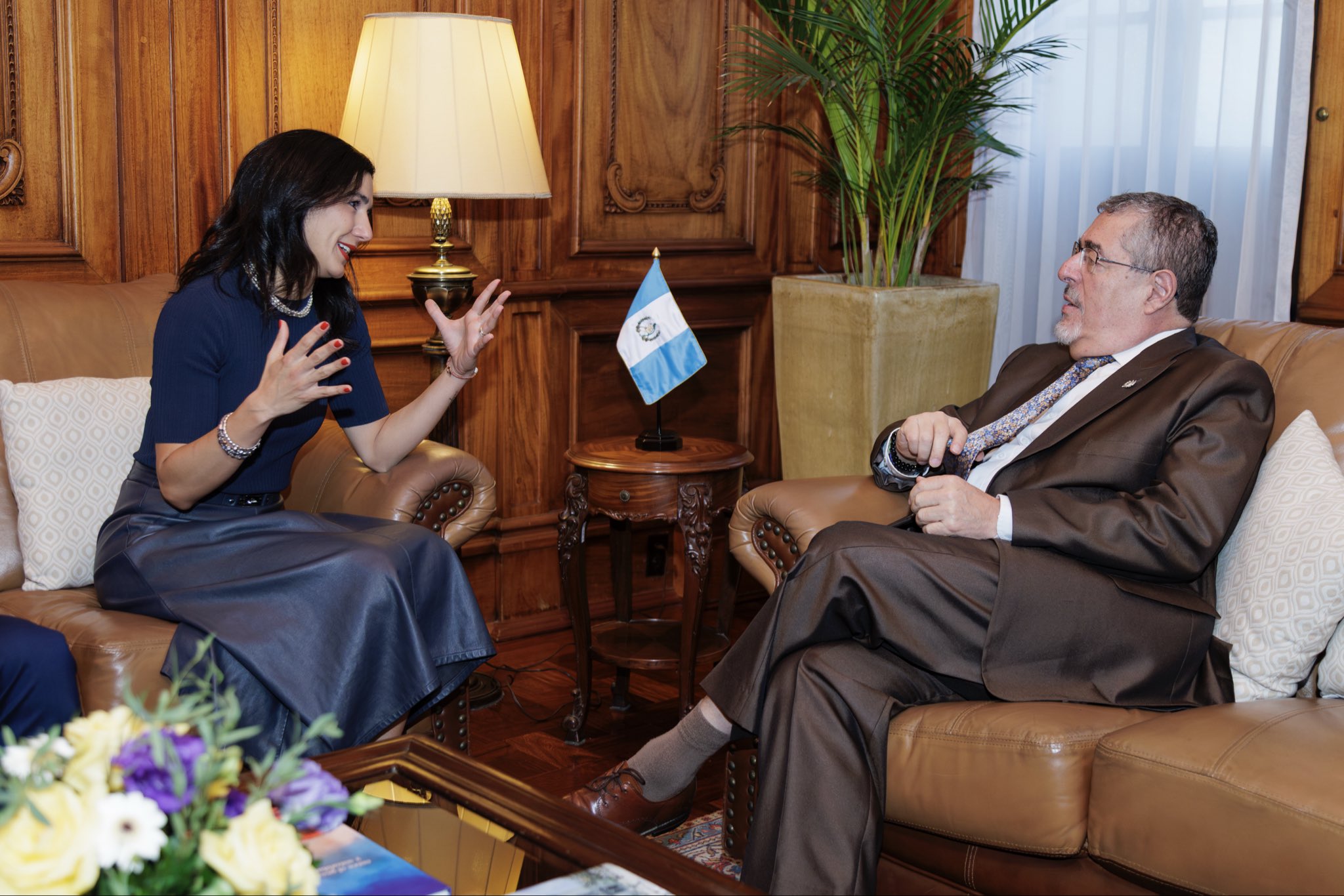
Last Wednesday, June 17, the presentation of the Report on Democracy and Development 2026 was held at the National Palace of Culture. Democracies under pressureprepared by United Nations Development Program (UNDP).
The report was presented by Michelle Muschett, Under-Secretary-General and Regional Director for Latin America and the Caribbean, UNDPwho, after presenting the document, granted an exclusive interview to Free press.
During the interview, the UNDP official indicated that Guatemala is an example for the region thanks to the efforts it has carried out to defend and sustain democracy in recent years. But it also recognizes that polarization is toxic, and is growing in Latin America, which represents a threat to the search for consensus.
What is the main message that the UNDP wants to give with this report, both to political leaders, citizens and different sectors in Latin America and the Caribbean?
The main message is to contextualize how the challenge of our generation is to have the collective capacity to transform the pressure that is currently being exerted on democracies and development into a positive impulse of transformation that allows us to protect progress and renew our democracies, to ensure that they have the capacity to give tangible results in terms of development, in people’s lives, a process that can only occur through properly democratic means such as dialogue, such as consensus building, and that definitely require the active participation of the different sectors of society.
The report highlights several emerging pressures for democracy, including polarization. How are these phenomena seen in the region?
Polarization is toxic. Latin America is the region where it has increased the most in the last two decades. The problem is not dissent, but when the adversary is seen as an existential threat, which makes it difficult to build consensus and affects the State’s ability to generate development. Technological advancement and digital platforms change information consumption, citizen participation and civic space. In addition, they increase polarization through misinformation.
In the case of Guatemala, it is mentioned that it has many strengths. What opportunities do you see in the country to advance democratic renewal?
I believe that there are important strengths behind all this, among which is the defense of the vote that this country had – in 2023 -, just at the moment when we were thinking about whether or not to embark on this effort – to prepare the report -, there we saw citizens defending democratic institutions and popular decision, which sends a very clear message that democracy is not defended only by government actors, but is a collective exercise that challenges all citizens; I believe that this is a living, participatory society, seeking to strengthen its democracies, demanding more and better institutions.
How did the presentation of this regional report take place in Guatemala, and what was President Bernardo Arévalo’s response?
I thank Guatemala and its president, Bernardo Arévalo, because they have directly and indirectly accompanied the process of preparing this report from the beginning, from the moment of the political transition in which we had the opportunity to accompany, as UNDP, the defense of the vote by citizens in the streets and the inauguration itself at the time. We had the opportunity to interview him—Bernardo Arévalo—where he wanted to contribute with his reflections, his perspective regarding those impressions about democracy, the ways and means to move towards a process of continuous renewal.
Guatemala is about to enter an electoral process. From the UNDP, what support and monitoring will be given?
The UNDP will be willing to accompany and strengthen these processes very closely, aware that, although electoral processes normally increase effervescence, they are unique opportunities and windows of opportunity for democratic renewal and for something very important: the construction of consensus between the different sectors of citizens, beyond public agendas, to achieve shared visions of the future.