
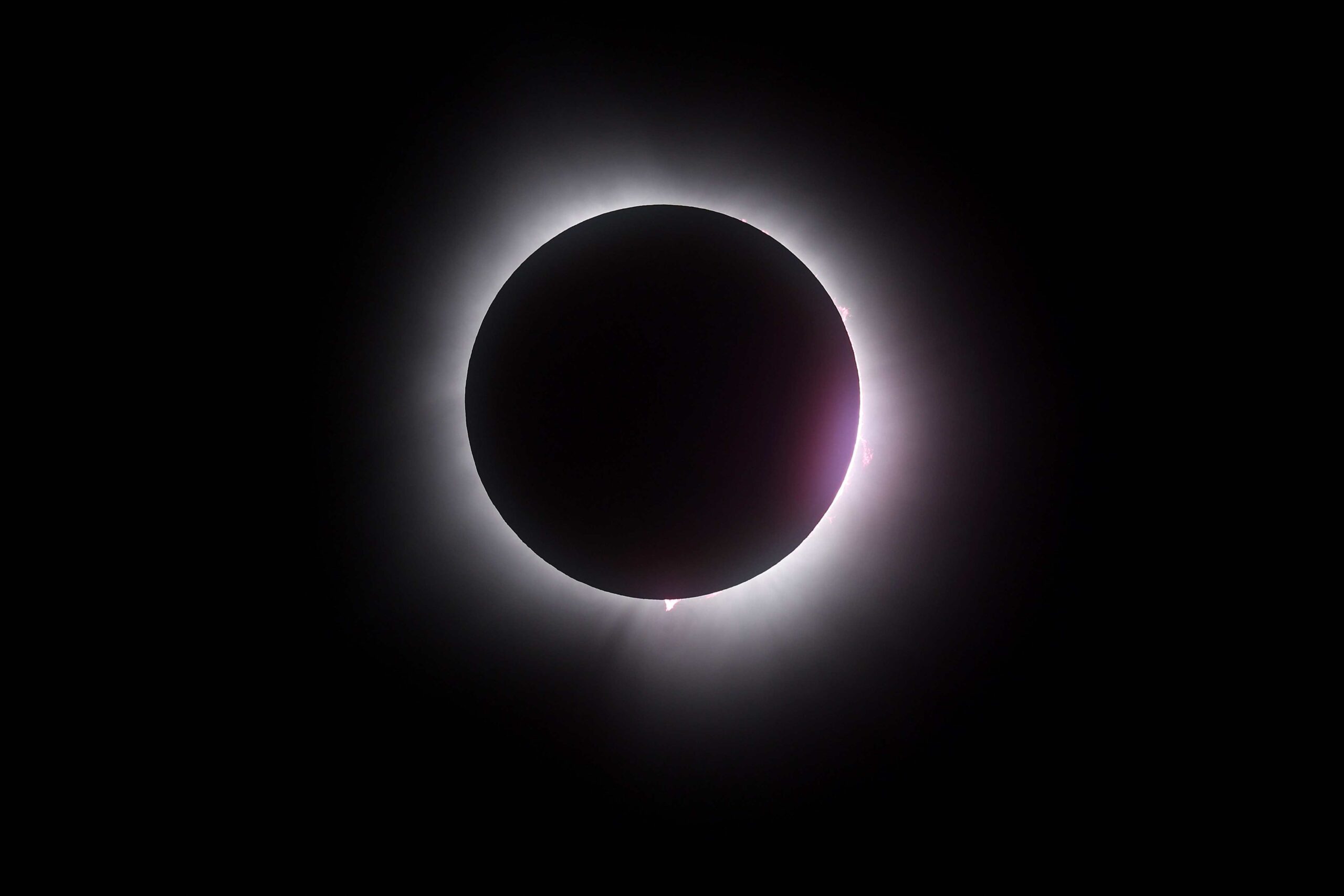
After the spectacle left by the annular solar eclipse that occurred last February, astronomy fans and scientists await the total solar eclipse that will once again make the Sun the protagonist of a unique astronomical phenomenon, visible mainly in the northern hemisphere.
2026 will give the world a second solar eclipse, which will occur on August 12, when the Moon passes between the Sun and the Earth. Those who are within the path of the satellite’s shadow will be able to witness an exceptional visual spectacle.
NASA explains that a solar eclipse occurs when the Sun, Moon and Earth align partially or completely, offering a unique view of both celestial bodies. The phenomenon occurs when the Moon passes between the Sun and Earth and casts a shadow on the planet that blocks sunlight.
In the case of a total solar eclipse, the Moon completely blocks the visible side of the Sun. As a result, those within the shadow will be able to watch the sky darken similar to dusk.
“If weather conditions permit, local residents in the path of a total solar eclipse can see the Sun’s corona, or its outer atmosphere, which is otherwise usually obscured by the bright side of the Sun,” the agency highlights.
NASA notes that this phenomenon is rare because the Moon does not orbit in the exact same plane as the Earth and the Sun. When these bodies align, an eclipse season occurs, an event that occurs twice a year.
In addition, the total solar eclipse is the only one that allows observers to briefly remove their protective glasses, specifically during the moment when the Moon completely blocks the Sun. This phase usually lasts less than two minutes.
Places where the total solar eclipse will be seen
In places like Greenland, Russia and some areas of the North Atlantic, darkness will last longer than in other territories, although it will still be less than two minutes.
According to NASA data, the eclipse can be observed on August 12, 2026. The strip of totality will cross the Arctic Ocean, Greenland, Iceland, the North Atlantic, northern Spain and the extreme northwest of Portugal.
In countries such as Russia, the United States and Canada, the phenomenon will be partially visible, since these regions will be located within the shadow of the Moon, but outside the path of totality. In those areas, the Moon will not completely cover the face of the Sun.
According to specialized media, the eclipse can also be seen in much of North America, Europe and the extreme north of Africa. Greenland, Iceland and Spain are among the places with the best conditions to observe the phenomenon.
Global map of the path of the shadow cast during the total solar eclipse of August 12, 2026. (Image: credit NASA)
How will this phenomenon occur?
According to NASA, the shadow of the total solar eclipse will first appear in the northern tip of Siberia and move south across the Arctic and North Atlantic oceans, then pass over Iceland and Spain.
In the rest of Europe, as well as in North American countries, such as the United States and Canada, and in some regions of Africa, a partial eclipse will be observed.
Countries and times where the total solar eclipse will be observed
| City | Starts partially | Totality begins | End of totality | End of partial eclipse |
|---|---|---|---|---|
| Leon (Spain) | 7:32 p.m. | 8:28 p.m. | 8:30 p.m. | 9:22 p.m. |
| Reykjavik (Iceland) | 16.47 hours | 5:48 p.m. | 5:49 p.m. | 6:47 p.m. |
| Valencia (Spain) | 7:38 p.m. | 8:32 p.m. | 8:33 p.m. | 9:01 p.m.* |
| Zaragoza (Spain) | 7:34 p.m. | 8:29 p.m. | 8:30 p.m. | 21.07 hours* |
partial eclipse
| City | Starts partially | Maximum | Coverage | End of partial eclipse |
| Anchorage, Alaska (USA) | 7.36 hours | 8:21 a.m. | 28% | 9.09 hours |
| New York, New York (USA) | 1:07 p.m. | 1:54 p.m. | 9% | 2:38 p.m. |
| Washington, DC (USA) | 1:17 p.m. | 1:53 p.m. | 4% | 2:27 p.m. |
| Barcelona (Spain) | 7:35 p.m. | 8:29 p.m. | 99% | 20.54 hours* |
| Berlin (Germany) | 7:15 p.m. | 8:08 p.m. | 85% | 8:38 p.m.* |
| Lisbon (Portugal) | 18.39 hours | 7:36 p.m. | 95% | 8:29 p.m. |
| London (United Kingdom) | 6:17 p.m. | 7:13 p.m. | 91% | 8:06 p.m. |
| Madrid (Spain) | 7:36 p.m. | 8:32 p.m. | 99% | 9:16 p.m.* |
| Oslo (Norway) | 7:02 p.m. | 7:57 p.m. | 83% | 8:49 p.m. |
| Paris (France) | 7:22 p.m. | 8:17 p.m. | 92% | 9:09 p.m. |
| Saint Petersburg (Russia) | 7:59 p.m. | 8:51 p.m. | 79% | 9:00 p.m.* |
(Table of times provided by NASA (Local time of the cities) where the eclipse will be seen. Those with an asterisk under the column “End of the partial eclipse” indicate that the eclipse will end after sunset and that the indicated time corresponds to sunset, the agency highlights.
*With information from NASA