
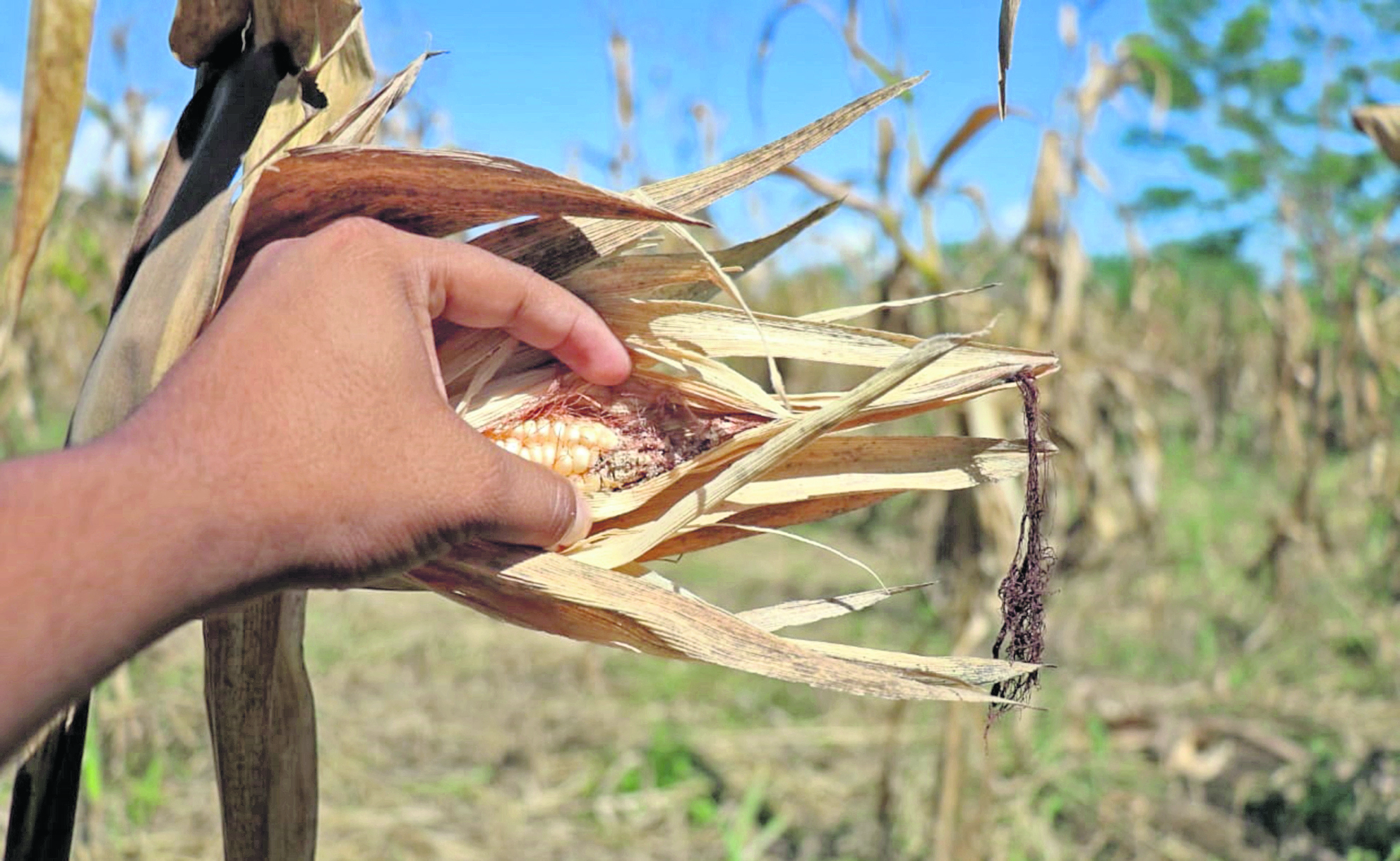
The prolonged dog days that looms between July and August would affect some 377 thousand 578 hectares of different cropsand near the 40% of the impacted surface corresponds to crops of corn and beansaccording to a forecast from the Ministry of Agriculture, Livestock and Food (MAGA).
The National Institute of Seismology, Volcanology, Meteorology and Hydrology (Insivumeh) predicted that in 2026 the rains will decrease in Guatemala up to a third as an effect of the transition to El Niño phenomenonbut the impact will be more drastic during July and August, when the heatwave is present: will extend for up to 40 days in some regions and will bring higher temperatures.
Under these conditions, crops can suffer water stress —demand more water than is available in the soil—, present reduced growth and development of plants, reduce yield and, in severe cases, cause partial or total losses of crops, according to a MAGA analysis.
The crops most vulnerable to prolonged heat waves are corn and beansand The affected hectares could reach 150,802. This represents 47.5% of the total of 317 thousand hectares that are planted with these basic grains in the country, according to calculations by the National Association of Basic Grains (Anagrab). If the forecast is fulfilled, The losses would approach Q2,722 million.
However, Gustavo Rivas, president of Anagrab, points out that it is too early to establish whether the forecast of the extended heat wave will be fulfilled, since low pressure systems may occur, such as Christinawhich just hit the country. On the other hand, he is more optimistic and considers that, if the phenomenon occurs, the losses would be between 25% and 30% of grain production.
If the prediction holds, the climate phenomenon would also affect 100 thousand 17 hectares of pasturesabout 42 thousand 55 of coffee and another 32 thousand 5 of sugarcane.
Other impacted products will be: banana (16 thousand 779 hectares), melon (12 thousand 196), banana (11 thousand 559), tobacco (9 thousand 657) and citrus (2 thousand 508).
According to MAGA, the effects of the heat wave would occur throughout the national territory, but semi-arid areas are the most vulnerable, such as those in the dry corridor.
Regarding whether the impact on these products will impact the availability of food for the population in the markets, the ministry responds that this will depend on the intensity, duration and distribution of the rains during July and August.
If the production of basic grains and other crops is reduced, could influence local supply and generate temporary increases in pricesso agro-climatic conditions are monitored to identify risk areas and implement mitigation measures in advance, according to the portfolio.
The effects
According to MAGA, prolonged lack of rain reduces the moisture available in the soil, and this will impact the development and functioning of crops.
“The biological activity of the soil is reduced, affecting microorganisms that decompose organic matter and recycle nutrients, which reduces their availability for plants. Water deficit restricts root growth (root development), reduces the absorption of water and nutrients and increases the physiological stress of crops,” explains the ministry.
These effects are more severe in areas with shallow soils or with less capacity to retain moisture, where high temperatures accelerate the evaporation and the soil water loss. This promotes surface compaction, crusting and reduces water infiltration when rain falls again.
The soils without plant cover are more susceptible to degradation and erosion, and the effect is that, when the rains intensify, the fertile layer is lost, agricultural productivity is affected, the soil stores less water and productive systems become more vulnerable to future droughts.
Meanwhile, high temperatures increase evapotranspiration, increase crop water demand, and accelerate soil moisture loss. This causes water stress, reduced yield and lower quality of agricultural production.
During the dog days, the cattle you can also experience thermal stressreduce food and water consumption, and thereby reduce milk production and lose body condition.
Regarding the availability of water, the lack of rain reduces the flow of rivers, springs and reservoirs, limits the operation of irrigation systems and, together with high temperatures, deteriorates agricultural infrastructure.
Greater impact
Prolonged dog days may have a greater impact on self-consumption farmers or subsistence, since they depend mainly on rain for the production of crops, such as corn and beans, which are sensitive when the lack of rain coincides with critical stages such as flowering and grain filling.
Furthermore, the decrease in production can affect the income of agricultural households, reduce the availability of food for self-consumption and increase their economic vulnerability and lead to food insecurity.
Constant monitoring
According to MAGA, climatic and agroclimatic conditions are monitored through surveillance systems, and information is transmitted through bulletins, early warnings and technical recommendations so that producers, extension agents and local authorities make timely decisions.
On the other hand, it provides technical assistance and promotes adaptation practices to climate change—soil moisture conservation, water harvesting, efficient use of water resources, productive diversification and adequate crop management.
MAGA also promotes Soil and Water Program for the Future, to strengthen resilience, food security and the sustainability of productive systems through the sustainable management of natural resources. Also, run the Institutional Response Plan 2026which incorporates anticipatory actions and territorial monitoring to reduce risks and protect livelihoods before losses occur.
Through the plan, technical assistance, the timely mobilization of supplies and the improvement of inter-institutional communication and coordination are strengthened.
In Rivas’s opinion, the mitigation measures implemented by MAGA, such as irrigation, must be carried out differentiated waysince the needs of the subsistence farmers are different from those of the surplus producerswhich produce grains such as corn and beans to supply the local market.