
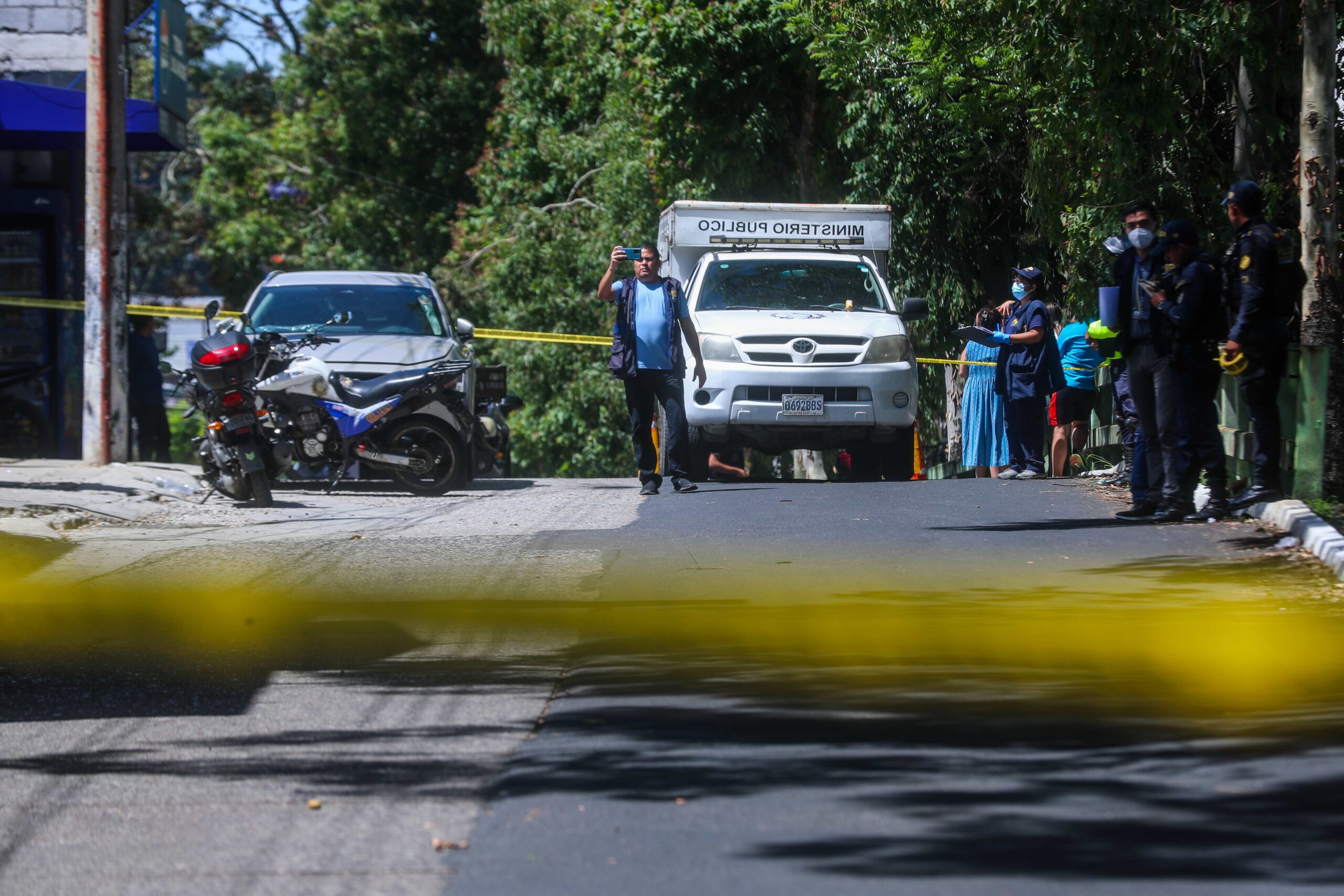
Although Guatemala registered the largest number of homicides So far this year, the interannual rate continues to show a downward trend, according to the analysis presented this Wednesday by the National Economic Research Center (CIEN).
During May, 297 homicides were recorded, eight less than the 305 reported in the same month of 2025. However, it was the month with the most homicides recorded in each month of 2026.
The data presented by the CIEN show that the homicide rate went from 17.4 to 16.2 homicides per 100 thousand inhabitants between May 2025 and May 2026.
“We continue to experience this downward behavior. However, as we can see, it is important to sustain it,” added David Casasola, CIEN researcher.
Fewer victims than last year
Between January and May 2026, 1,172 homicides were recorded, while in the same period of 2025, 1,345 were recorded.
“That is, today we have a balance of 173 fewer people who have died due to homicide,” said Casasola.
Young men continue to be the main victims
The analysis also confirms that homicidal violence continues to be concentrated in young men.
Of the 297 violent deaths recorded in May, 35 victims were women. Furthermore, 59.3% of the victims were between 18 and 35 years old.
Departments with the most homicides in Guatemala during 2026
Although homicides show a reduction compared to last year, violent deaths continue to be concentrated in ten departments, according to CIEN.
“Of all the homicides that have occurred in the first five months of the year, 85% are concentrated in ten departments and only 42% are concentrated in Guatemala,” said Casasola.
The ten departments with the most homicides (from January to May)
- • Guatemala: 489
- • Escuintla: 133
- • Petén: 78
- • Chiquimula: 59
- • Santa Rosa: 56
- • Izabal: 53
- • Chimaltenango: 36
- • Jalapa: 34
- • Jutiapa: 33
- • Zacapa: 29
Municipalities with the most homicides in Guatemala during 2026
In Casasola’s opinion, at the municipal level the concentration is also marked. There are ten municipalities that concentrate the highest number of homicides during the first five months of the year.
Ten municipalities with the most homicides
- • Guatemala: 195 homicides
- • New Town: 55
- • Amatitlán: 47
- • Mixco: 47
- • Escuintla: 39
- • Villa Canales: 35
- • San José Pinula: 24
- • Chimaltenango: 21
- • Chiquimula: 20
- • San Miguel Petapa: 17
He added that these municipalities account for 43% of the homicides recorded in the country during the first five months of the year.
According to Casasola, although the municipality of Guatemala continues to top the list, the number of homicides has decreased compared to last year.
“Compared to May 2025, 106 fewer homicides have occurred in the municipality of Guatemala. That is, there is a 35% reduction. However, there are still challenges because we are talking about a rate of 40.4 homicides per 100,000 inhabitants and that is important to address,” he indicated.
Extortions are down, business robbery remains and vehicle theft is up
The reduction observed in homicides was not the only favorable indicator reported by the CIEN.
According to the Crime Reporting Index, citizen security registered an interannual improvement of 5.56% as of May 2026, due to the decrease in crimes against people and property.
“The rate went from 125.6 per 100,000 inhabitants to 118 and that is a fairly considerable improvement. In addition, there was an improvement in both the motorcycle theft rate and the residential theft rate,” Casasola explained.
The researcher added that not all crimes showed reductions. Business robberies continue and vehicle theft increased.
In the case of extortion, the rate went from 150.62 per 100 thousand inhabitants in May 2025 to 118 in May 2026.
In addition, accumulated complaints decreased from 11,802 to 7,443 during the same period, a reduction of 4,359 cases.
“This is one of the crimes that most afflicts the population, especially those who are dedicated to entrepreneurship, those companies that need to mobilize throughout the national territory to distribute their products. It is a crime that must be followed up,” he stated.
CIEN proposes prevention, prisons and police targeting to sustain the reduction
Although the indicators show an improvement, Casasola believes that maintaining the reduction in homicides and extortions will require combining short- and long-term measures.
“In the long term we have an urgency to improve and maintain a downward trend in the case of homicides. Crime prevention is something important. We are talking about issues related to education and issues related to economic opportunities for young people,” he commented.
He indicated that it is necessary to strengthen the penitentiary system to prevent the coordination of criminal activities from continuing in prisons.
“There is another very important issue regarding the development of prison infrastructure and the strengthening of a career for prison guards, because this will eventually allow people deprived of liberty, depending on their profile, to have the possibility of resocializing and for those with a high degree of danger to be held. This would allow some crimes that are coordinated from prisons to be contained, such as extortion,” he explained.
Casasola said that operations at traffic lights and in areas with a higher number of homicides and crimes can contribute to reducing criminal acts in the short term.
CIEN warns that blockades continue to affect mobility and economic activity
Roadblocks have become an increasingly frequent phenomenon in Guatemala.
According to an analysis presented by the CIEN, between 2016 and 2025, 4,450 blockades were registered throughout the country, an average of 445 per year and 37 per month.
The study indicates that road conflict has increased in recent years and that the most critical period was concentrated between 2021 and 2023.
According to Francisco Quezada, security and justice analyst at CIEN, the records show a growing trend until reaching their highest point in 2023.
Blockages by the country’s budget
According to the CIEN, September and October are historically the months with the most blockages recorded since 2016.
According to Quezada, one of the reasons is the approval process of the General Budget of State Income and Expenditures.
According to the study, 54% of the blockades recorded during the last decade were concentrated in seven departments.
The departments that concentrated the most blockages were:
- • Quetzaltenango
- • Guatemala
- • Sololá
At the municipal level, 30% of the blockades were concentrated in 15 municipalities, led by the municipality of Guatemala.
You could read: Business chambers question road blockades and demand guaranteeing free movement
Businesses reported losses and closures
The CIEN cited a survey carried out by the Francisco Marroquín University (UFM) to 426 businesses in October 2023, in 176 municipalities in 22 departments.
The results show the economic impact of the blockades:
- • 60.8% reported a decrease in sales
- • 86.9% had supply problems
- • 55.4% temporarily closed
- • 48.3% of employees could not go to work
“When it comes to such small businesses, the question would be how the families survived, because they live off daily sales. 48.3% of the employees did not receive any income during those days. Incredibly, this issue, far from being a shame, becomes an apology for crime because there are those who still excuse it,” said Quezada.
CIEN says that demonstrating does not imply blocking
Quezada commented that citizens have the right to demonstrate, but they should avoid blocking the country’s roads.
“Democracy needs active, critical citizens capable of expressing their demands; that is why the right to demonstrate, but peacefully and without weapons, is very necessary. Blockades are not a natural extension of the right to demonstrate. Demonstrating is expressing an opinion; blocking implies restricting the rights of others,” he commented.
You could also read: Social conflict threatens to intensify if there is no dialogue: Analysis
More than 300 thousand vehicles enter the country every year
The analysis also warns that mobility problems are aggravated by the growth of the vehicle fleet and the lack of expansion of road infrastructure.
“More than 300,000 vehicles are entering each year, but the road infrastructure is the same. What’s more, it is not even the same because we see roads that are collapsing and presenting problems. Road capacity has not been increased, but the number of vehicles has increased sharply,” said Quezada.