
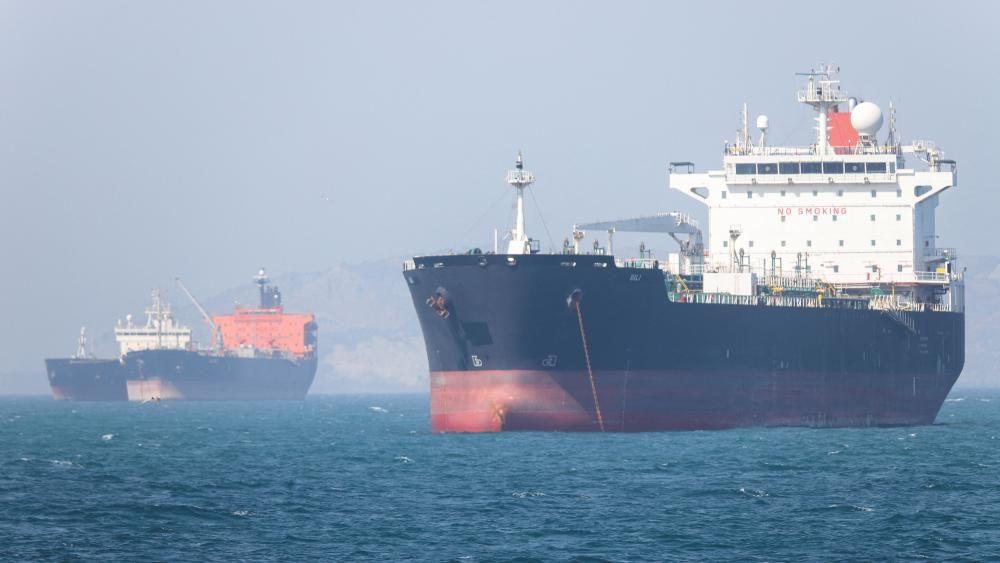
The reopening of the Strait of Hormuz for the transit of oil vessels in the Persian Gulf and the signing of the Memorandum of Understanding between the United States and Iran, signed on June 19, are factors that the international market is beginning to assimilate and that are leading to a decrease in prices.
During the session held on June 24, the members of the Monetary Board (JM) decided to maintain the leading monetary policy interest rate at 3.50%. At that meeting, the projections on oil barrel prices West Texas Intermediate (WTI), reference for Guatemala.
Until June 24, the average price estimated by the Bank of Guatemala (Banguat) was US$82.81 per barrel, higher than the US$64.81 registered in 2025.
It is indicated that the forecast for this year is US$78.61 per barrel and, for 2027, US$70.25 per barrel.
“Geopolitical tensions in the Middle East have moderated since June 19, the date on which the Memorandum of Understanding between the United States and Iran was signed,” explained Álvaro González Ricci, president of the Bank of Guatemala, and Jonhy Gramajo Marroquín, economic manager.
Crude reduces pressure
In the session of the Monetary Board (JM) held this week, the main topic was the behavior of the oil price and the national economy, for which the directors analyzed various scenarios.
“We have observed recent reductions in the international price. In fact, the price stood at around US$70 per barrel of WTI at the close of trading on Wednesday, June 24, which is the reference variety for Guatemala,” they stated.
When comparing this price with the one recorded at the end of last year, when it stood at US$57.42 per barrel, a accumulated increase of 22.50%.
“It is important to highlight that, at the highest point, when the price was close to US$110 per barrel, the accumulated increase was close to 90%,” they stated.
However, there has been a significant decrease in the price, associated with the Memorandum of Understanding signed by the United States and Iran, which, among other aspects, allows maritime transit through the Strait of Hormuz. This generated favorable expectations about a possible normalization of global crude oil supply.
Oil confirms expected trend
The authorities explained that, before the conflict, the number of oil tankers transiting the Strait of Hormuz was between 70 and 80 a day. During the conflict, traffic was reduced, but after the reopening of the route, it has gradually increased.
We have observed recent reductions in the international price. In fact, the price stood at around US$70 per barrel of WTI at the close of trading on Wednesday, June 24, which is the reference variety for Guatemala.
With the restoration of maritime traffic, the price of oil decreased substantially in June, confirming the forecast that the conflict would have short-term effects on the price of crude oil.
“Once again we see a transition towards the scenario that we originally predicted, where the price begins to normalize from June,” the authorities noted.
Market anticipates lower fuel prices
When consulted, Fausto Velásquez, Sales Manager of Unopetrol Guatemala – licensee of the Shell brand in the country – commented that a downward trend has been observed in international markets, due to the fact that transit through the Strait of Hormuz is beginning to normalize.
CONTENT FOR SUBSCRIBERS
This is a sign that supply, which had been restricted, would begin to increase with the resumption of shipping. Furthermore, on the global economy side, a reduction in demand has been observed, which tends to offset supply. As a result, A downward trend in prices is beginning to be reflected in the domestic market.
He clarified that there is still volatility in the market because it is a geopolitical issue, although everything will depend on how the negotiations and agreements develop.
The manager reiterated that the supply of petroleum products in Guatemala is guaranteed and that there has never been a shortage, so the commitment is to keep the national and regional market supplied.

Economy maintains stability
The monetary authorities presented the evolution of short-term indicators and confirmed that the inflation projection for the end of 2026 remains at 3.75%, and at 4% for 2027.
Along these lines, they project that the economy, measured by gross domestic product (GDP), will grow 4.1% this year and 4% in 2027. These scenarios remain in place, although a review is expected.
The monthly index of economic activity (Imae) stood at 4.5% in April, while the confidence index of economic activity (Icae) reached 55.94%.
Meanwhile, as of June 18, an accumulated income of foreign currency from family remittances of US$12,284 million (about Q94 billion) had been recorded, which represents a growth of 8.4%.
The closing estimate for this indicator is US$26,806 million and, for 2027, US$27,610 million.
Exports, until April, register a growth rate of 5.8%, with an amount of US$5,709 million. The closing projection is US$15,528 million and, by 2027, US$17,603 million.
Imports, until April, show a growth of 6.5%, for US$11,997 million, with a closing estimate of US$37,379 million and, for next year, US$40,370 million.