
In Guatemala, the industrial sector represents between 30% and 40% of the electrical energy consumption of the country, indicated Jorge Carlos Escobar, president of the Energy Efficiency Union (GEE).
It was explained that energy efficiency has become a determining factor for the competitiveness, productivity and sustainable development of the industry in the country.
Stephanie Melville, vice president of the Guatemalan Chamber of Industry, explained that energy efficiency directly impacts the competitiveness of companies, their ability to generate employment and the attraction of new investments. He also highlighted the importance of these practices for the sector, the country and the economy.
Although there is no estimate in the country, global figures indicate that 76% of the energy is used, while 24% is wasted, says Escobar. Based on these data, it is considered that in the country there is a high potential to reduce this gap by making its use more efficient with various tools and strategies of the industry and the sector. In addition, there is now the use of artificial intelligence (AI), added the manager, who considers it necessary to have a national strategy.
Escobar explained that, if we manage to be more energy efficient In just 5% or 10% more than today, that would represent a large number of megawatts that could be used in other areas and have greater availability of that resource.
Electricity consumption varies depending on the type of industry, derived from the production process, but on average it can be mentioned that 60% of consumption is related to electric motors and 15% to lighting, Escobar explained.
Based on these parameters, high efficiency technologies must be sought, such as high-performance engines, replacing old equipment and beginning to apply technology, including AI, he added.
Although he said that these tools or equipment require investment, he mentioned that there is also a return on capital that is recovered with the reduction of the bill.
CONTENT FOR SUBSCRIBERS
In the sector there are also industries that have implemented their own generation, among them sugar mills around 20 or 25 years ago, as well as some cement and textile companies, Escobar indicated. More recently, medium-sized industry has also implemented self-generation systems through solar panels, which helps improve energy efficiency, he added.
“If as a country we wanted to improve our competitiveness, reduce production prices and be able to carry our products in a more competitive way, there should be a country strategy between government, academia, industry and various sectors, to reach agreements, to be able to begin to implement clear rules regarding the use of energy, self-generation and the implementation of efficient technologies,” Escobar stated.
He remembered that This year the national energy demand record has been surpassed several timesand in the case of the industrial sector he attributes it to two relevant factors: the growth of production and investments of transnational companies that have installed plants, as well as the growth of the national industry and the construction of buildings and homes, which requires a large number of megawatts. The other factor is the climate, since in 2024 and 2026 the summers have been very strong, with high temperatures that generate demand for air conditioners and fans.
AI, the new tool
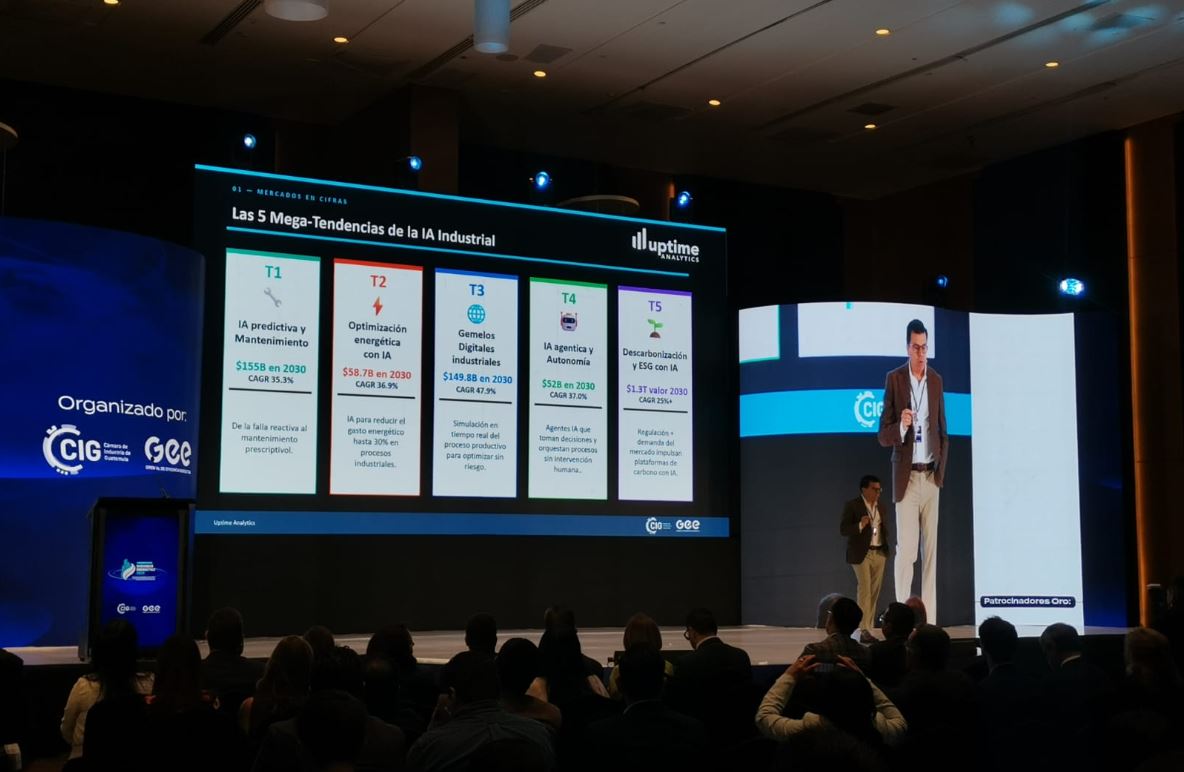
One of the most modern tools for the efficient use of energy is artificial intelligence, data analysis and digital tools to optimize processes, reduce costs and increase productivity, was presented during the IV Energy Efficiency Forum 2026, called From innovation to action: transforming the present, building the future.
Oscar Hoyos, founder and CEO of Uptime Analytics, unveiled five megatrends in industrial AI that can help make operations or electricity consumption more efficient:
- Predictive AI and maintenance helps move from reactive failure to prescriptive maintenance. The market is expected to reach US$155 billion by 2030, with a compound annual growth rate of 35.3%.
- Energy optimization with AI allows reducing energy expenditure by up to 30% in industrial processes. The global market is estimated at US$58.7 billion by 2030, with a growth of 36.9%.
- Industrial digital twins refer to real-time simulation of the production process to optimize without risk. The market can reach US$149.8 billion in 2030, with growth of 47.9%.
- Agentic AI and autonomy refers to systems that make decisions and coordinate processes without human intervention. This market is expected to reach US$52 billion worldwide by 2030.
- Decarbonization and ESG with AI responds to regulation and market demand, which drive carbon platforms with AI. The market is estimated at US$1.3 trillion by 2030.
“My goal is to motivate them to implement this type of technologies that today are transforming the way we do things and additionally to raise awareness that this is not a crystal ball. Artificial intelligence is here to stay, but somehow we have to know how to adopt it and we have to know what the obstacles are to be able to do it,” said the consultant.
He mentioned that currently the market reaches US$34.2 billion in artificial intelligence in manufacturing, but in five years it is expected to reach US$150 billion, which reflects its high growth.
This technology can be adopted in manufacturing, oil and gas, mining, food and beverage, cement, energy and utilities industries, among others.
The artificial intelligence Predictive in the public services sector has an adoption of between 9% and 10%, while AI through agents is between 2% and 4%.
However, adoption of these megatrends in the industry is still low, he added. The most used is predictive AI in maintenance.
For Latin America, Hoyos estimates that between 15% and 40% of industrial energy consumption could be reduced through these technologies.
For example, in predictive technology you can identify the savings potential depending on the type of industry and equipment and identify how much should be consumed.
CONTENT FOR SUBSCRIBERS
He explained that in the analytics In industrial applications, historical machine data and algorithms are used to improve consumption, although the models still need to mature.
In maintenance, energy efficiency is lost when equipment begins to fail, so predictive maintenance with AI can also be applied.
In addition, consumption estimates can be made and, with the rates, overconsumption identified and solutions sought to avoid this extra cost.
The consultant indicated that AI will not replace the engineer, but will optimize the use of data and solutions; However, he noted that there are challenges:
- Technical challenges: without data there is no AI. Industries have information in files or legacy systems and lack infrastructure for predictive or retraining models.
- Cultural challenges: resistance to change, lack of trust in AI recommendations and teams with isolated information for productive and administrative operations.