
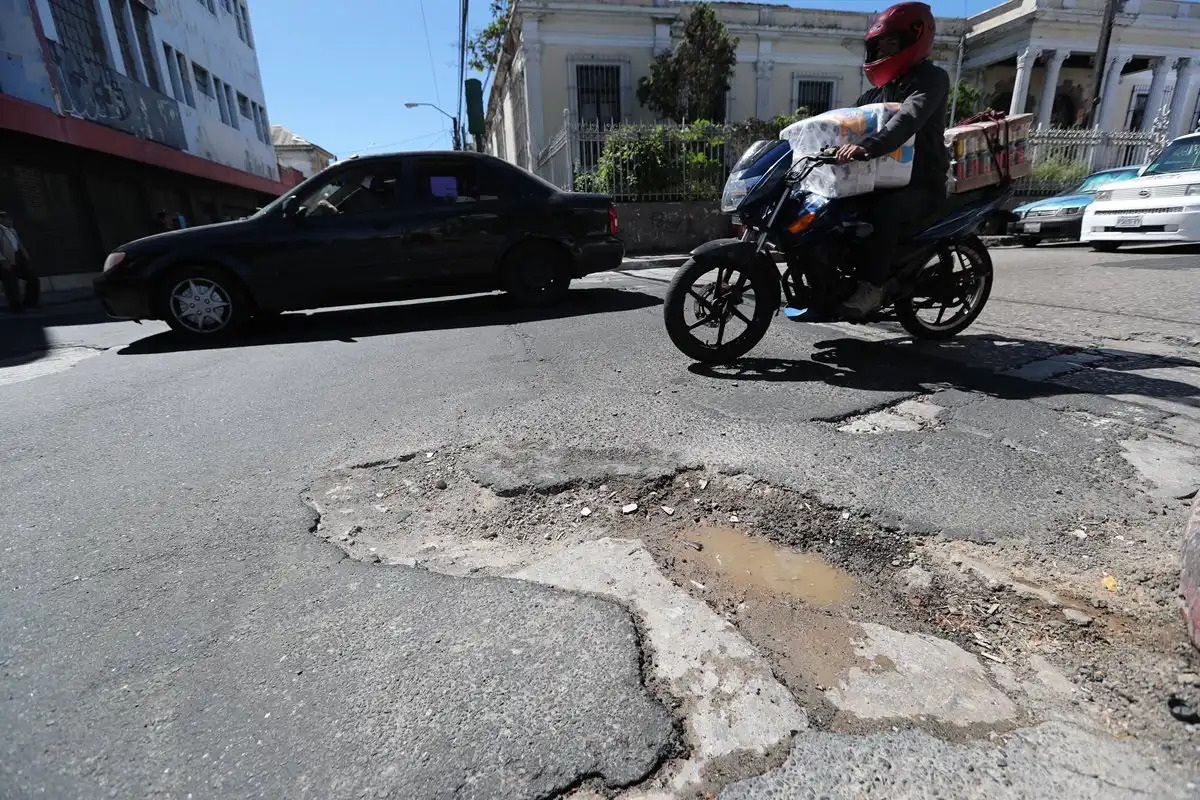
1,365 days have passed since September 30, 2022, when the Foundation for the Development of Guatemala (Fundesa) delivered the HDM-4 (Highway Development and Management System) platform to the Ministry of Communications, Infrastructure and Housing (CIV), a tool developed to evaluate the state of the road network and support decision-making on conservation, rehabilitation and investment in roads.
The platform was financed by the private sector and adapted to the conditions of Guatemala with the objective that the different executing units of the CIV would have technical information to prioritize projects and schedule interventions.
However, specialists consulted by Prensa Libre, who requested not to be identified, indicated that they do not know if the tool is currently used in the portfolio’s road planning processes.
One of those consulted pointed out that, although there is no public information that allows conclusively confirming whether the system is used, there are also no signs of its application in the projects currently promoted by the ministry.
“When you look at the projects that are being executed or that are being requested to be executed, you do not see HDM-4 reports or runs as a requirement. That can give us an idea that it is not being requested,” he explained.
Delfino Mendoza, an analyst at Fundesa, explained that the main strength of HDM-4 is that it allows evaluating not only individual projects, but entire road networks, which makes it easier to establish investment priorities based on technical criteria.
“Its main contribution is the prioritization of projects to be able to plan the investment of available resources. By applying it we would be investing in the most urgent projects, where it is most needed, and that would lead to a more efficient use of resources,” he stated.
Mendoza indicated that there are currently applications of the system in specific projects, but not in the comprehensive analysis of the national road network.
“The system does allow for an evaluation of a section or a particular project, but its greatest importance is when it is used at the level of the entire road network to plan and prioritize projects. That is what is not yet being done in Guatemala,” he noted.
From the perspective of the logistics sector, Herlindo Herrera, director of the Logistics Chamber attached to the Guatemalan Chamber of Industry (CIG), considers that tools of this type allow technical support for decisions about infrastructure.
“For the logistics sector, it is essential that decisions about road infrastructure are made based on technical and updated information, based on evidence. This allows investments to respond to the real needs of the road network and not only to isolated criteria,” he stated.
Prensa Libre consulted the Ministry of Communications about the current use of the system, the units responsible for its administration and whether it has been incorporated into the planning of road projects. However, at the time of writing this note there was no response.
A tool designed to plan with data
When Fundesa delivered the software in 2022, it explained that the system would allow variables such as vehicular traffic, weather conditions, structural capacity of the pavements and characteristics of the routes to be incorporated to determine which roads require attention and when each intervention should be carried out.
The tool was adapted specifically for Guatemala by incorporating information on the different climatic regions of the country, types of roads, topography, and regulations related to road infrastructure.
According to the specialists consulted, the process included the development of an “Object Master”, an initial database built with local parameters that would serve as a starting point to analyze specific projects.
One of the sources explained that during the adaptation, data on the climatic conditions of the west, north, east and south coast were incorporated, as well as information on Central American, national, departmental and tertiary routes.
“What was sought was for the tool to work with real conditions in Guatemala and not with parameters taken from other countries,” he indicated.
Mendoza explained that during the consulting carried out in 2022, a master file was also developed that gathers information on the road network, costs of materials, fuel, labor and other variables necessary to operate the system.
According to the analyst, this database remains available, although some parameters require updating due to changes registered in recent years. “The database already exists, it just needs to be updated and used,” he commented.
Herrera agreed that the usefulness of the system depends on the quality of the information incorporated. “The tool is a support for decision-making, but its effectiveness depends on the quality of the data that is fed, the constant updating of the information and, above all, that the investment decisions are really executed based on the technical results it generates,” he said.
From diagnosis to programming
According to specialists, HDM-4 works as a management tool that allows evaluating the state of a road, projecting its deterioration and estimating the interventions it will require throughout its useful life.
To do this, it is necessary to complement the base information with updated studies of each road section. Once this data is incorporated, the system can generate technical diagnoses, estimate costs and project when it will be necessary to carry out maintenance or rehabilitation work.
“If the road is in good condition, the tool can indicate that within three years a resurfacing or some other type of intervention will be necessary, in addition to estimating the associated costs,” explained one of the sources consulted.
One of the main challenges in using data-driven road management systems is the availability of up-to-date information on road conditions.
According to experts, Guatemala does not currently have a recent and systematic evaluation of the entire road network, which makes it difficult to feed tools such as HDM-4 with current information. “We have the information base, but it is necessary to go to the field, carry out studies and update the data so that the tool can generate reliable diagnoses,” explained one of the sources.
The specialists indicated that evaluations have been carried out in some strategic corridors, mainly on Central American routes, but they pointed out that there is no comprehensive survey of the entire national network.
Mendoza added that some bidding rules for contracting studies already request evaluations carried out with HDM-4. However, he explained that these applications continue to focus on individual projects and not on the evaluation of the entire road network.
“The bidding rules are already asking for it to be evaluated with HDM-4, but it is still at the level of individual projects. The system is not being used to analyze the entire network or a region of the country,” he indicated.
What could be done
The analysts agreed that the main contribution of a tool like HDM-4 is to facilitate the allocation of resources and the programming of interventions based on technical information.
As they explained, when decisions are made without a road management system, there is a risk of prioritizing projects that do not necessarily generate the greatest benefit for users or for the road network as a whole.
“When you do not have a road management system based on real data, you run the risk of allocating resources where the impact of the intervention may not be technically or financially the most appropriate,” they noted.
Mendoza explained that the methodology could also be used to prepare a portfolio of prioritized projects for both the General Directorate of Roads and Covial, based on the state of the network and profitability criteria for public investment.
“It could be applied to the maintenance of the road network carried out by Covial and have a portfolio of projects prioritized in order of importance and profitability for the country,” he commented.
Herrera indicated that, from a logistics perspective, prioritization should focus on the corridors where the greatest number of people and goods are mobilized, especially those that connect ports, borders, production centers and consumer markets.
“When public resources are limited, data-based planning helps optimize investment and obtain better results for the country,” he noted.
He added that planning based on technical information also has implications for competitiveness.
“Road infrastructure is one of the factors that most influence the logistics competitiveness of a country. When roads deteriorate or investments do not respond to strategic planning, travel times, operating costs and uncertainty in supply chains increase,” he stated.
Mendoza added that, if the tool had been used systematically since its delivery in 2022, the country could currently have a technical investment programming to first address the sections with the greatest needs.
“It would have changed the fact of having a technical prioritization of projects, not doing it a little by eye or due to other types of pressure. We would have a more orderly and more profitable investment process, and that would also be reflected in the state of the roads that required more urgent intervention,” he stated.