
Black voters in South Carolina and other Southern states are heading to the polls in defiance of what many consider the efforts of President Donald Trump for repressing his political powerfueling Democratic hopes for unexpected victories in the region in this fall’s midterm elections. The increase in electoral participation of the African-American community is energizing the close senatorial races in North Carolina and Georgia, where Democrats begin the summer with an advantage in many polls.
Some Democrats see the possibility of unexpected victories in South Carolina, such as unseating veteran Senator Lindsey Graham (R) and taking the congressional seat vacated by Representative Nancy Mace (R). “No matter what obstacles stand in our way, we will overcome them and vote,” said Beatrice Brown, 78, a retired public school teacher who led other black voters to the polls this month in the primary in St. Stephen, a town in the coastal region of South Carolina. “A people without a vote is a people without hope. And we are not without hope.”
Participation in early voting In that round of elections in South Carolina it skyrocketed to levels almost typical of presidential elections. In the district represented by the state’s only black congressman, Rep. James E. Clyburn (D), turnout increased by more than 50 percent. The groundswell of support for Clyburn led state lawmakers to abandon a plan to exclude African Americans from Clyburn’s district, and state Senate Majority Leader Shane Massey (R) warned that Republicans had angered voters “because they think we’re cheating.”
Some Republican states have resisted Trump’s directives for redistricting. Last week, the Georgia legislature backed down in the face of large public demonstrations. But the Supreme Court’s dismantling of the Voting Rights Act’s minority protections remains a major issue. Louisiana, Alabama and Tennessee responded by quickly passing electoral maps that dilute black voting power, raising fears that civil rights gains of the past 60 years are being undone.
According to The Cook Political Report and other observers, elections in those states and others have shifted to the right, showing that Republicans now have a numerical advantage heading into the fall. Republicans dismiss Democratic claims of mass turnout as fantasy, especially in South Carolina. “Republicans will continue to dominate South Carolina by staying focused on the issues that matter to voters: reducing the cost of living, improving citizen security and securing the border,” said Reilly Richardson, spokesman for the Republican Party. National Republican Campaign Committee, by email.
But some political observers argue that the GOP’s actions will backfire. Split Ticket, a company that creates electoral prediction models, said its data suggests an eight-point lead for Democrats in what could be the most favorable climate for the party since 2008, according to an analysis by Lakshya Jain, co-founder of the organization. According to the political analysis firm Downballot, Democrats have outperformed expectations by nearly 13 percentage points in more than 100 special elections since Trump took office in 2025.
If that margin held, many traditionally Republican districts would become vulnerable. Trump chipped away at Democrats’ overwhelming lead among black voters in 2024. Black voters tend to turn out in smaller numbers than white voters. Political organizers see an opportunity to reverse both trends. “We are trying to overcome the electoral apathy that exists in the states of the deep south due to extreme poverty“said Ashley Shelton of the Louisiana Power Coalition. “We are also hopeful that the rest of the country understands what this means: what happens in the South, happens in the rest of the country.
It’s true that the South is on fire right now, but soon this will come to a community near you.” Redistricting efforts in Louisiana sparked massive turnout in the first round of primary elections in May, with Senate candidates on the ballot. In Mississippi, thousands turned out for a voting rights rally in the rain, and Gov. Tate Reeves (R) canceled a legislative session to address redistricting, although he expressed his intention to eliminate the state’s only majority-black congressional district.
“People view these redistricting efforts as an existential crisis,” said Charles Taylor of the Mississippi NAACP branch. He added that the organization is receiving a large number of new volunteers and plans to hold public hearings to ensure high participation of African American voters this fall. “People recognize that there is a willingness among some people in this country to go back to the pre-1965 era, but there is also a resistance that has formed that says we need to keep moving forward,” Taylor said.
Democratic organizers recognize the challenge of maintaining enthusiasm of voters all summer and fall.
In Alabama, rapid redistricting could reduce voter turnout, said Shayla Mitchell, voter turnout coordinator for Alabama Values. “Overall, voters are very confused,” Mitchell said. His group is organizing voter information sessions and making preparations for voter mobilization campaigns.
Time and investment will tell whether we are able to convert those voters into true Democratic voters or mobilize voters who typically stay home.
Some activists warn that it would be a mistake for Democrats to assume that high black voter turnout is already guaranteed. “The party has failed to organize itself electorally effectively in the South,” said Tequila Johnson of the Tennessee Equity Alliance. While black voters are “much more aware and awake” Faced with the idea that hard-won voting rights are being rolled back, he added, Democrats must do more to inspire confidence that they will implement beneficial policies once the elections are over.
“Time and investment will tell whether we are able to turn those voters into true Democratic voters or mobilize voters who typically stay home,” Johnson said. In South Carolina, Democrats are trying to boost the campaign by fielding candidates in all state, legislative and general races. Having options in each locality will bring more people to the polls, said Jaime Harrison, former chair of the Democratic National Committee (DNC), who ran unsuccessfully against Graham for his South Carolina Senate seat in 2020.
“The real unknown,” Harrison said, “is whether state Democrats can get enough resources to take advantage of the favorable climate. “If we do it…if a blue wave hits, South Carolina is in for some surprises,” he said. “Republicans can only thank Donald Trump for this awakening.”
It’s still a big unknown
Last week’s runoff elections failed to achieve the high turnout recorded in the first round of the primaries. Voters in the 1st Congressional District chose Democrat Nancy S. Lacore, a former Navy admiral fired by Defense Secretary Pete Hegseth, while Republicans chose Charleston County Councilwoman Jenny Costa Honeycutt as their candidate. Black voters are crucial to Democratic aspirations in the state, making up about 60% of the party’s electorate.
In the First District — a long stretch of coastal Lowcountry bordering Charleston — about 17% of the electorate is African American. While that’s a significant number, it doesn’t compare to the majority-minority 6th Congressional District that Clyburn represents nearby. The 1st District supported Trump by about 13 points in 2024, and Mace did slightly better than the president. Now that he is not running for re-election, Democrats believe they have a chance of winning the vacant seat if they can mobilize mass participation.
In Moncks Corner, on the shores of Lake Moultrie, about 30 miles north of Charleston, most of the people who cast their ballots on the morning of last week’s primary were white Republicans. “I’m a strong Trump supporter,” said Mary Rudloff, 74, a retired event planner who said she agrees with Republican policies on immigration and policing. Wearing a straw hat to protect himself from the 36-degree heat, Rudloff acknowledged some momentum on the Democratic side.
“I want to be optimistic, because I think – Republicans – are the ones who are going to get us back to where we need to be,” Rudloff said. Could Democrats take the seat from him? “It’s possible,” he said. William Oscar Hutto, 85, a retiree and Republican voter, noted that Democrats won the seat by a single term in 2018, but he believes the party has moved too far to the left to win it again. Still, he warned that Trump — whom he supports — could alienate some voters over his redistricting initiative, the war with Iran and his efforts to “spend money putting his name on buildings.”
20 miles north, in St. Stephen, Democratic voters outnumbered Republicans, although both groups were small: 198 to 140. Most of the businesses on Main Street, along the railroad tracks, were empty or boarded up. Residents commented that this largely rural area has lost jobs and access to medical care, which has generated a great desire for change. Brown, the retired teacher, senses an urgency this year comparable, in some ways, to the excitement of voting in 2008 for Barack Obama to become the country’s first black president.
Back then, “we voted for hope,” he said. This time, “all races understand the vital importance of… trying something new to get off the current path of destruction.” Other Black voters who came to the sandy parking lot of the American Legion Hall to cast their ballots said they felt personally threatened by Trump’s voting rights measures. “They’re trying to stop me from voting again. It’s really unfortunate,” said Troy Goodman, 65, a deacon at the local Baptist church.
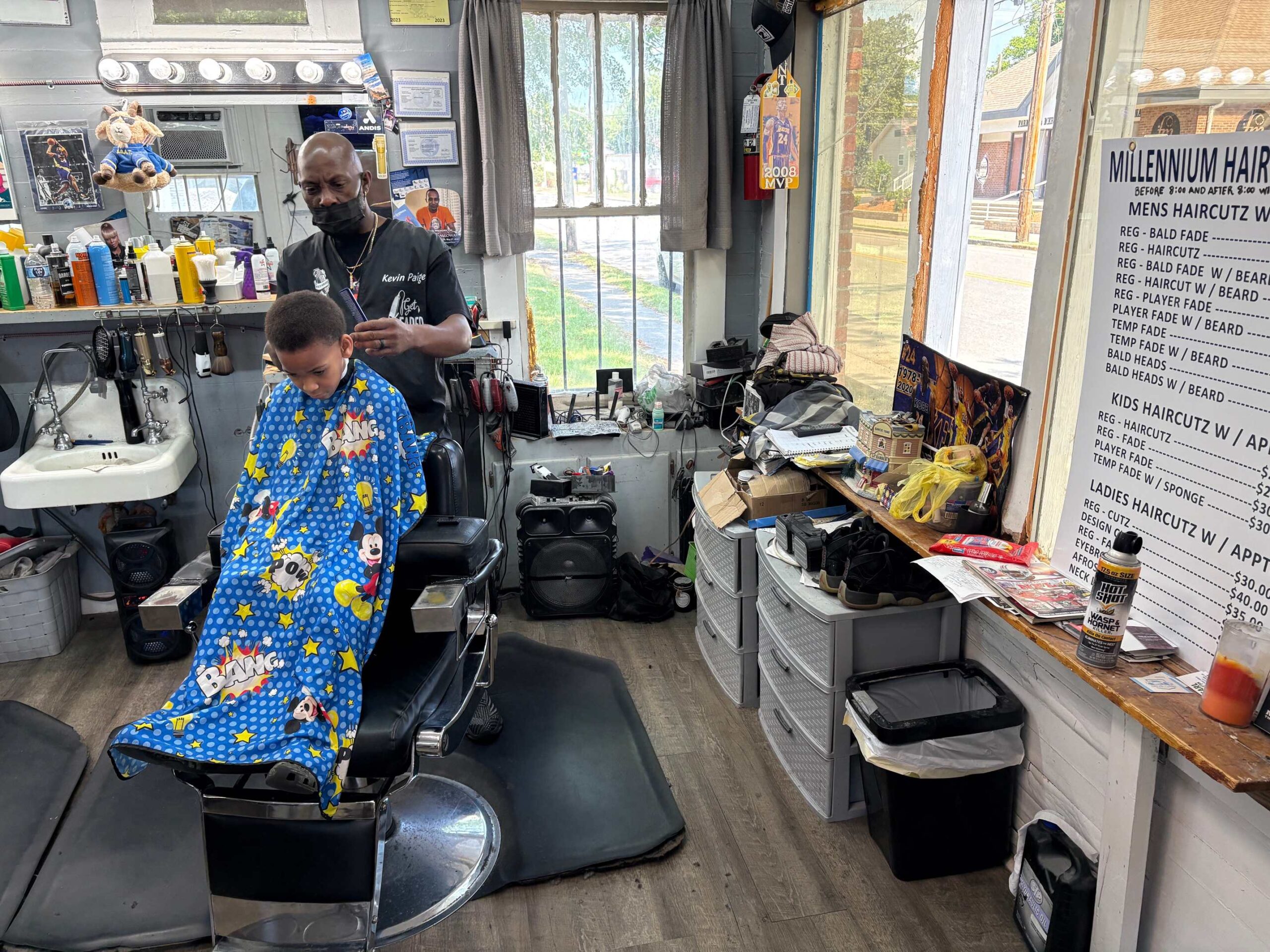
Although he made sure to attend the runoff election, Goodman expressed concern that the general climate would discourage black people from voting. The next day, barber Kevin Paige, 49, cut a young customer’s hair and said it was important for black people like him to vote to elect members of Congress to check Trump’s power. “He believes he has all the power to do whatever he wants,” Paige said. “He’s trying to stay there forever.”
According to Paige, she voted in the primary, but forgot that the runoff had been held the day before and did not vote. John H. Hamilton, 71, a disabled military veteran who was sitting across the store with a plastic bag containing his prescription medications, said he had wanted to vote but had no way to get to the polls. Both promised to vote this fall.