
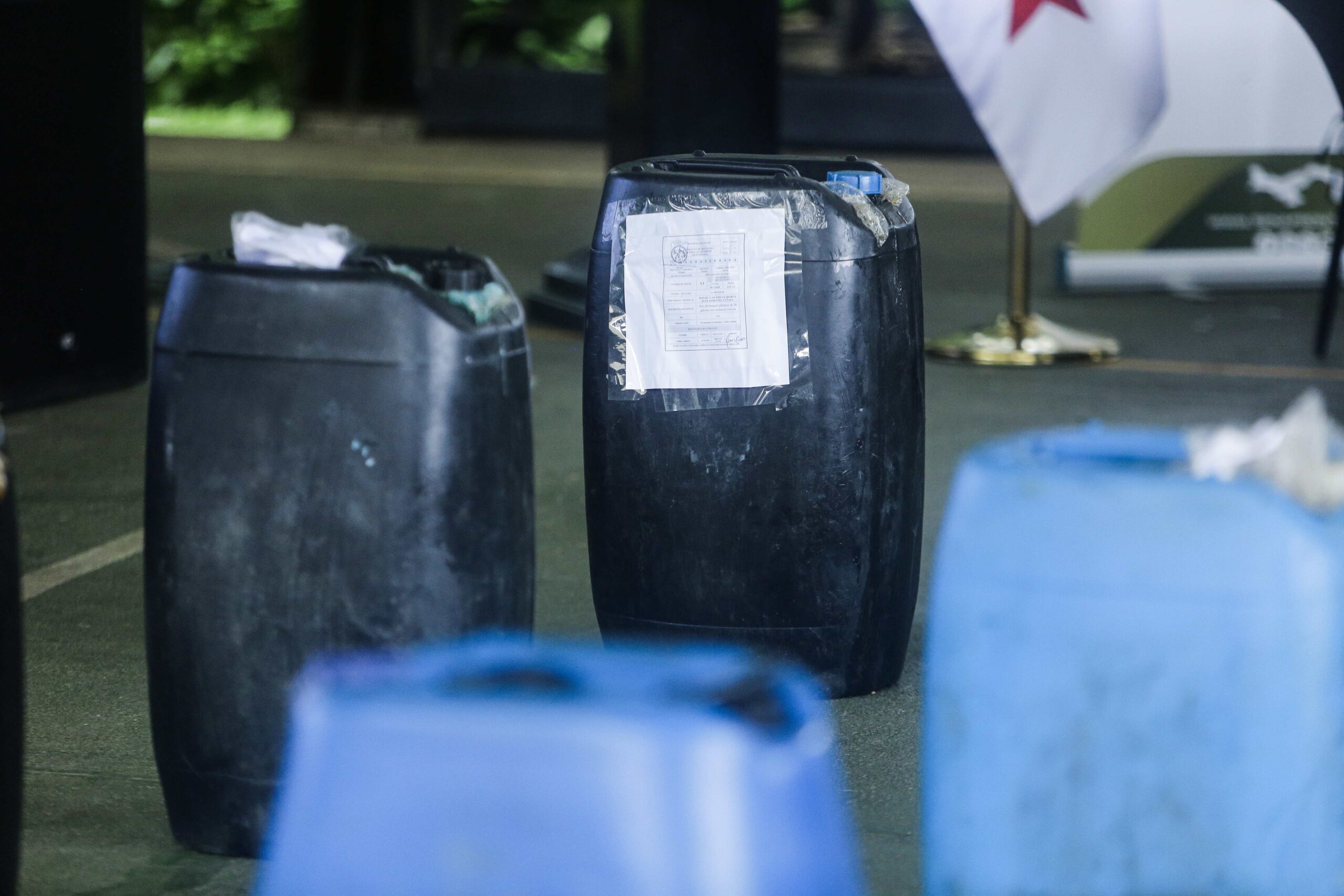
With Costa Rican flag and named Golden Sun VIa fishing vessel was intercepted by Costa Rican authorities 289 kilometers from the coastal town of Golfito, in the province of Puntarenas, with a shipment of 650 kilos of liquid cocaine.
The operation, carried out on July 3, was carried out in conjunction with the Colombian Navy, whose intelligence work and timely exchange of information allowed the vessel to be intercepted.
Costa Rican authorities described the seizure as a milestone of great importance for regional securityaccording to the medium Infobae.
Furthermore, according to that medium, this is the first time in history that the Central American country detects this method of transporting illicit substances at sea.
escape attempt
When the boat crew was surprised by maritime patrols, they tried to get rid of the drugs by throwing several barrels, known as pichingas, into the sea. However, the coast guard recovered all of the containers.
Stephen Madden, director of the Costa Rican Drug Control Police (PCD), indicated that, in this case, the criminals used an advanced method to try to circumvent the authorities’ controls.
The Ministry of Public Security of Costa Rica (MSP) reported that this action is part of an unprecedented event in the fight against organized crime.
“This is the first seizure of liquid cocaine made on the high seas, where five hundred and sixty kilos of drugs were located distributed in eight pichingas,” Madden explained to the media, as quoted Infobae.
Detained on the high seas
During the operation, the authorities detained four Costa Ricans who, according to the portal CR Todayare:
- Madriz Sánchez, captain of the boat, 32 years old. Records seven police reports for drug possession.
- Solórzano Villalobos, 46 years old. He has a record of aggravated robbery and five police reports for drug possession.
- Pérez Méndez, 49 years old. He has a history of physical violence and drug possession.
- Herrera Acevedo, 22 years old. He has a file for psychological aggression.
The detainees were transferred to the mainland and placed at the disposal of the Public Ministry of that country, where they will face charges of international drug trafficking, a crime punishable by up to 20 years in prison, according to Costa Rican legislation.
In total, the weight of the substance amounted to 560 kilograms, in addition to 95 packages of powder cocaine, weighing approximately one kilogram each.
In recent years, drug trafficking and associated violence have established themselves as the main public security problem in Costa Rica. The country has also experienced a historic spike in the homicide rate, mostly related to territorial and logistical disputes between criminal gangs and cartels, according to Infobae. However, this is the first time in the country’s history that this method of transporting illicit substances on the high seas has been detected, which represents progress in the fight against drug trafficking.
What is liquid cocaine?
According to the United Nations Office on Drugs and Crime (UNODC), it is cocaine in solution, which can be dissolved in aqueous solutions or organic solvents, mainly alcohol.
The substance is obtained from cocaine base and is subsequently converted into cocaine hydrochloride.
Furthermore, UNODC considers this to be the simplest method of chemical camouflage.