
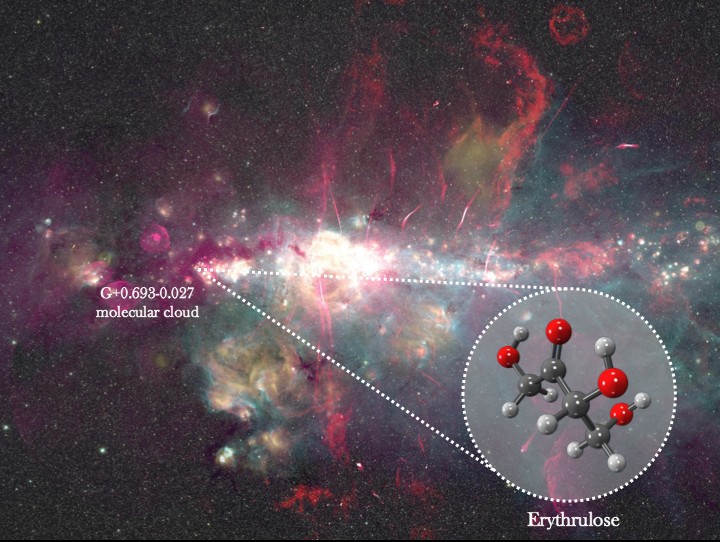
Interstellar space continues to surprise the scientific community. This time, the discovery corresponds to the first detection of a four-carbon sugar, achieved through observations made with two radio telescopes.
This discovery offers a new clue about the origin of sugars on Earth, but could also provide information about the emergence of life. The discovery was announced in the magazine Nature Astronomywhere the detection of erythrulose, a chiral four-carbon ketose, in the interstellar medium (ISM) was reported.
The researchers highlight that the detection was achieved through ultrasensitive broadband spectral studies of a molecular cloud at the center of the Milky Way, for which the Yebes radio telescope was used.
But why is this finding relevant? According to experts, the origin of sugars on Earth remains a mystery, although these molecules are essential for life, since they function as “metabolic fuels, components of the structure of nucleic acids and structural or energy storage polymers,” highlights Nature Astronomy.
Scientists explain that sugars could have been present since the origins of the Earth, since it is believed that they arrived through asteroid impacts during the early stages of the planet’s history, according to The New York Times.
The international team led by the Center for Astrobiology (CAB) was responsible for detecting this sugar in a molecular cloud located near the center of the Milky Way.
The main analysis suggests that these molecules could have reached the planet from space more than four billion years ago. These biomolecules would have been fundamental for the formation of DNA and RNA, essential components for the development of life.
This theory is supported by the fact that sugars, such as ribose and glucose, were previously found in meteorite fragments and in samples from the asteroid Bennu. This reinforces the hypothesis that part of these molecules were part of the nebula that gave rise to the Solar System 4.5 billion years ago, according to the EFE Agency.
In this new discovery, the team led by Izaskun Jiménez-Serra observed a region of the Milky Way with the purpose of collecting data on the radio frequencies emitted by the interstellar medium.
After analyzing the data, the researchers identified that the molecules present in a nebula near the center of the Milky Way matched the characteristics of erythrulose, a sugar also found in raspberries. According to the study, this sugar is made up of “four carbon atoms, eight hydrogen and four oxygen atoms,” according to The New York Times.
Finding erythrulose “suggests that these complex compounds are more widespread in the Universe than we thought,” said the researcher.
Detection of a four-carbon sugar in interstellar space https://t.co/LJ7Z2iWp8S ☄️ pic.twitter.com/81z9qsSlkM
— Nature Astronomy (@NatureAstronomy) July 14, 2026
“The fact that other sugars, such as ribose or glucose, have been detected in meteorites and asteroids is part of the same story: these molecules could be formed in the earliest stages of the birth of planetary systems in their mother nebulae and later be transferred to smaller bodies, such as comets and meteorites,” Jiménez-Serra explained to EFE.
According to The New York Timesthis finding demonstrates that sugar “can form without life in the interstellar medium, and even before stars and planets have formed.”
*With information from Nature Astronomy, The New York Times. and EFE Agency
SUGAR DISCOVERED IN INTERSTELLAR SPACE
For the first time, scientists have detected sugar in the interstellar space of the Milky Way, a finding that sheds new light on how life may have arisen on Earth. The team, led by the Spanish astrochemist Izaskun… pic.twitter.com/wVEiK5mLB0
— Clarín (@clarincom) July 15, 2026