
The alignment between the Sun, the Moon and the Earth causes one of the most striking phenomena for astronomy lovers: an eclipse, which gives the world an outstanding visual spectacle. For the second half of the year it is expected a total solar eclipse that will momentarily darken areas of the Earth.
The National Aeronautics and Space Administration (NASA) highlights that this phenomenon occurs when the Moon comes between the Sun and the Earth. This causes the territories located in the center of the lunar shadow to experience darkness in the sky, a phenomenon known as a total solar eclipse.
After the spectacle of the annular solar eclipse on February 17, which gave the world the phenomenon known as the “ring of fire”, astronomy lovers will see the second solar eclipse of the year on August 12, when the Moon passes between the Sun and the Earth.
It will be at that moment when the Earth’s natural satellite completely blocks the visible side of the Sun and darkens the sky. In some areas, sunlight will be blocked completely and in others, partially.
Beyond being a unique phenomenon to appreciate, NASA highlights that solar eclipses have also helped scientists “decipher the structure of the Sun and its explosive phenomena, find evidence of the theory of general relativity and discover a new element.” Therefore, each event is unique and important for the advancement of astronomical knowledge.
Visibility map and regions where it will be observed
The expectation for this phenomenon has grown, mainly due to knowing in which regions it will be visible. According to NASA, it can be observed in areas of northern Russia, Greenland, some areas of the North Atlantic, Iceland, Spain and the northwestern tip of Portugal.
In some places in the United States, Canada and Russia the eclipse can be seen partially, since they will be outside the path of totality. Some countries in Europe and the extreme north of Africa may also witness this phenomenon.
NASA revealed a map that specifically shows the region where the solar eclipse on August 12, 2026 will be visible. It explains that the strip of totality “will begin in the far north of Siberia, near the North Pole, and will move south through the Arctic and North Atlantic oceans, passing through Iceland and Spain.”
For the rest of Europe, as well as parts of North America and Africa, this phenomenon will be partially visible, NASA emphasizes. This is shown on the agency’s map.
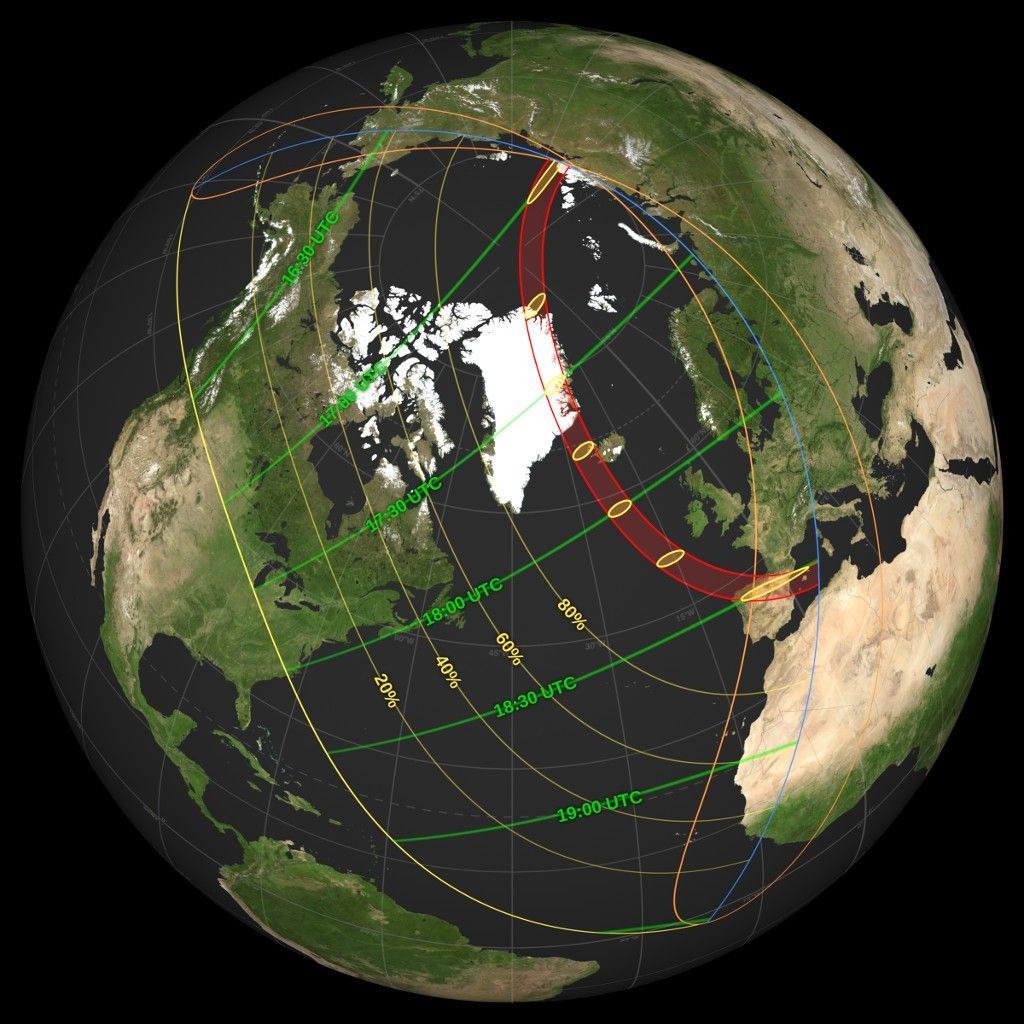
A map shows where the eclipse will be visible. The red stripe that runs through Greenland, Iceland and Spain indicates where a total solar eclipse can be observed. The yellow curves show where a partial eclipse will be visible, and the percentages indicate the maximum surface area of the Sun covered by the Moon during the eclipse along those lines. (Image: Courtesy NASA)
Data from the agency highlights that, for areas located within the eclipse path, the Sun will be completely eclipsed for less than two minutes. In the center of the trajectory, totality will last a little longer.
Broadcast of the total solar eclipse of 2026
International media indicate that NASA broadcasts this type of phenomena, so it is recommended to pay attention to its official channels, as well as those of other scientific platforms, such as the European Space Agency.
Schedules of the places where it will be seen
| City | Partial start | Maximum | Coverage | Partial end |
|---|---|---|---|---|
| Washington, DC (USA) | 13.17 | 13.53 | 4% | 14.27 |
| Anchorage, Alaska (USA) | 7.36 hours | 8:21 a.m. | 28% | 9.09 hours |
| New York (USA) | 13.07 | 13.54 | 9% | 14.38 |
| Barcelona (Spain) | 19.35 | 20.29 | 99% | 20.54* |
| Berlin (Germany) | 19.15 | 20.08 | 85% | 20.38* |
| Casablanca (Morocco) | 18.48 | 19.43 | 87% | 20.20* |
| London (United Kingdom) | 18.17 | 19.13 | 91% | 20.06 |
| Saint Petersburg (Russia) | 19.59 | 20.51 | 79% | 21.00* |
| Paris (France) | 19.22 | 20.17 | 92% | 21.09 |
(Table of times provided by NASA (Local time of the cities) where the eclipse will be seen. Those with an asterisk under the column “End of the partial eclipse” indicate that the eclipse will end after sunset and that the indicated time corresponds to sunset, the agency highlights. (Data: Courtesy NASA)
Upcoming eclipses in 2026 and 2027
Solar eclipses
2026 will continue to surprise the world with two solar eclipses: one annular and the other total.
- Annular: February 6, 2027. It will be visible in parts of South America, Africa, Antarctica, the South Pacific Ocean and the Atlantic Ocean.
- Total: August 2, 2027. It will be another key date, when the total solar eclipse will be visible in southern Spain and northern Africa.
lunar eclipses
- Partial: On August 27 and 28, 2026, a lunar eclipse will be visible in America, Europe, Africa and Western Asia.
- Penumbral: On February 20 and 21, 2027, a lunar eclipse will be visible in America, Europe, Africa, Asia, Australia and Antarctica.