
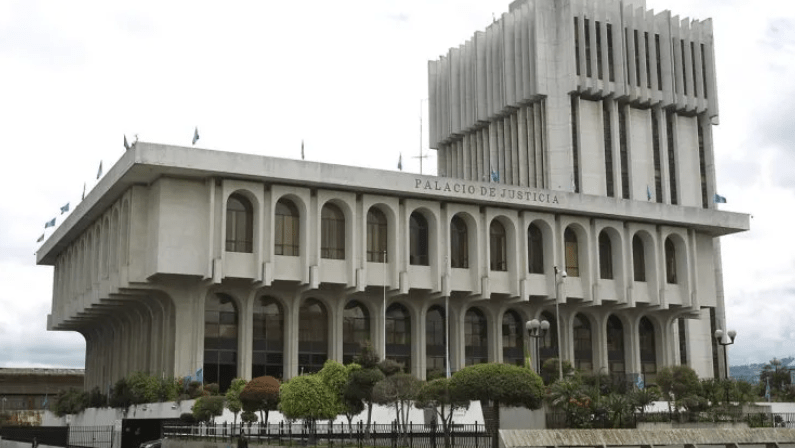
The Supreme Court of Justice (CSJ) rejected this Wednesday, July 15, through a statement approved with the favorable vote of 11 of its 13 judges, the statements of Vocal Judge V, Estuardo Adolfo Cárdenas, published last July 8 in an interview granted to Free pressin which he pointed out an alleged interference by external actors in the decision-making of the plenary session.
In the statement, the CSJ affirmed that the magistrate’s statements “are false” and that they do not reflect the institutional reality of the Judicial Branch.
The plenary session also rejected the allegations that there are power blocks within the Court or that the resolutions respond to interests outside the organization. According to the statement, decisions are made independently and in accordance with the Political Constitution of the Republic and the Law of the Judicial Branch.
The Court held that the existence of different legal criteria is part of the functioning of a collegiate body and that resolutions are approved through deliberation and majority voting.
Furthermore, he indicated that Cárdenas’ transfer to the Civil Chamber responded to an administrative reorganization derived from the election of the new presidencies of the chambers, a power that, according to the CSJ, corresponds exclusively to him.
The statement also indicates that the magistrate did not express any objection during the session in which this reorganization was approved and recalled that the Constitutional Court provisionally denied the protection promoted by Cárdenas against that decision.
Regarding the creation and integration of new chambers of the Court of Appeals, the CSJ affirmed that these actions were endorsed by the Constitutional Court and assured that Judge Cárdenas himself integrated one of these chambers under the same procedure during 2024.
The Court added that, although freedom of expression protects all officials, those who make up that high court must act responsibly when ruling on institutional matters. Likewise, he reiterated his commitment to administer justice with independence, impartiality and adherence to the constitutional order.
Antecedent
The response from the Supreme Court of Justice comes a week after Free press published an interview with Cárdenas, in which he described a series of internal disagreements within the plenary session and questioned the way in which, according to him, some administrative and jurisdictional decisions are made.
During the conversation, Cárdenas assured that, since the beginning of the term of the current Court, on October 13, 2024, there has been no cohesion among the 13 judges and stated that the plenary session is divided between a majority group and a minority group. As he explained, the majority bloc holds meetings prior to the official sessions, which he called “pre-plenary sessions”, in which, he stated, the issues on the agenda are discussed and the direction of the votes is agreed upon before the formal sessions.
The magistrate also pointed out that these meetings, which would initially have been held in the Palace of Justice and later outside that building, would sometimes have the participation of people outside the Judicial Branch. “There are external agents who join these meetings in order to be able to give certain instructions or opinions on certain topics,” he stated.
When asked who these supposed external actors would be, Cárdenas responded that he could not identify them and acknowledged that doing so would be a guess. “They don’t mention it; one could infer them, but ultimately they would be conjectures,” he said.
In the interview he also questioned his transfer from the Amparo and Pretrial Chamber to the Civil Chamber, a decision that he described as discretionary and arbitrary. For this reason, he promoted an amparo before the Constitutional Court (CC) to try to reverse the measure. However, the highest constitutional court refused to grant him provisional protection and left the substantive analysis of the file pending.
The Supreme Court of Justice informs the population:#OJ #CSJ #OJInforma pic.twitter.com/bdmhsANHvP
— Judicial Branch (@OJGuatemala) July 16, 2026
*Stay up to date with the Now newsletter. Key information at the moment it happens. Subscribe here.