
For forty years, football had the same point of reference. First it was Diego Armando Maradona. Then Lionel Messi appeared and the question stopped being who was the best of the present and became a much more complex one: could someone one day occupy the place that Diego had left in the collective memory?
That discussion spanned generations. He survived championships, Ballon d’Ors, goal records and lost finals. He fed on statistics, emotions and nostalgia. He resisted even when Messi lifted the World Cup in Qatar 2022. Because it was never just about titles. It was about two different ways of understanding football and an almost permanent need to compare them.
That is why the 2026 World Cup final can mean much more than the possibility of a new championship for Argentina. It may become the last chapter of a conversation that has accompanied football since Mexico 1986.
Until today, both reached the top as protagonists of a World Cup. Maradona won Mexico 1986 and played another final in Italy 1990. Messi lifted the trophy in Qatar 2022 and reached a new final in the United States, Mexico and Canada 2026. If he wins a second world title, he will break the only balance that still sustains an open discussion for four decades.
But reducing the debate to trophies was always insufficient.
Maradona was the hero of the rebellion. The footballer who seemed to play against everyone: against rivals, against power, against conventions and even against himself. His career was marked by excess, contradiction and an unrepeatable epic.
Messi went the opposite way. He built a legend through discipline, continuity and silence. While Diego seemed to set fire to every stage he stepped on, Lionel turned excellence into a routine. One made chaos a form of leadership; the other found the path to greatness in serenity.
This difference explains why the discussion never found a definitive winner.
As Martín Caparrós wrote, Maradona seemed to live each game as if it were his last. Messi, on the other hand, made the extraordinary seem everyday. Two opposite ways to get to the exact same place.
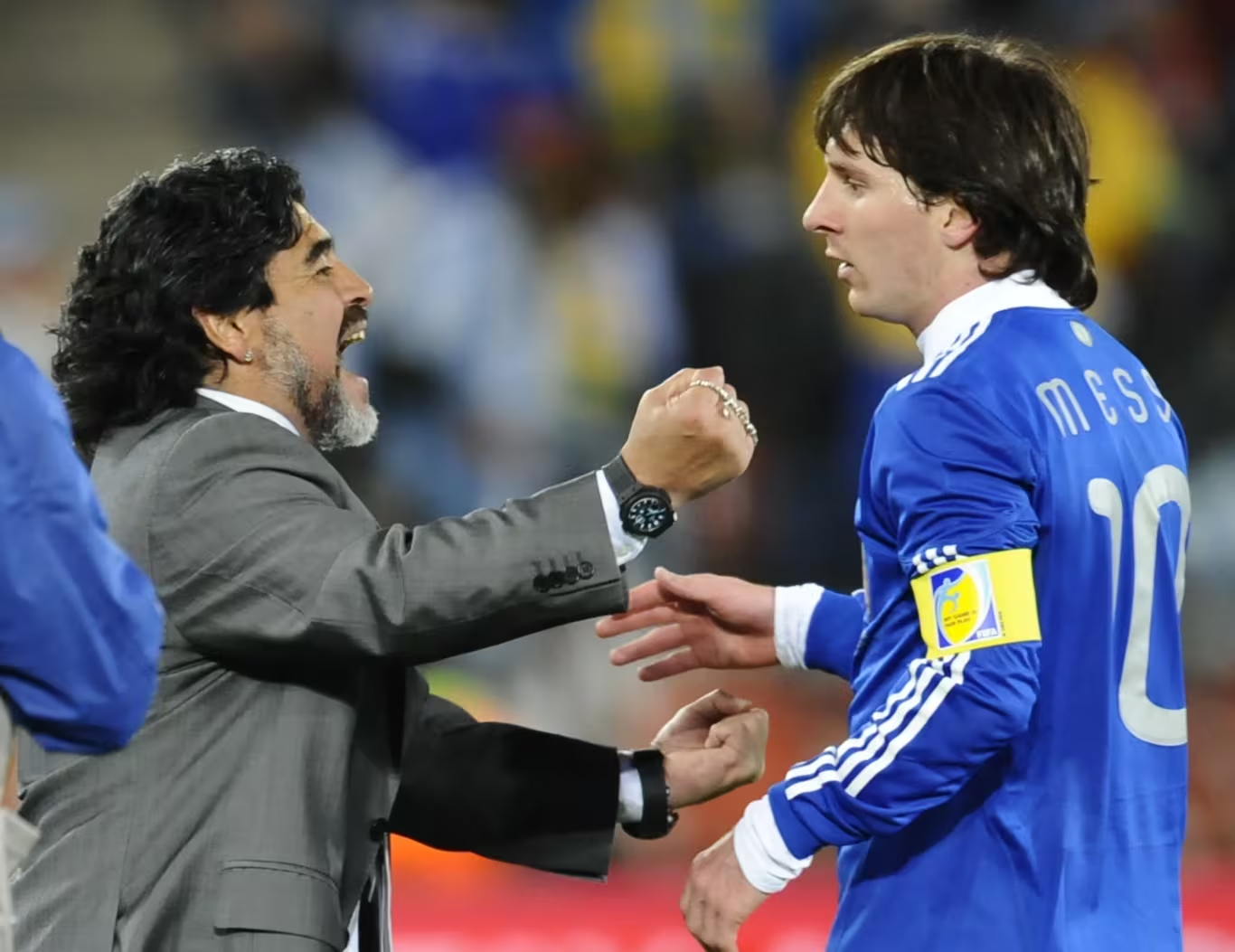
The only time these two stories officially coincided occurred at the 2010 World Cup in South Africa.
Diego led the Argentine team. Before the match against Greece, on June 22, he decided to leave Javier Mascherano on the bench and hand the captain’s ribbon to Messi for the first time. At 22 years and 363 days, the man from Rosario became the youngest Argentine captain in a World Cup.
Argentina was eliminated in the quarterfinals against Germany. However, that photograph ended up acquiring a meaning that went far beyond the result. As time went by, it stopped being a simple image of a group stage match and became the symbol of the bridge between two generations called to share the same conversation.
Maybe that conversation says as much about the footballers as it does about those of us who watched them play.
Those who discovered football in the eighties grew up waiting every four years to see Maradona again. His best plays traveled on video tapes, television highlights or stories transmitted from memory. The scarcity of images turned many of those memories into a form of mythology.
The generations that grew up with Messi lived exactly the opposite. Every goal, every assist and every dribble was recorded from multiple angles, repeated millions of times and discussed in real time. Never had a footballer been observed with such precision.
Technology changed. The speed of information changed. It changed the way we consume sports.
The comparison, however, remained intact.
Juan Villoro has argued that soccer retains a rare democratic condition because it still allows a short player to dominate a sport designed for giants. Maradona, at 1.65 meters, and Messi, at 1.70, showed that talent can also prevail from a low center of gravity, impossible driving and an intelligence that no laboratory can manufacture.
That is why for forty years each new Argentine talent was presented as “the new Maradona” and, later, as “the new Messi.” No one managed to escape that rod.
Not even Messi could do it.
For much of his career he played under the shadow of a comparison that seemed impossible to resolve. He won leagues, Champions Leagues, Ballon d’Ors and broke almost every record imaginable. Even so, for many, a World Cup was still missing. When she finally won him over in Qatar, the conversation didn’t go away. He simply changed arguments.
This shows that it was never an exclusively sports discussion.
It was a conversation about identity. About the way Argentina learned to narrate itself through two footballers.
About how different generations chose their heroes. And about the human need to measure the present with the happiest memories of the past.
That’s why Sunday’s game can mean something that no scoreboard can explain on its own.
Not because Messi needs a second World Cup to become a legend. He reached that condition a long time ago. Nor because Maradona is going to stop occupying the place he conquered in the history of football.
What can change is the reference point.
Starting Monday a different stage will begin. Argentina will continue producing extraordinary footballers. Spain will continue to feed a generation led by Lamine Yamal. Brazil will once again offer candidates for leadership. France, England, Portugal and other powers will continue to develop players capable of dominating an era.
But, for the first time since Mexico 1986, new generations will no longer be forced to answer the same question.
They will not have to prove if they are the new Maradona or if they can catch up with Messi. They will have to build a story that does not depend on either of them.
When the 2030 World Cup arrives, football will once again discuss who is the best of the moment. It has always done so and will continue to do so.
What will probably cease to exist is that comparison that for forty years conditioned every conversation about greatness.
Because on Monday there will still be the World Cups, the finals and the great footballers. What may end this Sunday is something else: the comparison that for four decades used Maradona and Messi as the definitive measure of football.
From then on, new generations will no longer have to look like either of them.
They will have to learn to be themselves.