
International Soccer
Didier Deschamps never wanted to coach the team that played football best. He wanted to coach the team that won the most games. Fourteen years later, he will leave the French bench as the most successful coach in the history of the World Cup.

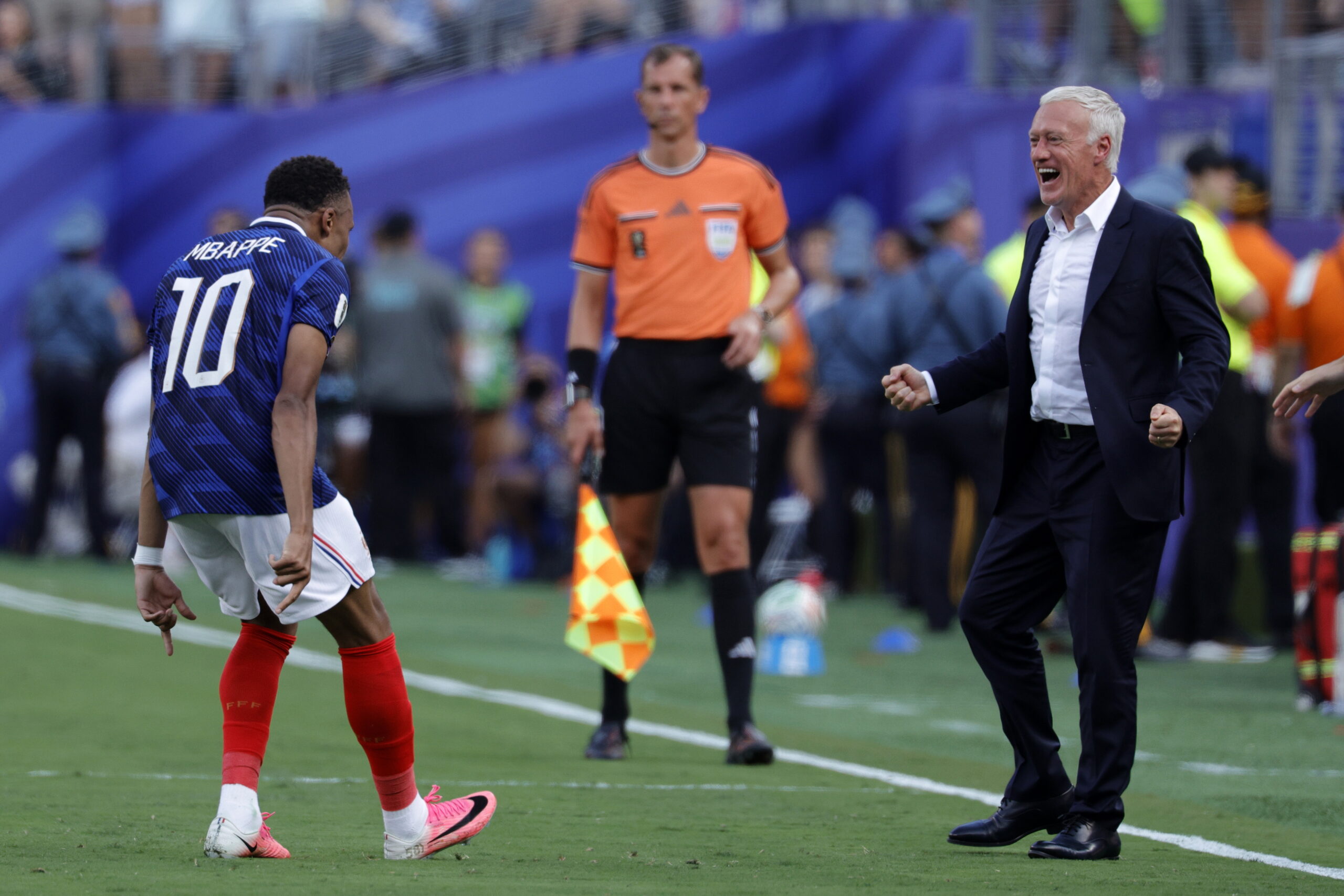
EAST RUTHERFORD (United States), 06/30/2026.- Kylian Mbappe of France (L) celebrates with his head coach Didier Deschamps after scoring the 1-0 goal during the FIFA World Cup 2026 Round of 32 match France against Sweden, in East Rutherford, New Jersey, USA, 30 June 2026. (France, Sweden) EFE/EPA/SHAWN THEW
France arrived at the 2026 World Cup with the possibility of playing in a third consecutive final, but the 2-0 defeat against Spain in the semifinals changed the course of their farewell. Instead of fighting for another title, Deschamps will close his time on the bench Les Bleus playing the match for third place against England.
To understand Didier Deschamps you have to put aside, for a moment, titles and records. What defined his 14 years at the head of the French team was not a tactical revolution or an aesthetic proposal. It was an unshakable conviction: in a World Cup, the teams that best manage the decisive moments survive.
Since taking office in 2012, Deschamps has made pragmatism France’s identity. While a part of the environment demanded a more colorful football, he chose the least romantic and most effective path. He never sought to convince everyone. He sought to win.
That philosophy ended up shaping an entire generation. He convinced Antoine Griezmann to transform into a sacrificial midfielder during the 2022 World Cup in Qatar and built a system capable of unleashing Kylian Mbappé’s offensive talent without compromising collective balance. His teams rarely dominated possession, but almost always controlled the moments that decide the playoffs.
Weeks before the World Cup he summarized this way of understanding football in an interview with FIFA.
“We won the World Cup in 2018 and were finalists in 2022. Honestly, I only care about the present and the future. Do you know how many teams will make it to the end? Just one. Which means that at least eleven will not end up happy.”

“We won the World Cup in 2018 and were finalists in 2022. Honestly, I only care about the present and the future. Do you know how many teams will make it to the end? Just one. Which means that at least eleven will not end up happy.”
Didier Deschamps, coach of France.
That answer explains his legacy better than any tactical scheme.
The coach of records
The numbers ended up supporting a philosophy that never stopped being questioned.
During the 2026 World Cup, Deschamps surpassed German Helmut Schön as the coach with the most games coached in the history of the World Cup. The semi-final against Spain was their 26th match in the tournament and the duel for third place against England will raise that number to 27.
He also set another record that is difficult to match. With the victory over Morocco in the quarterfinals, he reached 20 World Cup wins, more than any other coach since the tournament began in 1930.
But those records are just one part of an exceptional career.
As a footballer he won the 1998 World Cup in France and the Euro 2000 as captain. Two decades later he repeated the feat from the bench by winning the 2018 World Cup in Russia.
With this he joined the small group made up of Mário Zagallo and Franz Beckenbauer, the only men capable of winning the World Cup as players and as coaches.
A circle that closes before England
The end of his cycle comes after another deep campaign in a World Cup. France once again established itself among the four best teams on the planet and was one game away from playing in a third consecutive final, an unprecedented streak in the recent history of the tournament.
The defeat against Spain forced the French to play the match for third place, a match that Deschamps himself acknowledged that no footballer wants to play. However, even that commitment will serve to expand records that will likely remain for many years.
The match will also have a symbolic value. It will be Deschamps’ 290th appearance with the French national team: he played 103 games as a player and will reach 187 as a coach. His last game in both positions will have been against the same opponent, England.
His departure also opens a new stage for French football. Everything indicates that Zinedine Zidane will inherit a team that maintains one of the most talented generations in the world, but also the challenge of succeeding the most successful coach in the history of Les Bleus.
When the referee signals the end of the match at the Hard Rock Stadium, it will not only end Didier Deschamps’ time at the helm of France. He will also conclude a relationship of almost three decades and 290 games with the French team, first as a footballer and then from the bench. His legacy, however, transcends numbers: he convinced France that, in national team football, winning would always be more important than being liked.