
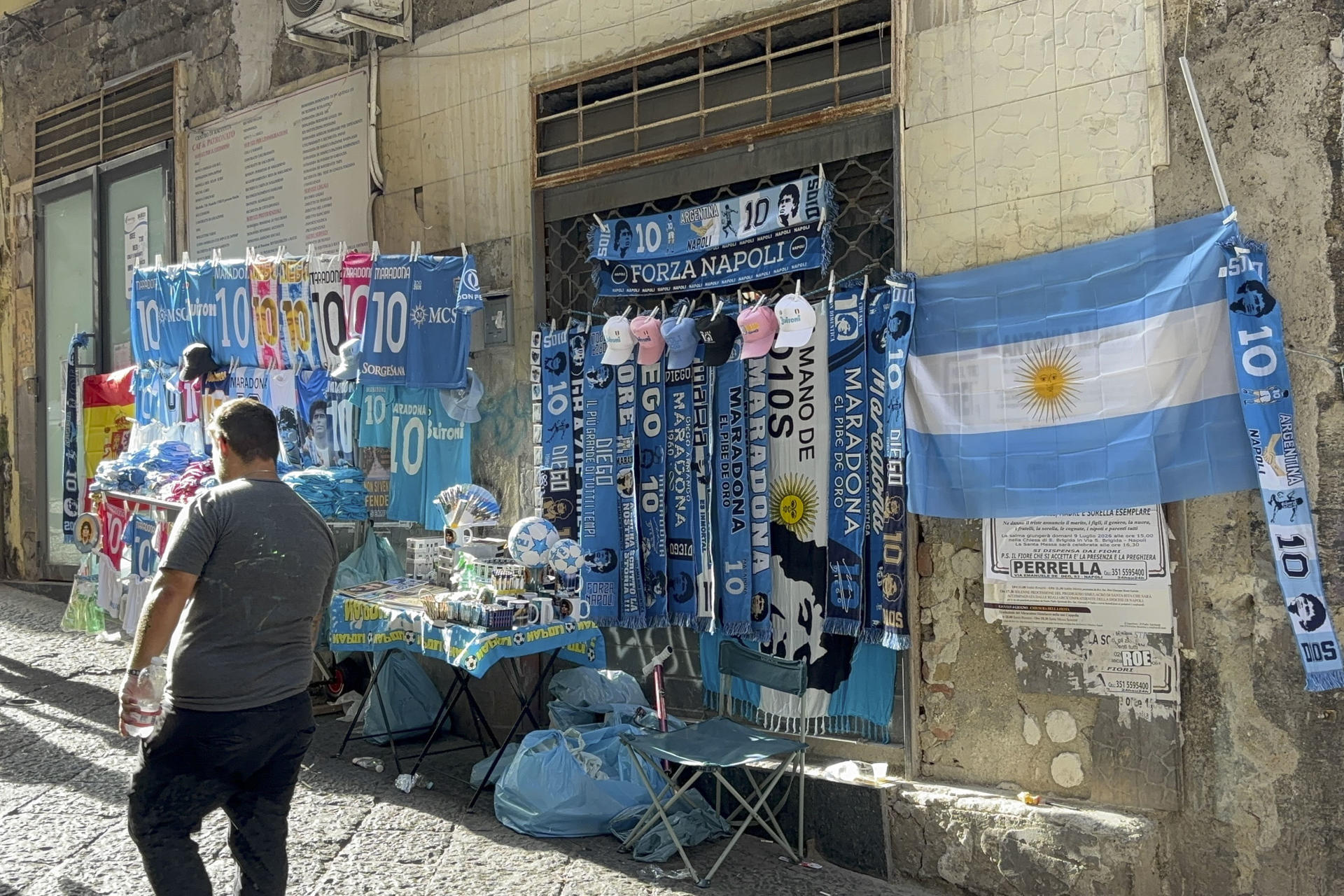
While Argentina and Spain prepare to play the World Cup final, another city experiences the match as if it were its own. More than seven thousand kilometers from the stadium where the champion will be determined, Naples is once again dyed white and blue, driven by a feeling that was born with Diego Armando Maradona and that, more than three decades later, remains intact.
In the heart of the Quartieri Spagnoli, under the gigantic mural of Maradona that has become a place of pilgrimage for thousands of fans, Juan Pablo observes the constant parade of visitors. Some take pictures, others leave flowers, t-shirts or scarves. Everyone stops in front of the face of the man who forever transformed the history of Napoli.
“The Neapolitans do more for Argentina than for Italy,” says the Argentine painter, who works every day next to the mural.
“Naples is a city closely linked to Argentines. People are coming from all over Italy to watch the final here,” he adds.
The scene sums up the atmosphere in the city. Conversations revolve around the game, Argentine flags hang from balconies and shops, and albiceleste shirts predominate among those who walk through the squares and alleys of the historic center.
In Piazza Dante, a huge Argentine flag covers the facade of a kiosk. In Piazza del Plebiscito, among tourists and fans, the same greeting is repeated:
“Forza, Argentina!”
A city that learned to feel Argentine
The affinity between Naples and Argentina goes far beyond Lionel Messi or the current situation of the national team.
During the years in which Maradona defended the Napoli shirt, between 1984 and 1990, the club won two Serie A titles, a UEFA Cup and other trophies that forever changed the sporting history of a city accustomed to looking back at the great teams of northern Italy.
Since then, the link with Argentina stopped being solely football-related and became part of the Neapolitan identity.
Today that feeling is visible again.
After each triumph of the team led by Lionel Scaloni in this World Cup, Argentines and Neapolitans celebrated together in the streets. Murals, t-shirts and flags coexist with portraits of Maradona and, now, also with images of Messi, as if both were part of the same story.
According to the Italian National Statistics Institute (ISTAT), between 1,500 and 3,000 Argentines reside in Naples, a figure that could be higher if those who have dual nationality are considered thanks to the historical migratory links between both countries.
But the phenomenon surpasses any statistics.
You just have to walk around the city to discover which selection arouses the most sympathy.
The memory that never disappeared
The support of many Neapolitans for Argentina was not born in this World Cup.
It has a date engraved in the collective memory: July 3, 1990.
That night, Italy and Argentina played the semifinal of the World Cup at the San Paolo stadium, today renamed after Diego Armando Maradona.
The city was divided between supporting the Italian team or the footballer who had taken Napoli to the top of European football.
On the eve of the match, Maradona uttered a phrase that still resonates in Naples:
“For 364 days a year they consider them foreigners in their own country; today they want them to support Italy.”
Argentina advanced to the final after winning the penalty shootout and that episode consolidated a relationship that was never broken again.
“Naples is Argentina”
“Naples is Argentine,” says Roberto Federico, a young Neapolitan who will tour the city wearing the Albiceleste shirt during the final.
He explains that he supports Messi’s team because Maradona’s legacy continues to be part of the city’s identity.
A few meters from him walks Priscila Segura, who arrived from Buenos Aires to experience the game.
“In the end (the match) has to be experienced in Naples because I feel that within Europe it is a very part of us,” he tells EFE.
Both agree that football has the ability to unite cultures.
The final will be played away from Italy.
But in Naples there will also be a match.
It will not be played on the grass, but in the streets, on the balconies dressed in albiceleste and in front of the mural where thousands of people continue to pay tribute to the footballer who turned the city into a place where Argentina still feels at home.