
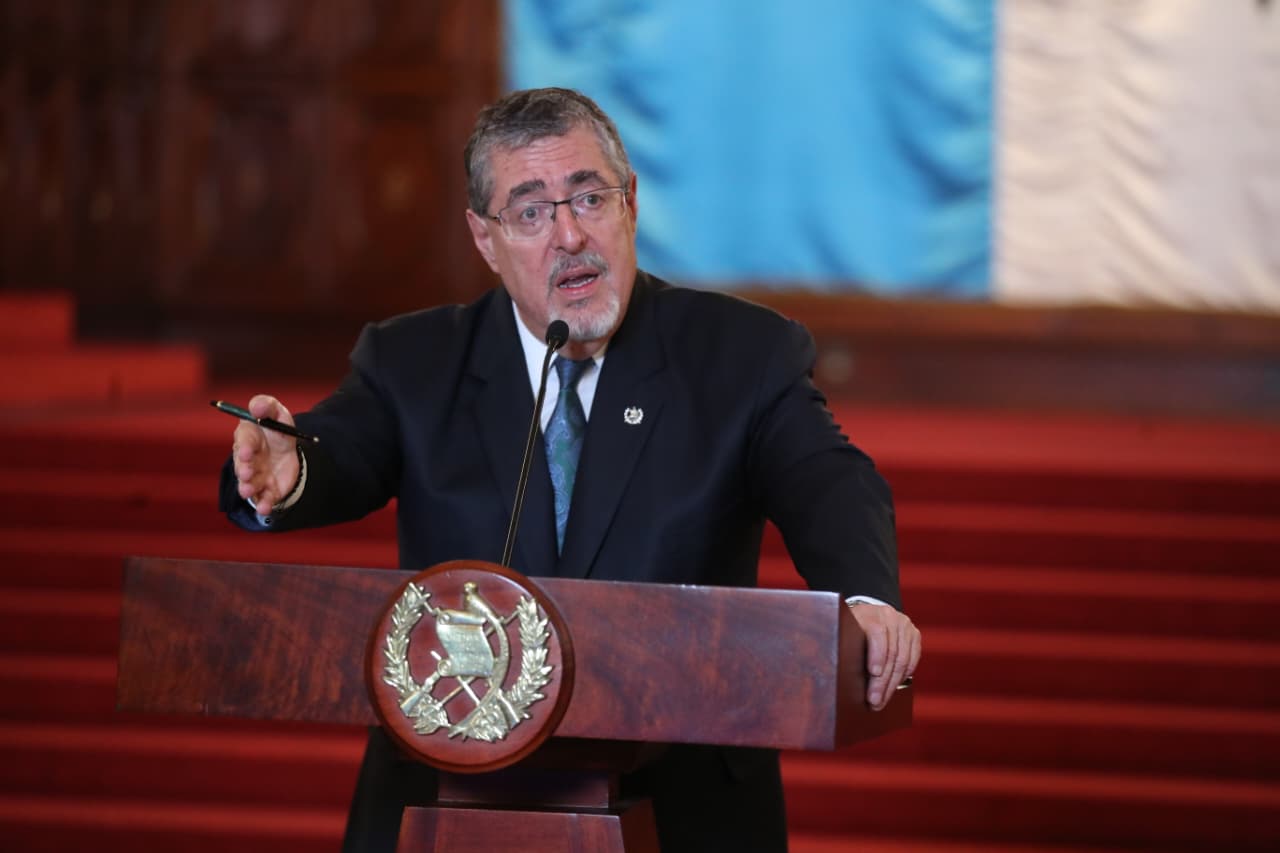
President Bernardo Arévalo announced this Friday, July 24, that he presented to the Congress of the Republic a bill to grant a temporary subsidy for Q12 per gallon of diesel and Q3 per gallon of regular gasolinea program for which the Executive plans to allocate Q3 thousand 480 millionin order to mitigate the impact of the increase in fuel prices on the economy of Guatemalan families.
During a message to the nation, the president explained that the increase in diesel and gasoline prices has an impact not only on the cost of getting around, but also on public transportation rates, the price of food and other consumer products, due to the effect it has on the distribution chain.
Arévalo attributed the rise in fuel prices to the increase in the international price of oil, caused by the war in the Middle East, and stated that Guatemala faces a crisis that also affects other countries in the region.
The president assured that the initiative seeks to provide immediate relief to consumers and maintained that the resources to finance the subsidy will come from a reorganization of public finances, without resorting to additional debt. He added that the support would be in effect until the end of this year, as long as Congress approves the proposal.
“Our government is putting first the care of the family economy of Guatemalans and not the interests of groups that want to take advantage of it to obtain political benefits,” he stated.
The president maintained that the subsidy represents a faster and more effective alternative than other proposals, such as the temporary suspension of taxes or the establishment of maximum prices for fuel, which, he indicated, would require legal processes that would delay their application.
Arévalo recalled that the support mechanism implemented months ago made it possible to reduce the impact of the increase in international oil prices and contributed to containing inflation, which is why he considers that the measure proved to be effective in protecting the purchasing power of families.
Likewise, he urged the deputies to learn about and approve the initiative quickly so that the subsidy can be applied as soon as possible at service stations.
The president also reported that the Executive installed a technical table to evaluate additional measures that could be implemented if the international fuel crisis continues beyond the period planned for the subsidy.
Finally, he assured that the Government listens to the demands of the sectors that have expressed their concern about the increase in fuel prices and reiterated that the approval of the initiative constitutes an immediate response to alleviate the economic burden of Guatemalan households.
Protests and blockades
The presidential announcement occurred while Guatemala was registering blockades on strategic roads and caravans of vehicles towards the center of the capital in rejection of the increase in fuel prices.
Taxi drivers, motorcycle taxi drivers and cargo transporters carried out mobilizations that affected vehicular circulation in different parts of the metropolitan area and in departments in the north and west of the country.
The demonstrations began after the state subsidy approved in April by Congress expired, which allocated Q2 billion to temporarily reduce the price of gasoline and diesel.
The Chamber of Urban and Interurban Transporters of Guatemala suspended the protests it had called for this Friday and announced that it would wait to know the content of the Executive’s measures before defining new actions.
However, the union reiterated that a direct fuel subsidy does not represent a structural solution to the financial problems faced by public transportation.
“For several months, operators have absorbed economic losses without receiving effective support that would allow us to recover the sustainability of the service. In this context, we consider that a new direct fuel subsidy no longer represents a real solution for the sector or for the continuity of the operation,” the organization said in a statement.
Sectors maintain conflicting positions
While the Government is once again betting on a subsidy to contain the economic impact, the main business chambers have expressed their rejection of this type of measures, considering that they increase the burden on public finances and transfer the cost to the State’s debt.
For their part, independent transporters and representatives of the informal sector continue to demand additional measures, including the suspension of taxes applied to fuel imports.
Prices exceed Q43 per gallon
According to the most recent monitoring by the Ministry of Energy and Mines, in the metropolitan area the gallon of gasoline is priced, on average, at Q41.07 in self-service mode and Q42.10 in full service.
Regular gasoline registers an average of Q40.07 in self-service and Q41.08 in full service.
Diesel reaches an average of Q42.26 per gallon in self-service and Q43.19 in full service, although in some service stations it exceeds Q43 per gallon.*Stay up to date with the Now newsletter. Key information at the moment it happens. Subscribe here.