
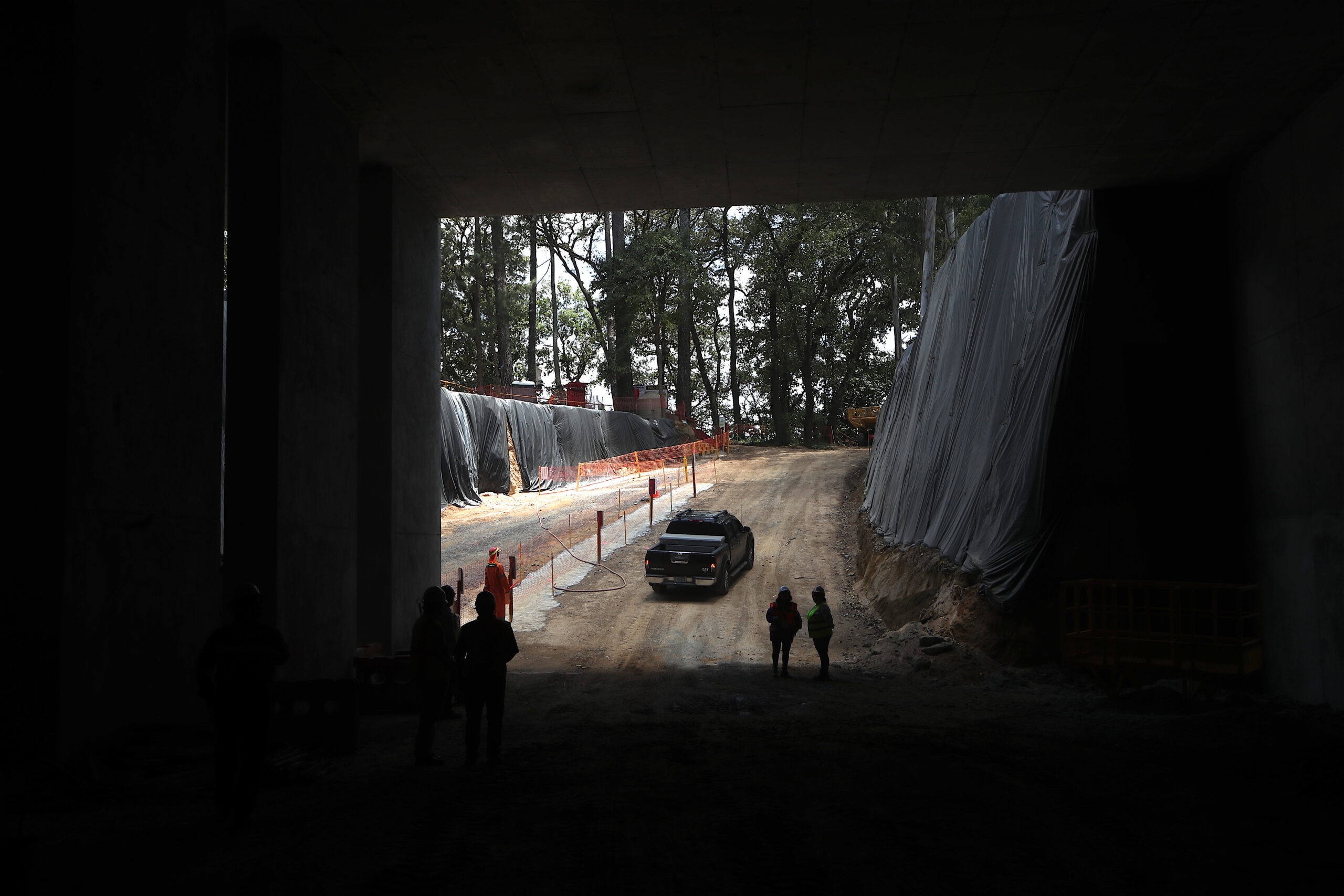
Under the sports fields of Salesian Youth Studies Center (Cejusa)in zone 11 of the capital, one of the most important stages of the Green Corridor: The construction of underpasstechnically known as depressed step.
This structure is part of the second phase of the private road project that will connect the Peripheral Ring with South Boulevard San Cristobal City, Zone 8 of Mixco, with the intention of streamlining mobility between both points.
During a tour taken by Free press in it Salesian Theological Instituteit was found that the construction of the depressed step register a 50% progress in this section. On site, the engineering team Green Corridor explained the construction system used, showed the progress of the work and detailed the stages that remain to complete the gray work, scheduled for the end of this year or the beginning of 2027, subject to any unforeseen events.
Is it a tunnel, an overpass or a depression?
On social networks it is common to read that they describe the work as a tunnela underpass or even a overpass. However, Diana Larissa Montesa member of the project’s Engineering department, explained that the correct term is depressed passage or false tunnel.
“On social networks we have seen that they use different names, but technically it is a depressed step,” he explained.
The difference, he added, is that the road is developed below ground level through a covered excavation, but it does not constitute a completely closed tunnel like those built on mountain roads.
This is how the Cejusa underpass is built
The depressed step will initially have 460 meters longalthough that distance could be extended when the final design of the crossing under the Peripheral Ring.
The structure will have four lanestwo for each direction of traffic, an exclusive lane for motorcycles, 26 meters wide and a depth that will vary between seven and eight meters.
According to Montes, one of the main challenges of the design was to ensure that the sports fields continue to function once construction is completed. For this, the infrastructure work It was calculated to withstand both the loads generated by sports activities and the characteristic seismic movements of the country.
“From the beginning of the project it was made clear that the land would continue to be used as a sports field. The Salesian community granted the easement, but there was never the intention to change the use of the area,” explained the engineer.
Currently, the work is divided into four sectors. Two have already been intervened and the other two remain in progress, while the gray work registers progress close to 50%.
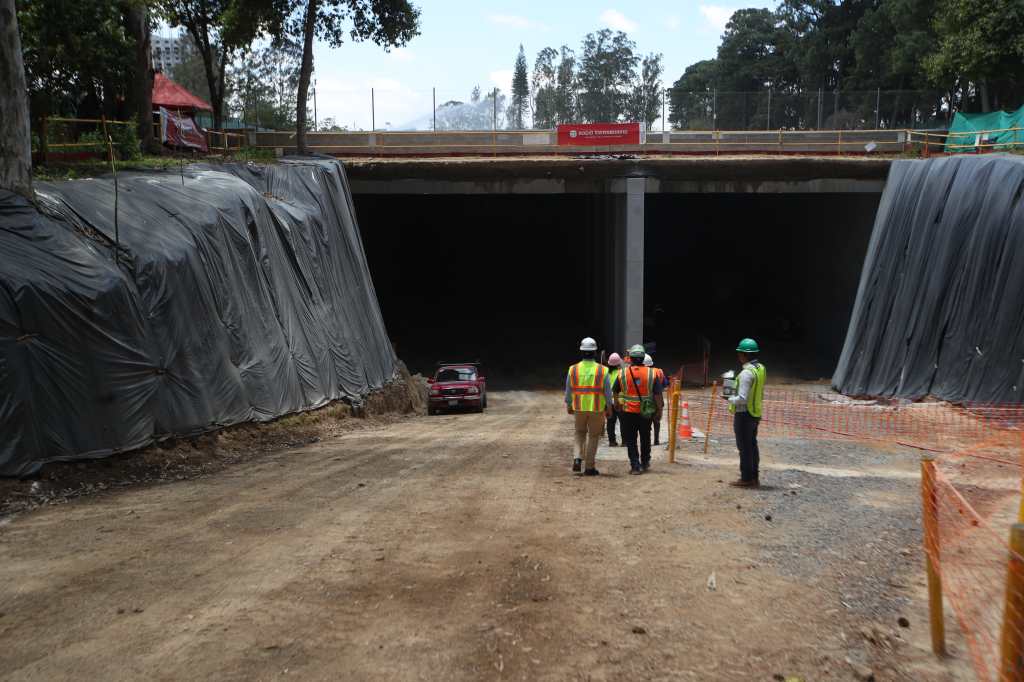
One of the main design challenges was to ensure that the sports fields can continue to be used once the work is completed. For this reason, the structure was calculated to withstand both the loads inherent to sports activity and the seismic movements characteristic of Guatemala.
The innovation that allows us to build without losing the fields
One of the most innovative aspects of the project is the construction method, which is patented, used by the company Rhodium-Swissboringwhich, according to the engineering team, will be applied for the first time in Guatemala and Central America.
Unlike a conventional excavation, the holes are not opened. 460 meters of the step at the same time. The process begins by removing approximately 1.50 meters of land along with the grass of the field where they work. Then a reinforced concrete slab of between 60 and 70 centimeters thickwhich is waterproofed and protected with a bitumen membrane (modified asphalt) before covering it again with soil.
During the tour made by In this environment, field 4 was already showing progress in the recovery of the grass, an example of how the method allows the sports areas to be progressively restored without waiting for all the work to be completed.
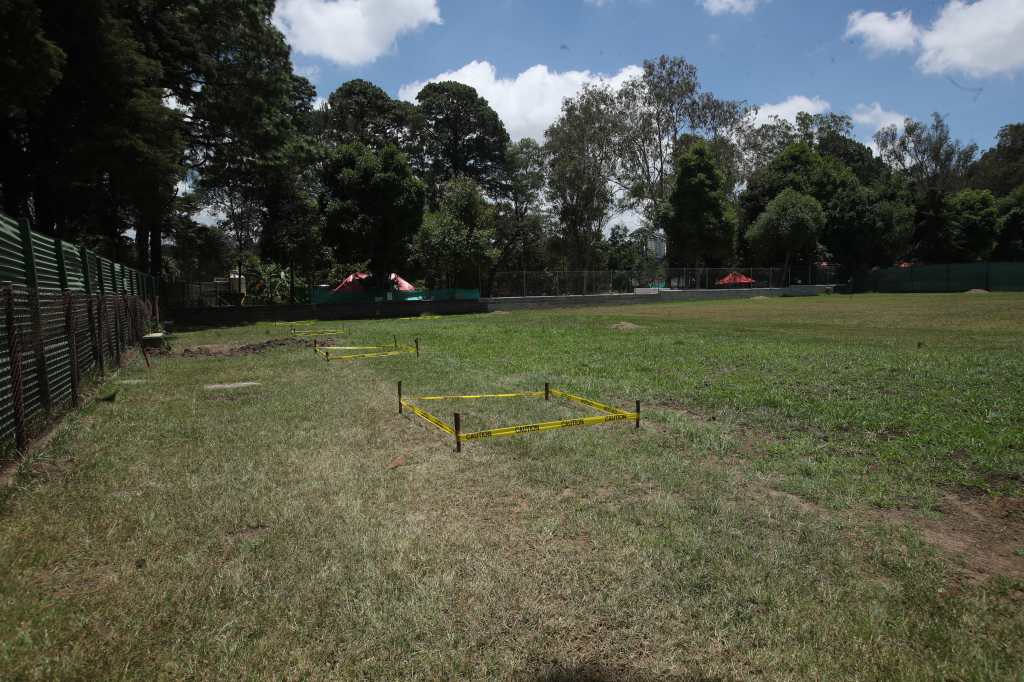
In addition to reducing the area intervened, this technique allows work to be maintained during the rainy season, since the excavations remain protected under the concrete slab.
The excavations began on January 10, 2026 and, six months later, the construction is already halfway complete.
The next stage of the Cejusa phase
The next phase of the work will be carried out in the area of 20 avenue of zone 11.
Before intervening on this section, a temporary paved crossing will be enabled to maintain the circulation of vehicles and pedestrians. The plan includes temporary signage, pedestrian crossings and will allow the transit of heavy transportation and school buses.
In addition, the relocation of electric power poles is planned to conclude the August 5, 2026. Subsequently, an information campaign will be developed with neighbors and auxiliary mayors before the partial closure of the road.
According to the project schedule, this stage of the Green Corridor could close 2026 with around 90% of the structure executedas long as no new unforeseen events arise.
RELATED READINGS


Quality and safety controls
On the other hand, because this work is the first of its kind in the country, Montes commented that the safety of the structure is also part of the construction process.
The work incorporates the system Crossholea test used to verify the integrity of concrete using sensors installed within structural elements.
Montes explained that this procedure works as a kind of “x-ray”, since it allows possible internal anomalies to be detected before continuing with the next stages of construction.
Likewise, the design of the depressed pass was developed based on studies of traffic, vehicular demand, soil mechanics, vulnerability and seismic risk.
Because the project is located within the area of influence of KaminaljuyúBefore each intervention, archaeological inspections are also carried out to rule out possible heritage finds.
When will the Green Corridor start operating?
Although he Cejusa underpass It is one of the most important works of the project, still There are several stages left before the Green Corridor can come into operation.
Months ago, the slope stabilization work in the sector of Megafraterwhere the private road will pass and where a bridge will begin to be built that will connect with the main boulevard of San Cristobal Cityaccording to statements by Montes. That structure will be one of the next phases of the project.
In the case of CejusaOnce the gray work is completed, it will be necessary to install the ventilation, lighting, signaling, video surveillance and other operational equipment systems, in addition to completing the connections with the existing road infrastructure.
If the schedule is met and no new delays arise, the developers anticipate that the Green Corridor can start operating during 2028.