
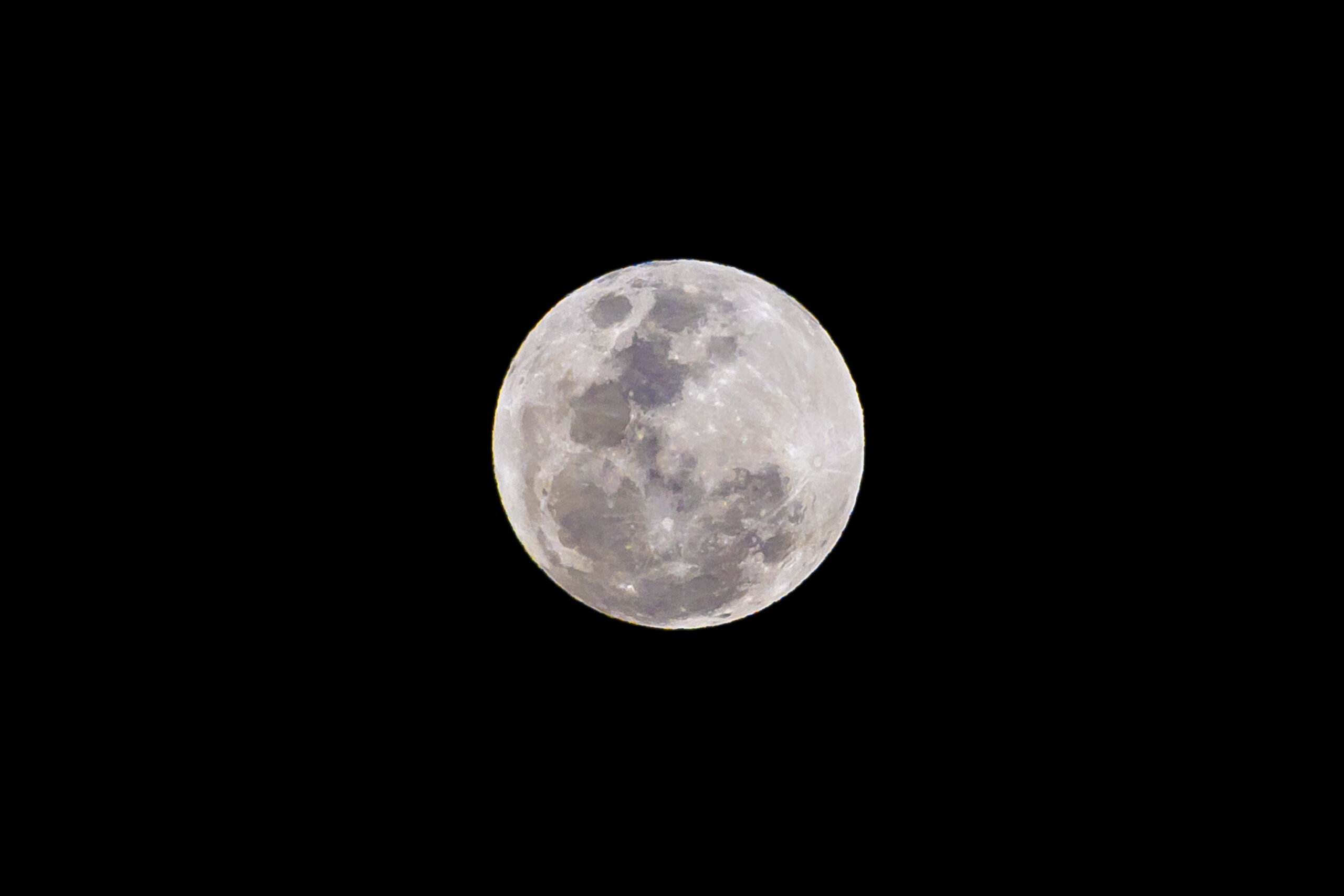
The so-called Sturgeon Moon in August will offer a spectacle in the sky and will be one of the most anticipated full moons of the year, as it will coincide with another notable astronomical phenomenon.
Like every month, the Moon will offer the world the opportunity to observe its different phases, in a cycle that repeats every 29.5 days. The month will begin with the Moon in the direction of the last quarter and will conclude with the full moon phase.
The well-known Sturgeon Moon is named after the tradition of the Native American peoples, who named it in honor of a species of fish that, according to National Geographiccomes from the era of the dinosaurs and has survived various natural phenomena.
According to this medium, the presence of these fish was abundant in the lakes of North America. It was even stated that, at this time of year, it was possible to cross the rivers where they lived by walking on them, which made their capture easier.
According to the director of the Institute of Earth Sciences and Astronomy of the Galileo University, Edgar Castro, the Sturgeon Moon will arrive between the night of next August 27 and the early morning of August 28 and will coincide with another of the most anticipated astronomical phenomena: a partial lunar eclipse.
This phenomenon will occur on the night of August 27 in regions such as Central America, while in other parts of the world it can be observed between the night of August 27 and the early morning of August 28, when part of the Moon acquires an orange tone and the rest retains its usual color.
Castro highlighted that the threshold magnitude of the eclipse will be 93%, so it will touch totality. Likewise, once the eclipse is over, the public will be able to enjoy the August full moon, whose visibility will depend on the level of cloud cover in each region.
In addition, during the month you can observe the lunar cycle of 29.5 days, distributed in the following phases:
- Last quarter: August 5
- New Moon: August 12
- Waxing quarter: August 19
- Full Moon: August 27
Edgar Castro explained that the perigee, or closest point of the Moon to the Earth, will occur on August 10, 2026, about 363,265 kilometers away, almost coinciding with the new Moon. The apogee, or most distant point of the Moon with respect to Earth, will occur on August 22, 2026, at about 404,678 kilometers.
Appreciation of the partial lunar eclipse
For those who wish to observe the eclipse, Castro shared the approximate time of the partial lunar eclipse, which will coincide with the full moon in August:
- Start of the threshold phase: 8:33 p.m. (Guatemala)
- The umbra will cover 50% of the lunar disk: 9:20 p.m.
- Maximum point of the partial lunar eclipse: 10:12 p.m.
- The Moon will begin to leave the Earth’s shadow: 11:08 p.m.
- End of the partial eclipse (Moon discovered): 11:52 p.m.
Dates of the next full moons in 2026
The Moon will continue offering shows for the rest of 2026. These are the dates and names by which the next full moons are known:
- Corn Moon: September 26
- Hunter’s Moon: October 26
- Beaver Moon: November 24
- Cold Moon: December 24
Recommendations for observing the Moon
- Look for spaces with low light pollution.
- Check the weather forecast to determine if there will be cloudiness.
- Dress appropriately if observing in open areas