

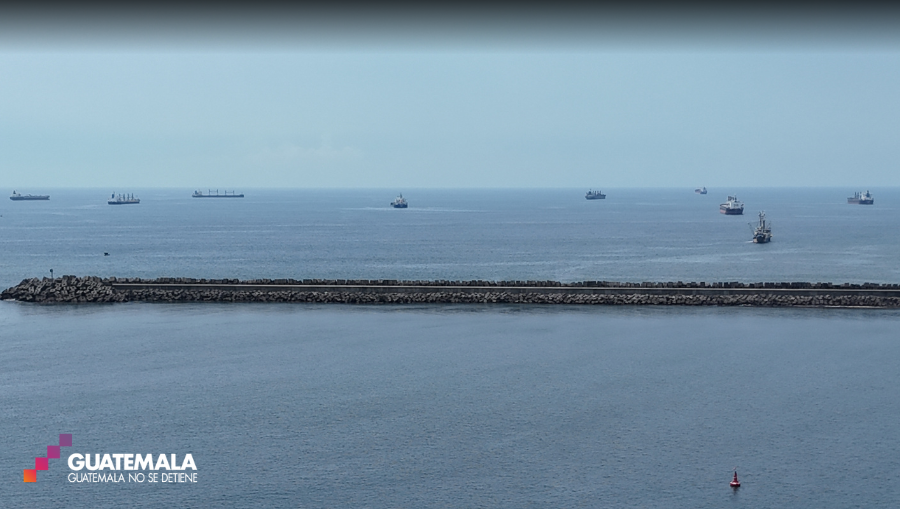
On April 4, the Superintendence of Tax Administration (SAT) registered a tail of 24 ships in the funding area waiting to download in Puerto Quetzal: four loaded wheat, 12 had grains, six iron, one of salt and one of cement. These add a taxation of Q331 million 280 thousand 535.10. Estimates of the Port Company Quetzal (EPQ) indicate that ships wait between 25 and 30 days.
The bulktering union, attached to the Guatemalan Chamber of Industry (CIG), said that in 2024 the Fondeo ships paid US $ 70 million only in cost overrun per delay. This port in the Pacific “has a limited number of docks where you can receive those ships, and what we have to work is to expand the capacity of Puerto Quetzal to receive more ships at the same time, to thus minimize all those ships that are in anchono,” says Raúl Bouscayrol, president of the CIG. The commercial dock has an extension of 800 meters that allows simultaneously to serve three or four ships, depending on the size.
The capacity of the port has not grown so far in the century. From 2000 to 2024, the Guatemalan Association of shipping companies (ASONAV) counted an approximate growth of 360% in container mobilization and 252% in solid bulk in the national port system, but not in infrastructure.
In the long term, there is the project with the United States Army Engineers Corps (Usace), of approximately US $ 600 million. The construction is proposed to start between November and December 2027. Meanwhile, there are seven proposals to respond to the problems that Puerto Quetzal presents today.
1. Specialized cranes
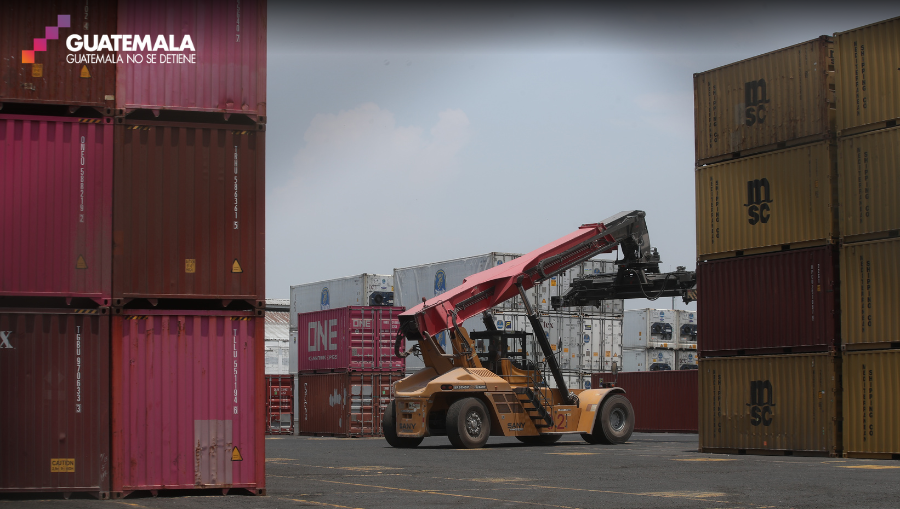
One of the starting points to attend the ships that arrive at the port is to expand the installed capacity. ASONAV considers it important to “evaluate the current machinery and equipment and make the necessary investments in faster loading and/or discharge systems.”
Bouscayrol considers cranes investment necessary: “If you don’t have enough cranes to download, the download will not be agile“
Always in the short term, ASONAV indicates that the evaluation of effective times of operational continuity would help implement the necessary measures that allow established operational yields. Therefore, investment in specialized cranes could increase the amount of tons that are discharged.
In Puerto Quetzal, Lemus estimates that “125 tons per hour per hook, that is, by boat crane, because the bulk ships have their own crane. Then, if I manage to have a mechanism that, instead of 125 tons, can download 400 or twice that, 250, for example, it would be with in the same physical space, but in the time that it previously attended a ship, it adds a ship, it adds two, it adds two, it adds two, it adds a ship, it adds a ship.
This can have a positive impact; However, Lemus considers that it will not be significant, since it needs to have more dock.
2. Adapt existing docks to receive bulk
One of the modernization works with the USACE is to expand the existing infrastructure to allow the reception of larger and capacity ships, which is projected by 2027. In the short term, the solution is to adapt the existing docks. From the CIG they propose to make the necessary investments to transform them and that in these spaces discharge the bulk vessels.
These conversations are in development. This port, In addition to the commercial dock, it has five specialized terminals. Lemus indicates that they are in a negotiation with the coal and fuel terminal: “We hope to finish as soon as possible so that they develop their own infrastructure and can attend bulk ships.” The EPQ already did a test in this terminal, in which the strip to attend bulk was cleaned.
“They want to evolve to have their own band that has no link with coal. The other carbonera also wants to make an infrastructure so that trucks arrive near the ship, to attend bulk and general load, ”adds the Vice Admiral. These works are projected for the coming months and it is expected to have them within a period of less than one year.
3. Dredging by service providers
With the increase in the level of shaking at the bottom of the sea, Asonav considers urgent to be dragged in the port for the maintenance of the depths. This type of works “plays an indispensable role for the reduction of operational risks, so we trust the interest of the Congress of the Republic to eliminate the locks that are currently presented for the execution of Dragados in the maritime ports of the country,” says the association. This would allow access of ships of different sizes to the port.
A solution to perform the Dragados is through the service providers with the specialized port terminals. Lemus indicates that they are in the process of Create an alliance to dredge the dock under this toolsince it is a “legal figure that allows them to have that ability to dredge their own docks, dredge part of ours in exchange for a remuneration in the lease, because the regulation allows.”
This would be a palliative measure for Optimize ship’s beans and not depend on the high tide. “We are in the negotiation phase with them, they are looking for close dredging equipment to do so, ”adds Lemus.
In the future, a tender is proposed to buy a dredging team. “We have that possibility of our own dredging and, if for any reason in Congress, the law comes out authorizing the hiring of Dragados, which we have blocked right now, because we will also take advantage of that,” says the Vice Admiral.
4. Coordinated and automated inspections
In addition to the EPQ, there are other institutions involved in this panorama and whose coordination is key to accelerating attention to ships. Bouscayrol considers that “it is of no use that the download of the ships is very agile and then we will have a brake because there is no review of the SAT, to give an example, of the Ministry of Agriculture or the issue of narcotics.”
Edwin Curta, mayor of Customs of the SAT, indicates that the solution is to coordinate inspections together between the SAT, the Ministry of Agriculture, Livestock and Food (Maga) and the National Civil Police – as the division of ports, airports and border stalls (Dipofront) -. Although there are protocols authorized by the high authorities of each ministry on how to be carried out, “sometimes due to lack of personnel only two arrive or one arrives. And sometimes there is a high percentage of review by the magician. Then, It is useless that the 100 containers sAT reviewed only 10, when the magician only lets go 10 and 90 is checking”Says the mayor.
This is linked to the automation of the process. The SAT proposes to have “a unique platform where everyone will register what it checked, what it retains and what results it obtained. Because today all that remains on paper,” adds a tanner.
5. Early statements in anchorage
According to CIG estimates, ships wait in anchor 30, 45 and even 60 days to be treated and download in Puerto Quetzal. To expedite attention on the dock, Bouscayrol indicates that lto investment in the operating systems of the port would help anticipate which ships and with what products they will arrive.
This anticipation can also be applied in customs procedures. A tanner proposal to improve interoperability is to make the statements prior to landing. This means that “when the vessel is already in the anchief area, if we and the importer have a confirmation that its container is inside the ship, from that moment he can pay taxes, which means that, when the ship sticks and being down, he can withdraw the container immediately, without further delay and without storage,” explains the mayor.
This requires the exchange of web services Service to facilitate and have controlled operations, and measure the dispatch times.
6. Communication between load and import consolidor
“We have attended importers whose merchandise fell in abandonment and we consulted them about what happened, because they have 20 business days to be able to withdraw a container prior to the fact that it falls in abandonment. The justifications they have given us is that the consolidor does not informed him that he had the container for 20 days in the port for 20 days,” says Curther.
This is another problem that has identified the SAT. In this case, the mayor of Customs considers that the solution is the coordination between the importer and who brings the load.
Ronaldo Gómez, vice president of customs managers in Puerto Quetzal, identifies that there is an urgent need to improve communication between the actors of the port, as EPQ, specifically to notify the movements of the containers to Rampa. “They do not warn any, then they are saying that the manager does not appear, that the problem is from the manager, that the containers are not opened, but the reality is that we have no communication, that they are informing us that the container is already attached to the ramp or that they already arrive for a ramp and that one presents.” Gómez proposes to implement automation systems to generate that communication.
7. Extraport deposits
Another way of having space for loading is with the authorization of deposits outside the port, or not to the port area, to facilitate and expedite the load movement from and to the ports. This is “a short -term solution that is already used in other ports in the Latin American region,” according to Asonav.
For the Association, “having extraportal deposits helps reduce congestion in the sea ports where ships operate, also considering that they generate sources of work and other services to the load, such as special emptying, specific treatments to the load, among others.”
Find more than Guatemala does not stop In our video channels of Free press and Guatevisión, An alliance content Focused on journalism of solutions.