

Over six decades, the Peruvian writer Mario Vargas Llosa, Dead on Sunday, April 13deployed a prolific work in which novels, stories, essays, theater pieces and newspaper articles are counted.
The universal writer from the complex reality of his country, Vargas Llosa was part of the call Latin American ‘boom along with other greats such as the Colombian Gabriel García Márquez, the Argentine Julio Cortázar or the Mexicans Carlos Fuentes and Juan Rulfo.
Although there had been a drama in Piuray published a book of stories, The bosseswho won the Leopoldo Alas Award, his literary career charged notoriety with the publication of The city and dogs.
These are part of his most famous fiction works of the Nobel Prize for Literature born in 1936 in Arequipa:
1. The city and dogs (1963)
Written between Madrid and Paris, he recounts the climate of violence prevailing at the Leoncio Prado Military College of Callao, where the author studied as a teenager and was marked by what was lived.
The work, starring a handful of impetuous students (the cava, the poet, the jaguar, the slave), is by extension a lacerating criticism of a certain concept of masculinity and latent hypocrisy and hatred in a strongly stratified Peruvian society.
His technique surprised by the diversity of points of view, the freshness in the tone, the black humor and the rawness of the language, features that gave his work a counterpoint with the regionalist costumbrismo prevailing until then in the Latin American narrative.
The work won in Spain the Brief Library Award, awarded by the Seix Barral publishing house, and contributed to the beginning of the so -called Latin American ‘boom.
https://www.youtube.com/watch?v=bpFempw3TG0
2. The Green House (1966)
Set in Piura (northern coast of Peru) and the Peruvian Amazon jungle, between three stories around a brothel known as the ‘Green House’. Its founder is Don Anselmo, a businessman without known past or scruples.
His style delves into the complexity of the narrative technique. Vargas Llosa builds his work as a puzzle, with simultaneous dialogues and different space-time planes.
In a letter prior to the publication of the work and addressed to its author, the Argentine writer Julio Cortázar praised the novel: “It is enough for you to tell your way so that everything is given in the same narrative instance, without that school separation between ‘description’ and ‘action’ that is typical of the common novelist.”
3. Conversation in the cathedral (1969)
Allegate against corruption, social prejudices and authoritarianism, his “Incipit” went to the history of Spanish literature: “At what time did Peru screwed?”
The star Santiago Zavala, “Zavalita”, a young Lima journalist son of a collaborative businessman with the dictatorship of General Manuel Odría (1948-1956).
The work, endowed with a wide gallery of characters and survived by a hidden homosexuality history, surprised by the extreme complexity of its construction, in which cross dialogues and the multiplication of temporary planes stand out.
4. Aunt Julia and the writer (1977)
In this work of biographical background, Vargas Llosa gives literary form to his relationship with his aunt Julia Urquidi, divorced and 10 years old (14 in this autobiographical fiction). A relationship that his father opposed with all his might, and that in the Lima Society of the 1950s was a scandal.
The counterpoint comes from the hand of Pedro Camacho’s character, an eccentric radiophonic folletinist and co -worker of ‘Varguitas’.
5. The War of the End of the World (1981)
Set in a poor area of the Northeast of Brazil at the end of the 19th century, the novel is turned to the Canudos War, a conflict between the economic-military elite of the newly created Republic, and a rebellion of peasants crowded around Antonio Deporese, a preacher mesianic.
It is an incursion outside the usual scenarios of Vargas Llosa and whose genesis is due to the astonishment caused by a book by Brazilian author Euclides da Cunha, The Setones (1902).
“For me he gave the first strictly American description of an American event,” said the Peruvian author.
6. The goat party (2000)
As in the case of Colombian Gabriel García Márquezthe Paraguayan Augusto Roa Bastos or the Guatemalan Miguel Ángel Asturias, in the production of Vargas Llosa could not miss the dictator novel, focused in his case on the Dominican Rafael Trujillo.
A “baroque” novel, as he defined it, composed of three intertwined stories and with the murder of the dictator as a focal point.
In his writing, the author mixed historical documentation and fiction, to dissect “such complicity” in society “that makes dictatorships perpetuate.”
7. Celta’s dream (2010)
Roger Casement’s story goes out and reborn after his death. His remains were buried without a tombstone, or cross, or initials.
Mario Vargas Llosa restores the position of an amazing character who lived between 1864 and 1916. He was British diplomat, denounced great crimes that were committed in the Congo and the Amazon in the name of colonialism, and actively militated in Irish nationalism. But neither in the Congo nor in the Amazon has remained a trace of who did so much. In Ireland, scattered on the island, there are only a few memories of his. Mario Vargas Llosa brings it to the present, in this impressive novel, with the forcefulness of who made his life an exercise of intellectual freedom.
8. The discreet hero
In this work, two men tested by life discover the true sense of courage and loyalty.
It tells the parallel story of the ordered and endearing Felícito Yanaqué, a small businessman from Piura, who is extorted; And from Ismael Carrera, a successful businessman, owner of an insurer in Lima, who urges a surprising revenge against his two lazy children who wanted to see him dead.
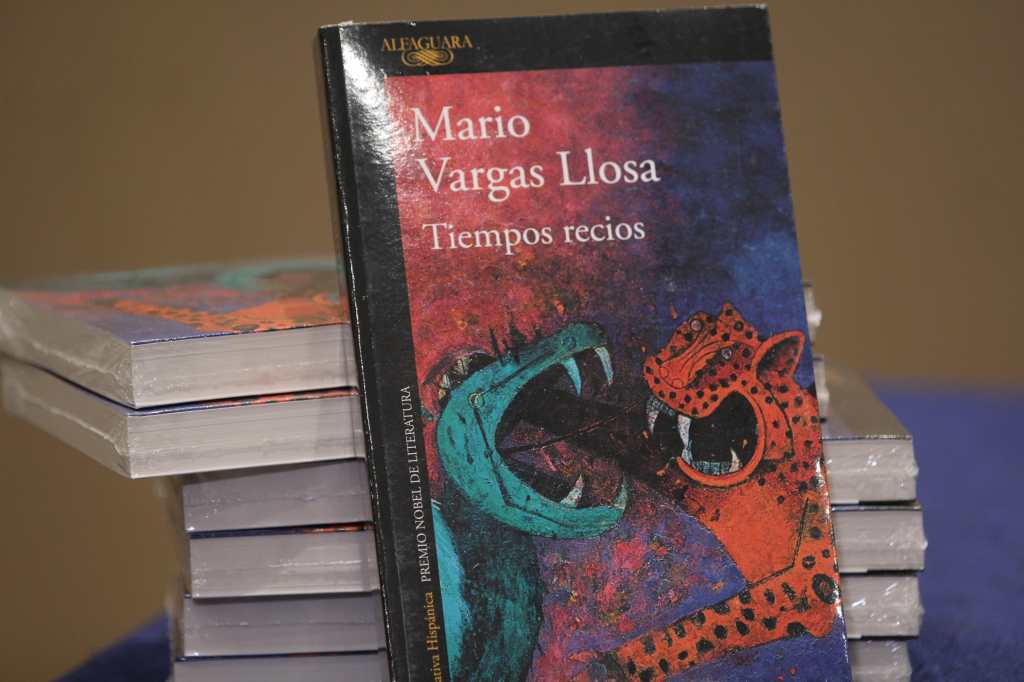
9. RECIOUS TIMES (2019)
This is a story of international conspiracies and interests found, in the years of the Cold War, whose echoes resonate until today.
The story focuses on Guatemala in 1954. The military coup perpetrated by Carlos Castillo Armas and sponsored by the United States through the CIA overthrows the government of Jacobo Affenz. Behind this case is a lie that went through truth and that changed the future of Latin America: the accusation by the Eisenhower government that Affenz encouraged the entrance of Soviet communism into the continent.
This novel connects with The goat party and melts reality with two fictions. The author came to Guatemala during the presentation of the book in 2019.
.
10. I dedicate my silence (2023)
The story of Lalo Molfino, a man who dreamed a country united by music and crazy wanting to write a perfect book to tell him. A kind of Quijote in America.
Toño Azpilcueta spends his days between his work in a school, his family and his great passion, Creole music, on which he has been investigating from his youth. One day, a call changes his life.
Awards
Vargas Llosaof Peruvian and also Spanish nationality since 1993, the Nobel Prize for Literature received in 2010.
RAE academic, was also worthy, among others, of the Romulo Gallegos Award (1967), the Prince of Asturias de las Letras Award (1986), the Planeta Award (1993) and the Cervantes Award (1994).
With information from AFP.