“Death does not distress me. Man, life has that wonderful: if we lived forever, it would be greatly boring, mechanical. If we were eternal, it would be frightening. I think life is so wonderful precisely because it has an end”. These were the words of the Peruvian writer and novelist Mario Vargas Llosawhen, in a Interview with BBC News Mundohe was consulted about social utopias.
This April 13, the world of literature, his family and his readers cry their departure.
“With deep pain, we make public that our father, Mario Vargas Llosa, has died today in Lima, surrounded by his family and in peace,” wrote their children Álvaro, Gonzalo and Morgana Vargas Llosa in a statement published in the social network X.
Although the cause of death of the Nobel Prize for literature has not been confirmed, in the statement their children recognize that “His departure will be sad to his relatives, his friends and his readers around the world, but we hope they find comfort, like you, in the fact that he enjoyed a long, multiple and fruitful life, and leaves behind his a work that will survive him”.
With deep pain, we make public that our father, Mario Vargas Llosa, has died today in Lima, surrounded by his family and peace. @Morganavll pic.twitter.com/mkfeanxja
– Álvaro Vargas Llosa (@alvarovargasll) April 14, 2025
Biography of Mario Vargas Llosa
Jorge Mario Pedro Vargas Llosa was born on March 28, 1936 in Arequipa, Peru. It is considered one of the most important exponents of contemporary literature.
He was a writer, politician, journalist, novelist, essayist, polemicist, articulist and academic who will go down in history as an extraordinary narrator and an influential intellectual, born in a middle -class family.
He studied lyrics and law at the National University of San Marcos and began to collaborate professionally in newspapers and magazines, being editor of the composition and magazine notebooks Literatureaccording to The Cervantes Institute portal.
In 1958 he obtained a scholarship to study at the Complutense University of Madrid, where he was a doctorate in Philosophy and Letters. A year later he moved to Paris, where he worked for media such as the France-Presse agency and French radio, places where he met numerous Latin American writers.
It was part of the Cuban magazine HOUSE OF THE AMERICASas a member of his writing Council, and worked as a translator for UNESCO in Greece, together with the writer Julio Cortázar.
In 1975 he began a series of film works and, in March of that year, he was elected number of number at the Royal Peruvian Academy of Language.
Collaborated with El Diario The countryfrom Spain, and with the Cultural Magazine Free lyricsafter in March 1993 he obtained Spanish nationality without giving up the Peruvian.
In 2010, the Swedish academy surprised him at dawn in New York – where he was as a guest professor at Princeton – to inform him that they granted him the most prestigious literary award in the world: the Nobel Prize for Literature, for “his cartography of the structures of power and his scathing images of individual resistance, rebellion and defeat”.
I was 74 years old and, According to the Spanish mediaI had just sent a novel that approached the brutal colonialism linked to the exploitation of rubber: Celta’s dream.
In October 2023 he published his latest novel, I dedicate my silencewith which he closed his stage as a fiction writer, for two months later to say goodbye to his biweekly column in The country.
Mario Vargas Llosa works
In 1959, with only 23 years, Vargas Llosa debuted with a volume of stories entitled The bosses. From that publication it became one of the greatest representatives of the Latin American boom, along with Gabriel García Márquez, Julio Cortázar and Carlos Fuentes.
His work was characterized by narrative wealth, technical experimentation and deep analysis of social and political contexts.
Among his most outstanding works are:
- The city and dogs (1963) – Brief Library Award and Spanish Critics Award
- The Green House (1966) – Romulo Gallegos Award
- Conversation in the cathedral (1969) – Considered one of his most complex works
- Pantaleon and visitors (1973) – A military satire
- THE WAR OF THE END OF THE WORLD (1981) – Based on Canudos rebellion, in Brazil
- The goat party (2000) – On the dictatorship of Rafael Trujillo, in the Dominican Republic
- Celta’s dream (2010) – Inspired by the life of the Irishman Roger Casement
An attempt in political life
In his youth, Vargas Llosa sympathized with ideas from the left, even supporting the Cuban revolution. However, over time, his thinking evolved towards liberalism, and criticized authoritarian regimes both from the left and right.
In 1990 he ran to the Presidency of Peru by the Democratic Front (Fredemo), but was defeated by Alberto Fujimori. After that experience, he focused on his literary career and political essay, from where he defended democracy and free market.
For him, writing and politics were expressions of the same struggle: the defense of individual freedom, even if that implied leaving social justice in the background. That is why he closed his Nobel’s speech with a blunt reflection: “The lies of literature become truths through us, the transformed readers, contaminated with desires and, because of fiction, in permanent question with the mediocre reality,” he says The country.
The legacy of Vargas Llosa and its influence in Guatemala
In addition to the Nobel, Vargas Llosa received numerous awards, such as the Cervantes Award (1994), the Prince of Asturias de las Letras Award (1986) and multiple doctorates Honoris Causa.
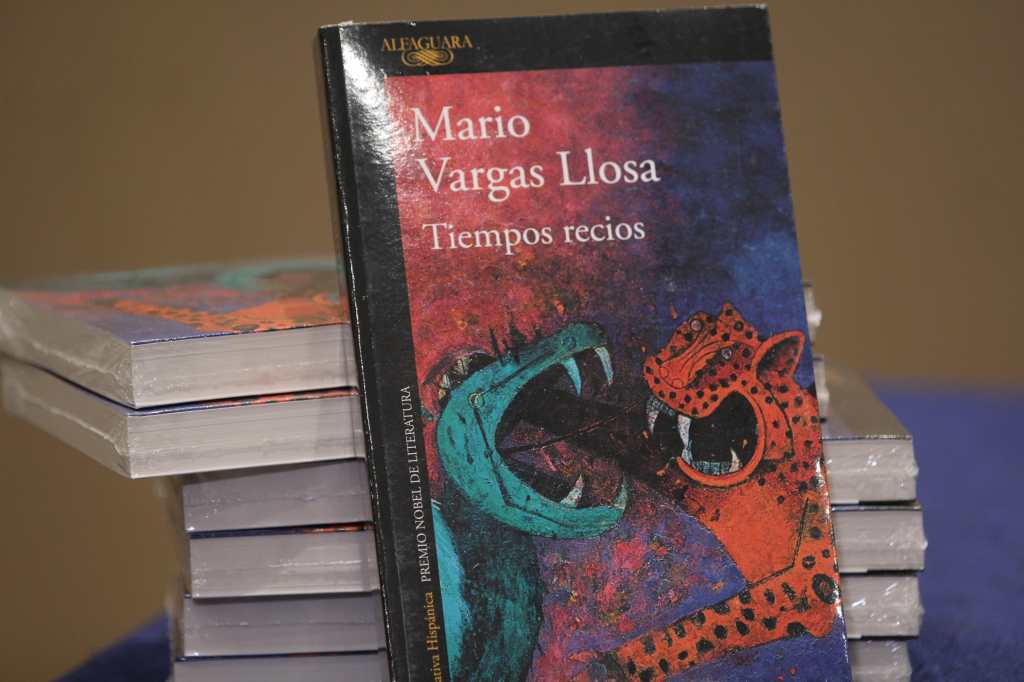
The Peruvian writer cultivated a special link with Guatemala, to which his novel RECIOUS TIMESpublished in 2019. Before writing it, he confessed that he had only visited the country twice, mainly as a tourist in Petén and other regions, and admitted to having a superficial knowledge of the place.
In 2018, his relationship with Guatemala deepened when he visited Zacapa and met with the Zacapaneca Association of Tales and Anecdotes (Azcca) counters, founded in 1987 in Gualán by Julio Morales and Virgilio Cordón. From that experience, he wrote in one of his columns in The country An invitation to discover that area of the country beyond traditional destinations.
“If you go to Guatemala, after visiting the Mayan steles and pyramids and that colonial jewel that is old, I beg you to go to the east of the country and stop in the city of Zacapa”wrote. “This is a less tourist region than others, but, scraping a little, it is also full of surprises and wonders”he added.
However, for the writing of RECIOUS TIMESThe author explained during the presentation of the book that made three trips to Guatemala with the purpose of following the steps of Carlos Castillo Armas and tour the towns where, according to the stories, clashes occurred.