
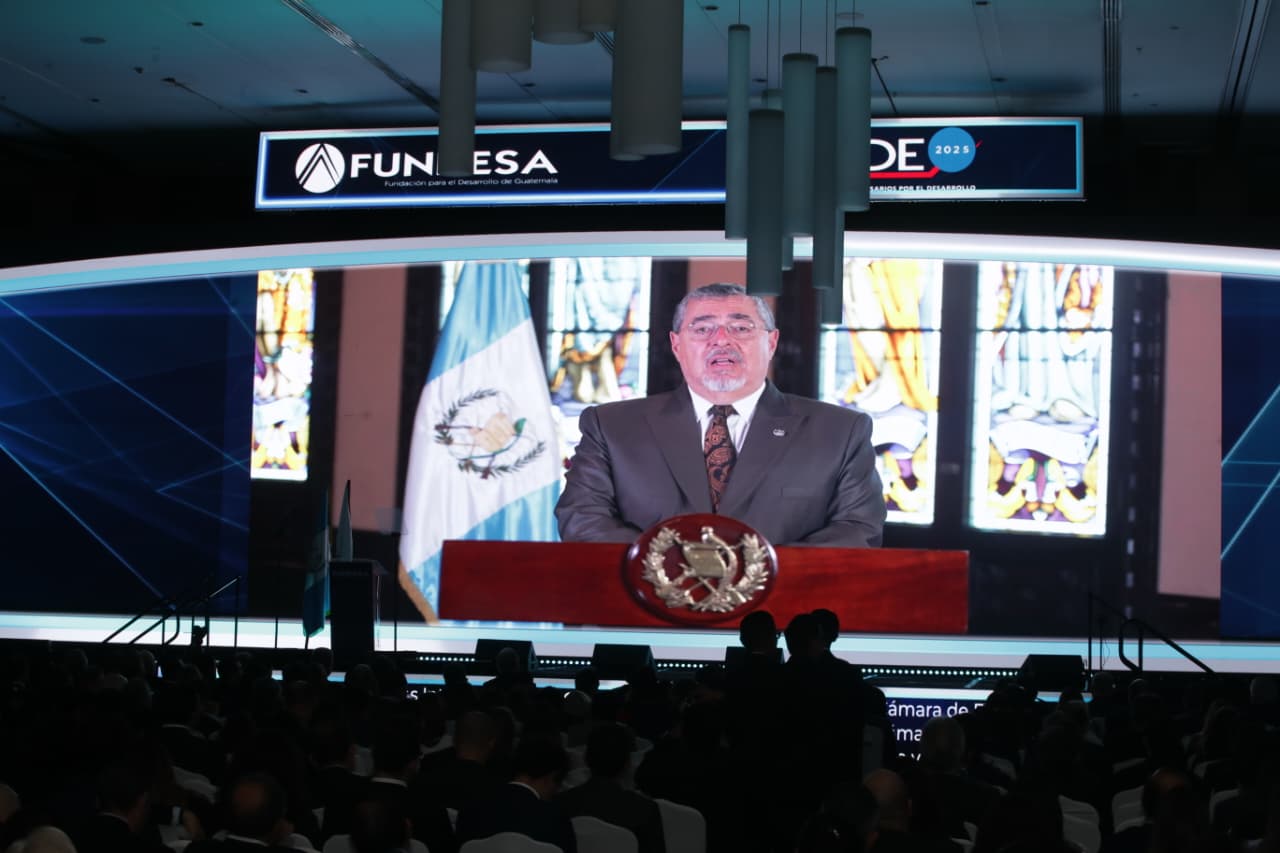
In his speech transmitted by video, the president stressed that Enade is an annual opportunity to exchange opinions on the future of the country, as well as to listen, reflect and understand Guatemala from different perspectives.
He highlighted that this space allows us to identify opportunities and assume responsibilities as leaders of the country, both from the public and private sectors.
“We are responsible for what we do today and for what we stop doing, since these decisions shape our collective future. We all want Guatemala to reach its maximum potential, and we agree that this necessarily involves multiplying opportunities so that all people have the real possibility of growing and prospering,” he expressed.
From the perspective of the Executive, Arévalo de León affirmed that the Government has worked since the beginning of its administration to rescue the State, which implies “removing it from the hole of corruption and directing it towards its constitutional function of protecting the person, the family and property, for the realization of the common good.”
He added that strengthening the role of the State in the planning, promotion and construction of development has been a priority. For this, social and productive investment has increased substantiallyand financing options have been created that stimulate everything from entrepreneurship to home acquisition.
Likewise, he noted that the “most ambitious university scholarship program in history” has been launched.
“We have put order in the Ministry of Education and we are recovering key ministries such as Communications, which we found captured by mafia interests, and which we are now redirecting towards their real function. We have invested in the construction of hospitals, health posts, maternal and child care centers and in the rehabilitation of thousands of schools throughout the national territory,” he pointed out.
He acknowledged that some people distrust this approach, but insisted that the measures adopted to strengthen the functioning of public institutions also have a multiplier effect on private sector activities.
“We have been responsible by preserving and even improving the conditions that make Guatemala an attractive destination for investment,” he insisted.
International confidence in the Guatemalan economy stands out
President Bernardo Arévalo de León highlighted several economic indicators during his participation in Enade. He recalled that real gross domestic product (GDP) grew 3.7% in 2024, and stressed that public debt remains at 27% of GDP, the lowest on the continent, as he stated. He added that the net public debt is 16%.
He explained that, in the first quarter of this year, Foreign direct investment flows reached US$476 millionwhile domestic investment grew 12.8%.
Tourism has also shown an upturn, with annual growth of 16%.
Regarding international perception, he indicated that the main risk rating agencies have improved the country’s credit position. “Standard & Poor’s gave us the highest rating in our history, BB+, last May. Moody’s and Fitch have also assigned us positive outlooks in the category closest to investment grade,” he said.
“We have been responsible in preserving and even improving the conditions that make Guatemala an attractive destination for investment”
He added that these results are due, in part, to an economy that has taken decades to build, but also to the efforts of his administration in both domestic and foreign policy.
“Domestically, the creation of a new competition framework has been very important, but our efforts to eradicate corruption are also a sign that gives confidence to those who observe us from the outside,” he said.
Likewise, he noted that the Government maintains a productive relationship with its main trading partner, “the largest economy in the world and an engine of innovation and prosperity.”
Government modernizes ports and digitizes procedures to attract investment
President Bernardo Arévalo de León affirmed that it is vital to advance the process of modernizing the country’s ports and railways, for which there is support from the United States Army Corps of Engineers.
He reported that a key phase in trade negotiations with that country has been completed, making Guatemala the ninth to reach this milestone. The president expressed his expectation that national companies will continue to access the US market under favorable conditions, which would allow them to have a comparative advantage over other competitors.
He added that the Government is also working to improve the relationship between the public apparatus and users. Through the National Competitiveness Program, the Intervention Strategy for Digital Transformation, with which 70% of the processes have been digitalized in 14 agencies, including at least seven ministries related to the authorization of licenses and the supervision of economic activity.
So far, 444 of the 571 identified procedures have been simplified, and it is expected that by June 2026 the figure will exceed 860.
This transformation, he said, not only facilitates economic activity, but also contributes to combating corruption. “By simplifying procedures, we are closing opportunities for bribery and extortion; however, we need to do more,” he said.
In that sense, he announced the presentation to Congress of the Whistleblower Protection Law, which seeks to protect those who report acts of corruption within the state apparatus and promote a culture of transparency and accountability.
He also presented an initiative for an Anti-Money Laundering Law, with which Guatemala would align with international standards and strengthen its image as a safe destination for foreign investment.
“The promotion of these initiatives must be part of a national effort that brings together the will of the economic and political sectors to favor the investment climate in Guatemala,” the president said.
He added that this approach is directly related to the biggest challenge currently facing the country.
President urges to guarantee transparent elections in key bodies
President Bernardo Arévalo de León warned that the progress made in security in recent years is at risk, due to the collapse of the national consensus that allowed significant reductions in levels of violence since 2010.
“It is vital to advance the process of modernizing the country’s ports and railways, for which we have the support of the United States Army Corps of Engineers”
Bernardo Arévalo, president
He noted that that year marked the beginning of a gradual decline, although imperceptible to some, in the rates of violence and insecurity. In 2024, the homicide rate was barely half of that recorded in 2010.
These advances, he explained, were the result of strengthened coordination between the Executive and the justice system, key legal reforms in the fight against organized crime and close collaboration with international partners concerned about their own security.
However, since 2017, he said, that consensus collapsed, allowing mafia structures to take control of parts of the justice apparatus and divert it towards corruption and impunity.
“Next year will be crucial to get back on track, rescue the advances and make them more effective, more timely, sustainable and long-lasting,” he stated.
The president stressed that it is necessary for all sectors committed to a Guatemala of well-being and inclusion to guarantee transparent and legitimate processes in the election of the new attorney general, the magistrates of the Constitutional Court, the comptroller general of Accounts and the magistrates of the Supreme Electoral Tribunal.
“We are facing the definitive battle between the decent people of Guatemala, on the one hand, and corruption and impunity, on the other,” he said.
He concluded that this is a responsibility shared by the country’s public and private leadership, and that whether Guatemala advances toward a future of security, prosperity, and opportunity, or retreats to a past of violence, corruption, and impunity will depend on their actions—or inaction.