
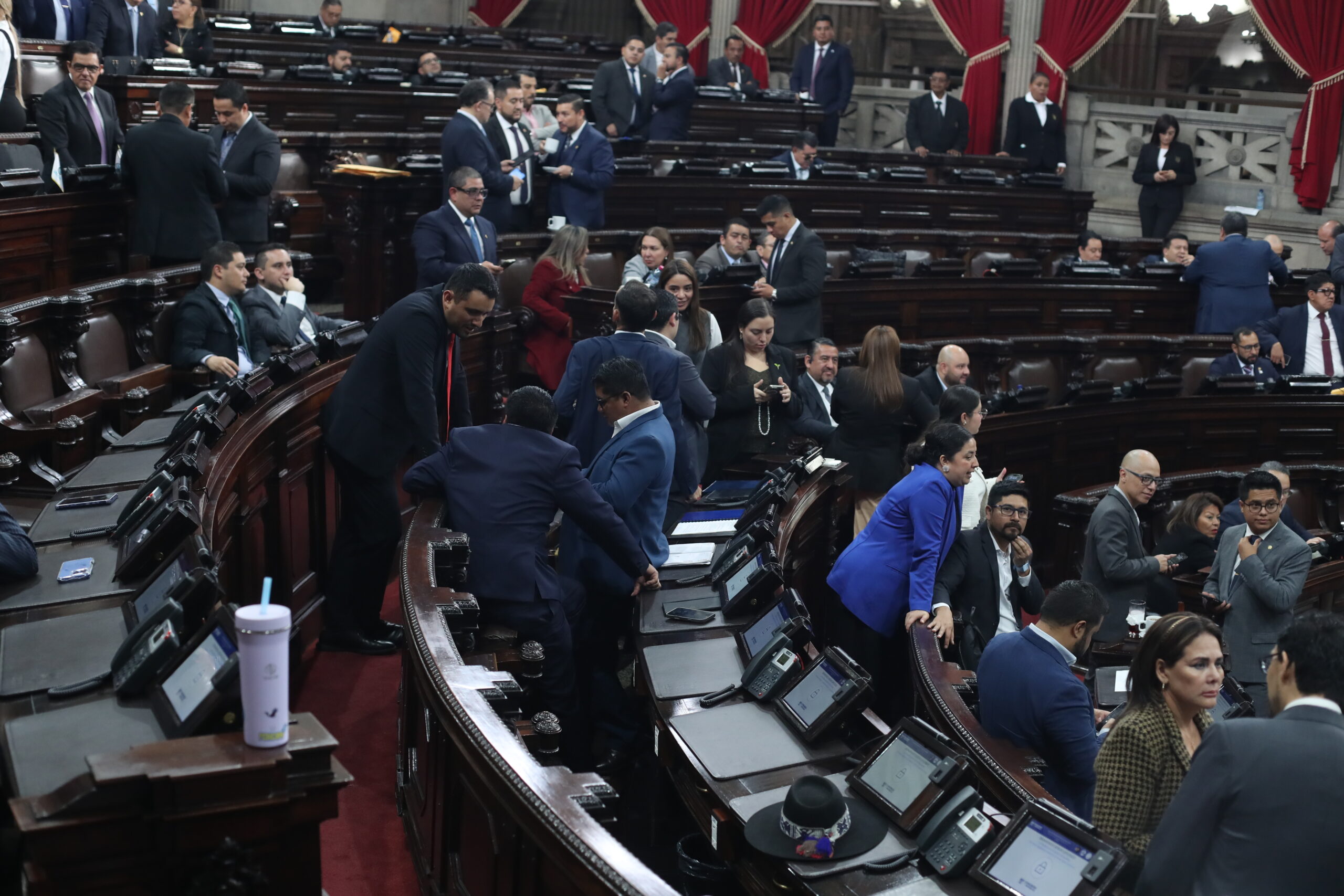
On Monday, April 6, Congress will resume its activities after the Easter break, and it is planned that, in the first meeting of the block heads, which will be held that same day, different issues will be discussed that, according to several deputies, require urgent attention, such as the issue of fuel subsidies.
On Tuesday, March 25, the last ordinary session was held in the chamber, prior to the break for Semana Mayor.in which the deputies were expected to know and approve as a matter of national urgency the bill sent by the Executive Branch to subsidize the price of fuel, given the increase registered in recent weeks.
On that occasion, The agreements that the benches were said to have had to approve the Executive’s proposal were broken during the course of the session, which caused the quorum to be broken after approving the anti-money laundering bill in its first reading.
According to several deputies, the agreements were broken because the official bloc was seeking, along with the approval of the subsidy, the approval of a budget expansion for Q1,500 million.
Subsidy as the first point
The president of Congress, Luis Contreras, stated that, for the session of the block chiefs’ instance, which will be held on Monday, Several issues are planned to be addressed, mainly the fuel subsidy that was pending approval prior to Holy Week, as well as other issues that constitute a country agenda, he stated.
“We want to approve the fuel subsidy, we want to approve the washing law in the second debate and we want to approve the ports law in the third debate and final drafting, that is the country’s agenda. We are going to discuss the agenda with the block heads and if they approve it we will have a session,” he assured.
Contreras commented that an invitation has also been issued to the transporters to meet with the block leadersin order to know your concerns regarding the issue of fuels, mainly diesel, and find an immediate solution to the problem.
“I am inviting the transporters with whom I have already had a dialogue to come and tell us, and we are in constant negotiation, to be able to approve the diesel subsidy that is so needed at this time,” he stated.
Permanent dialogue
In relation to the statements made by pro-government deputies during the last ordinary session, Regarding the lack of dialogue and agreements with the Board of Directors to seek a solution to the fuel problem, Contreras assured that “permanent” dialogue is maintained with the different legislative blocks, with the aim of achieving the necessary consensus to approve not only this issue, but others that are also priorities for the country.
“Guatemala is not built with monologues, nor with absurd impositions, it is built through dialogue, permanent dialogue. We already gave you examples of that, the TSE – election of magistrates – was a dialogue of 40, 50 hours and we achieved a good result. The CC – election of magistrates – was a dialogue, a session of 14, 15 hours, but we achieved results. I thank the block heads and the plenary session in general because yes We agree, we build a country,” said Contreras.
This year the tenth legislature of Congress is under the presidency of Congressman Luis Contreras, of the Commitment Renewal and Order (Creo) bloc, after the ruling alliance once again won the election of the political body.
But, although Congress has complied with the election of magistrates of the Supreme Electoral Tribunal and with the processes that correspond to it for the renewal of the Constitutional Court (CC), analysts see few results for the population in general.
This year, legislative activity is also in danger due to the pre-election year scenarios, which could mean a decrease in the number of decrees and the quality of legislation, according to analysts.
Lower costs
For Pablo Alejandro Solórzano, an analyst at the Legislative Observatory, the actions of the deputies focused on political issues, perhaps prioritizing party needs more than the collective and social good.
“The decisions they have had to make are based precisely on interests that have to do with their future political decisions, their future participation, and in a pre-electoral year we are seeing how the Congress of the Republic is organizing itself politically, which has made it unproductive,” he said.
But after the Easter break, Solórzano believes that deputies should not continue leaving aside the proposals that seek to mitigate the increase in fuel prices.
“I think it would be important to address the economic issue in relation to the current situation. Obviously the country’s issues that have been on the table and that have not advanced despite the consensus,” he said.
Lack of government action
At the discretion of Deputy Orlando Blanco, fourth secretary of the Board of Directors of Congressthis situation that has led to the increase in fuel prices in the country is due to the lack of concrete actions and sanctions by government authorities, mainly the Ministry of Energy and Mines, which, according to the statement, have allowed speculation by fuel distributors.
“This situation is regrettable, but all this has a point of origin and it is the weakness, the collusion of the authorities of the Ministry of Energy and Mines for not sanctioning all these people who have been in charge of speculating. We have now had a policy of speculation for more than a month,” he stated.
Blanco also indicated that, together with the members of his bench, They will be summoning the authorities of the Ministry of Energy and Mines to find out what the concrete actions are. that they hope to implement to solve the problem that is mainly affecting the pockets of Guatemalans.
“The president – Arévalo – should dismiss the Minister of Energy and Mines, who has colluded with the fuel businessmen. What we are going to ask is that he be summoned to the Congress of the Republic and that he publicly give explanations. Enough of so much anarchy for not wanting to put the gas stations and all these people who are speculating in order,” he assured.
For his part, deputy Juan Carlos Rivera, first secretary of the Board of Directors, He stated that, in addition to the Executive’s proposal, there are several legislative initiatives that seek a solution to the increase in fuel costs, so they must also be analyzed to find a solution to this problem.
“There are several bills, I think some of them will have to be discussed with amendments. A solution must be found for the issue of fuel, because the war continues – in the Middle East – and the rise in prices also and the issue of the basic basket is complicated for Guatemalans,” the congressman pointed out.
Political issues
For Francisco Quezada, from the National Economic Research Center (Cien), although Congress has issued some laws so far this year, the decrees have not been of good quality.
“I am referring to what they did with the Municipal Code and the repeal of the Law of Inheritances, Legacies and Donations, which, far from being an advantage and that there were probably good ideas, unfortunately did not materialize in a precise wording, so it is a contradiction,” Quezada said.
When speaking about the second-degree election processes, despite the fact that the deputies have complied with the calls of the postulants, elections and swearing-in that are their responsibility, Quezada sees the actions of some deputies as regrettable when magistrates were elected for the CC.
“Unfortunately they trampled on the dignity of a very high office such as a CC magistracy and that really left a very negative note on the part of Congress and those who lent themselves to this type of issues,” he said.