
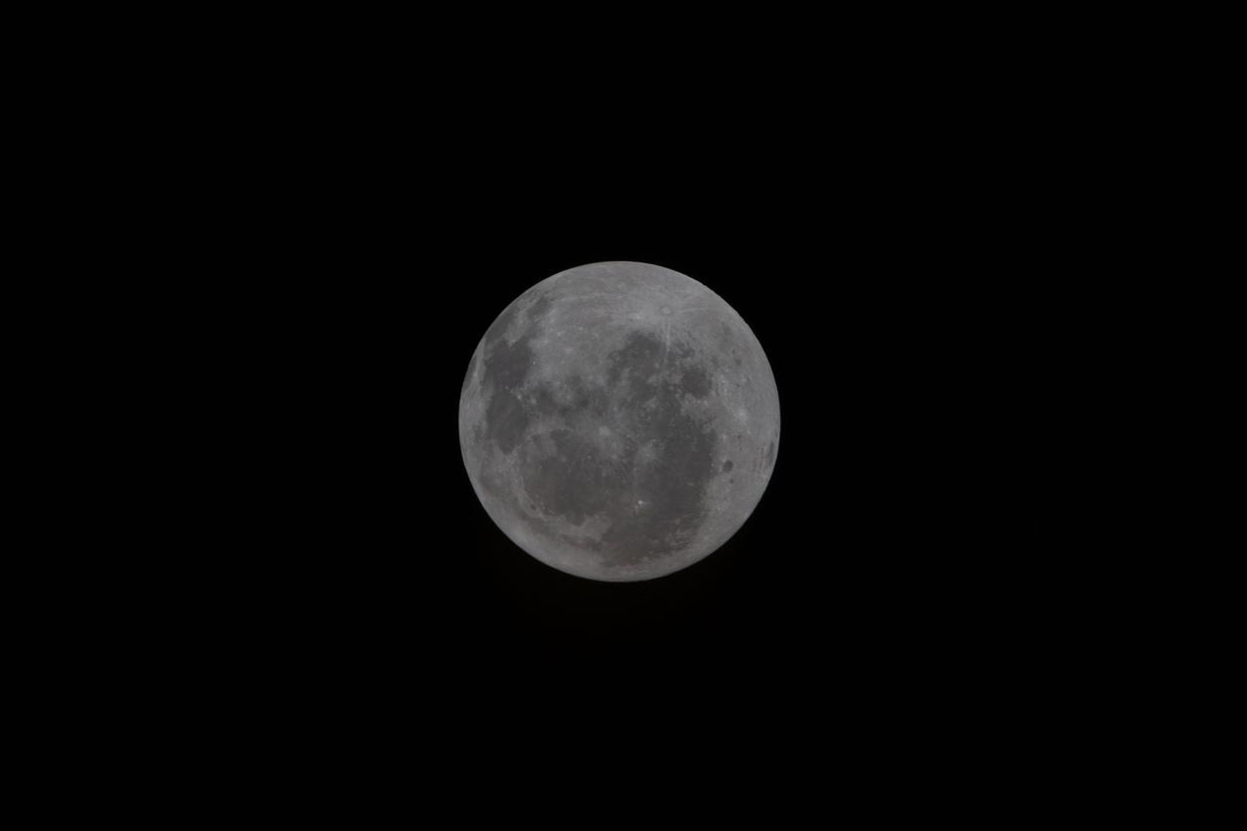
In the image, taken this Saturday, the Moon is seen upside down, with its south pole pointing up, and a complete view of the Eastern basin, which has never before been seen in its entirety by human eyes, as described by the space agency.
The Eastern basin will be an object of continuous study for the crew—made up of Commander Reid Wiseman and astronauts Victor Glover, Christina Koch and Jeremy Hansen—who hope to reach a strategic observation point on the far side of the Moon this Monday, after traveling the greatest distance ever recorded from Earth: 406,773 kilometers.
On Sunday, April 5, the fifth day of the Artemis II mission, from inside the Orion spacecraft the four astronauts shared a view of Earth captured from inside the Orion spacecraft. In a few hours the crew will reach its closest point to the Moon.
One last look at Earth before we reach the Moon.
This view of the Earth was captured on April 5, the fifth day of the Artemis II mission, from inside the Orion spacecraft. The four astronauts will reach their closest approach to the Moon tomorrow, April 6. pic.twitter.com/P9eTDbh1hl
— NASA (@NASA) April 5, 2026
This Sunday the astronauts have also reviewed a detailed list of the features of the Moon’s surface that they will photograph and analyze during their six-hour flyby, the afternoon of April 6, when the windows of Orion’s main cabin will point towards the Moon.
When the crew, who will not land on the moon, pass by the far side of the Moon tomorrow, they will lose radio communication with mission control for about 40 minutes, which is fully controlled, according to NASA.
Another image they shared was seeing the Orientale basin on the right edge of the lunar disk. This mission marks the first time the entire basin has been observed with the naked eye.
History in the making
In this new image from our @NASAArtemis II crew, you can see Orientale basin on the right edge of the lunar disk. This mission marks the first time the entire basin has been seen with human eyes. pic.twitter.com/iqjod6gqgz
— NASA (@NASA) April 5, 2026
After a ten-day adventure, the four astronauts plan to reach the coast of San Diego next Friday, where the Orion capsule will dive into the sea.
NASA explains that Artemis II builds on the success of the unmanned Artemis I mission in 2022 and seeks to demonstrate a wide range of capabilities necessary for deep space missions. The Artemis II test flight will be NASA’s first crewed mission aboard the SLS (Space Launch System) rocket and the Orion spacecraft says NASA.
NASA’s Orion spacecraft is taking humanity to the Moon. Launched aboard NASA’s SLS (Space Launch System) rocket, Orion transports and supplies the crew on the Artemis missions to the Moon and will bring them back to Earth.
On NASA’s Artemis II test flight, the first crewed mission of the agency’s Artemis campaign, astronauts took the controls of the Orion spacecraft and manually steered it periodically during the flight around the Moon and back. This mission offers the first opportunity to ensure the spacecraft operates as intended with a human crew on board, ahead of future Artemis missions to the lunar surface.

The Orion spacecraft is built by NASA and prime contractor Lockheed Martin. It is currently the only spacecraft capable of performing manned flights into deep space and returning to Earth at high speed from the vicinity of the Moon.
The Orion capsule is specifically designed to carry astronauts on deep space missions farther than ever before. It provides protection from solar radiation and high-speed entry into the Earth’s atmosphere, as well as advanced and reliable technologies for communication and life support. The Orion missions will span multiple phases, as part of NASA’s plan to build a flexible, reusable, long-duration infrastructure that will last for several decades and support missions of increasing complexity.
The Moon is the testing ground for sending astronauts to Mars. It provides the opportunity to test new tools, instruments and equipment to expand humanity in our solar system. Mars remains the long-term goal. NASA hopes to leverage the unique exploration capabilities of SLS and the Orion spacecraft, as well as emerging commercial capabilities, to build and support the Gateway space station.