
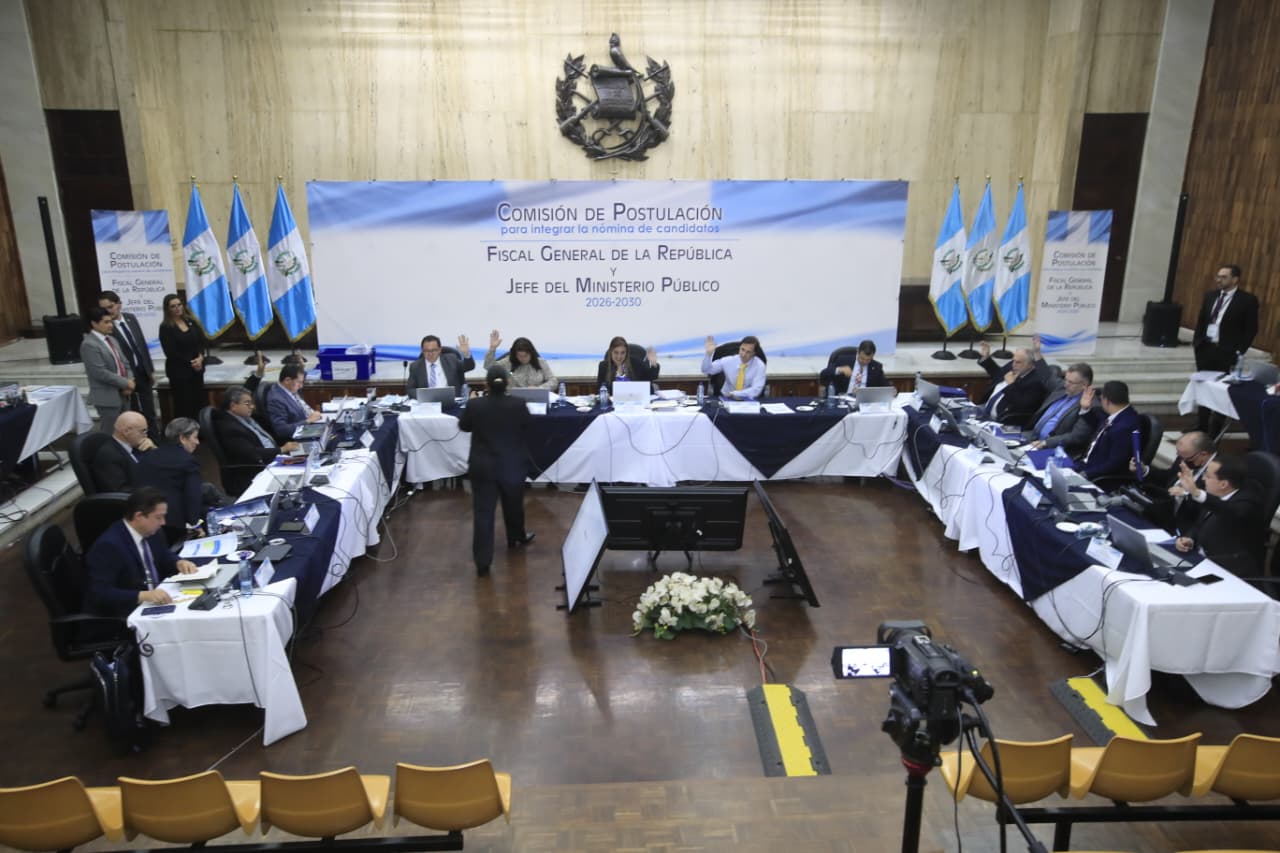
The Eighth Pluripersonal Court of First Instance Civil of Guatemala, constituted as a protection court, admitted this Wednesday, April 15, for processing a constitutional action that seeks to exclude career judges from the renewal process of the Public Ministry (MP), judicial sources reported.
The action was brought by the Association Center for the Defense of the Constitution – Cedecon – against the Nomination Commission in charge of the election of the attorney general and head of the MP.
As part of the process, the judge in charge granted the denounced authority a peremptory period of 48 hours to send a detailed report, along with a copy of the case history. Based on this information, the court must analyze whether or not to grant the requested provisional protection.
In accordance with the resolution, the court also ordered that, subsequently, a hearing be given to the requesting party, the Public Ministry and interested third parties, if any, as part of the corresponding legal procedure.
The judicial document establishes that the decision on provisional protection will be made until the complete background and the required report to the nomination commission are available.
In addition, it was learned that in the nomination commission there is a group in charge of meeting the requirements related to amparo actions. However, in this case it was established that the report prepared be previously sent to all members before sending it to the judge.
In this context, the Special Mission of the Organization of American States (OAS) for the Strengthening of Democratic Institutions in Guatemala recalled that inter-American standards and the Constitution recognize citizens’ right to elect and be elected, as well as the right to run for public office, within the requirements established for each position.
“In processes of this relevance, the analysis of requirements must be carried out with clear, objective and predictable criteria, safeguarding legal certainty, equal access to public service and institutional stability.”
It adds: “Without prejudice to the powers that correspond to the Constitutional Court and the other national authorities, the Mission observes that article 251 of the Constitution establishes that the attorney general must be a registered lawyer and meet the same qualifications as the judges of the Supreme Court of Justice. In turn, article 216 provides, among the requirements for the latter, to have served a full term as a judge of the Court of Appeals or to have practiced the profession of lawyer for more than ten years. Likewise, the Constitution itself requires, as a general rule, that magistrates and judges be registered lawyers. From that perspective, the jurisdictional function, exercised by legal professionals within the framework of constitutional and legal powers, constitutes a specialized, continuous and public manifestation of legal practice.
#Urgent
Court admits amparo proceedings that seek to exclude career judges from the MP renewal process. The judge in charge of the case requests a report from the applicant within a period of no more than 48 hours to analyze whether the provisional request by CEDECON is appropriate or not. pic.twitter.com/BlIA4Rc1ev—Douglas Cuevas (@dcuevas_pl) April 16, 2026
*Stay up to date with the Now newsletter. Key information at the moment it happens. Subscribe here.