
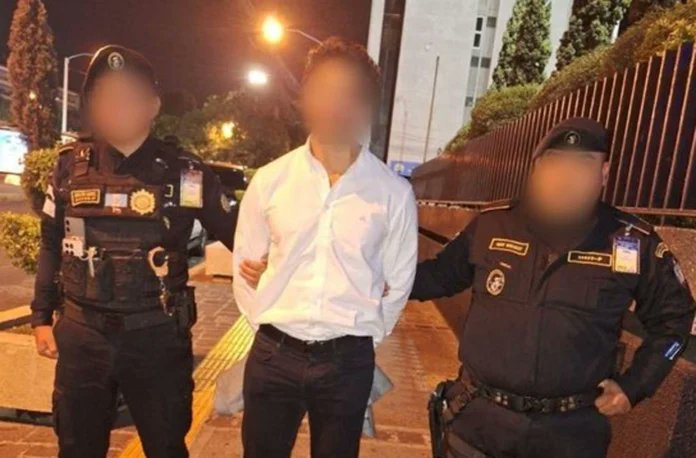
Security forces captured Pedro Andrés García Manzo Méndez46 years old, on Thursday, April 16 at the La Aurora International Airport in Guatemala, when required by the justice of Honduras for his alleged involvement in a tax fraud network.
The arrest was carried out by Dipafront agents in compliance with an arrest warrant for extradition purposes issued on February 26 of this year.
After his arrest, he was placed at the disposal of the competent court to continue the process that will define his eventual surrender to the Honduran authorities.
According to the Ministry of the Interior, with this case Guatemala adds 23 arrests for extradition purposes in 2026, of which 14 are linked to drug trafficking and nine to other crimes.
Former link with Bukele
According to an investigation by El Faro, from 2021, Pedro Andrés García Manzo Méndez He was part of a business environment with operations in Guatemala and El Salvador, linked to advertising businesses, image management and commercial projects.
The report documents that he maintained business relations in the private sphere with Nayib Bukelewith whom he created two companies between 2005 and 2006, and also with Ernesto Castrowithin that same business circle.
At that time, Bukele was still carrying out activities outside the full exercise of presidential power or in the initial stages of his political career.
According to the investigation, these connections are not presented as formal political links, but as part of a network of businesses and operators that later had an impact on regional projects and contacts, including the attempt to promote a political party in Guatemalan territory.
The link extends to the political sphere through the detainee’s nephew, José Luis Araneda Cintronwho in 2021 started against the Supreme Electoral Court the process to found in Guatemala the New Ideas party.
According to the report, Araneda not only promoted an organization with a name, colors and symbol identical to the Salvadoran party, but also appears in records and photographs in activities with Bukele in El Salvador.
The investigation indicates that this attempt replicated the Salvadoran political model, both in its visual identity – cyan color and emblem with the “N” – and in its narrative of renewal and rejection of traditional parties, in addition to being promoted by a close group of lawyers and collaborators. However, the official Salvadoran party denied any formal relationship with that initiative in Guatemala.