
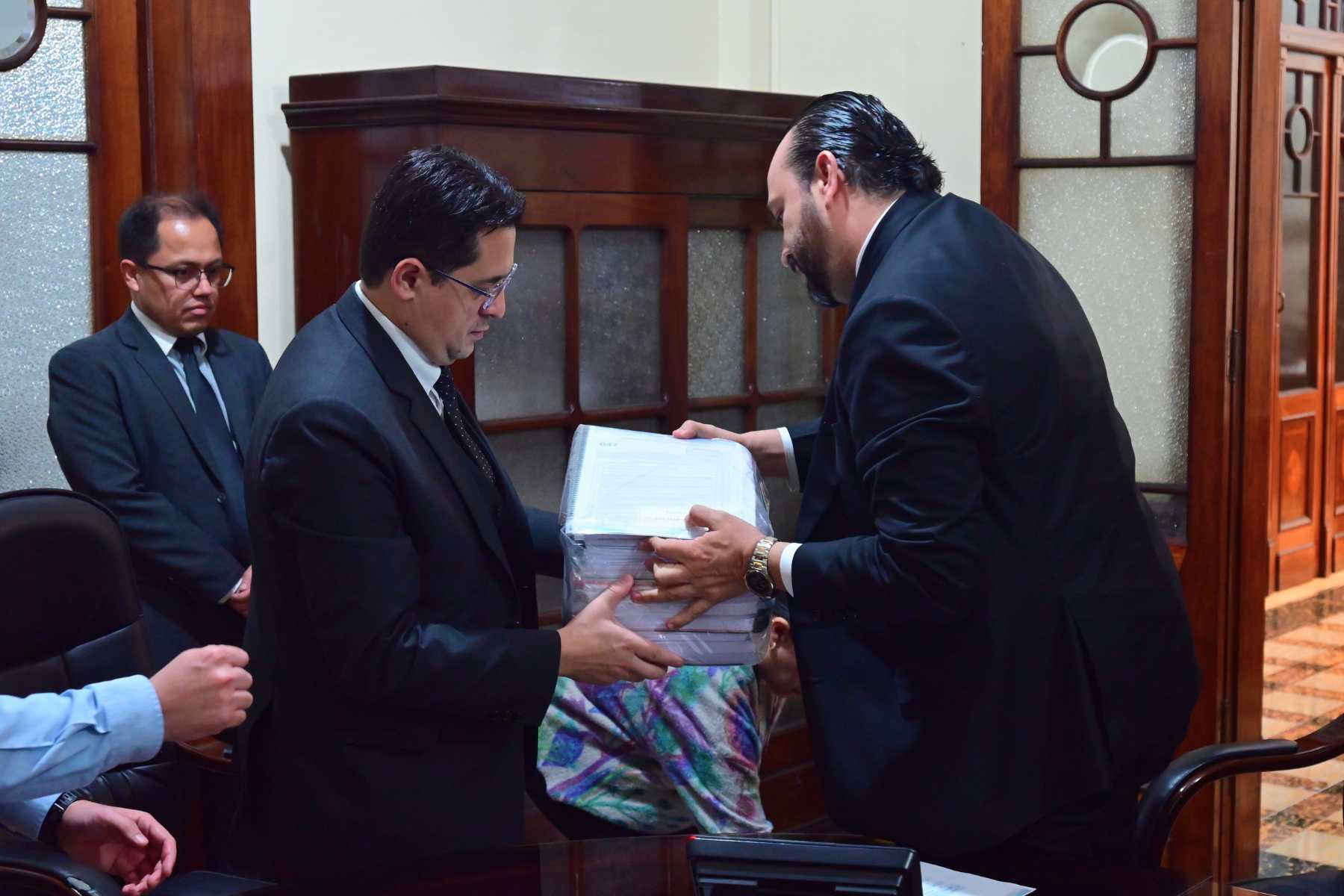
Finally, The nomination commission for attorney general and head of the Public Ministry included the list of six candidates,which It has already been sent to President Bernardo Arévalo to designate the new head of the investigative entity for the period 2026-2030.
The final list, which was already received by the General Secretariat of the Presidency, was made up of professionals Beyla Adaly Estrada Barrientos, César Augusto Ávila Aparicio, Julio César Rivera Clavería, Gabriel Estuardo García Luna, Zoila Tatiana Morales Valdizón and Néctor Guilebaldo de León Ramírez.
From this list, The president must choose the successor of María Consuelo Porras, who, despite having obtained the highest qualification, was not included in the final list prepared by the commission.
Candidate profile
According to the experts and analysts consulted, within the payroll delivered to the president There are some defined profiles that may represent a change, but they also identify other candidates who could be the continuity of the model that currently governs the Public Ministry.
According to Christa Walters, president of the National Civic Movement (MCN), Within the list there is a balance, since, although profiles that the president “would have wanted” to facilitate his decision were not included, others that the president “would not have wanted” were not included within the list, as is the case of the current attorney general, Consuelo Porras. According to Walters, the list was made up of diverse profiles that must be carefully evaluated by the president.
“There are some who perhaps have a slightly higher profile, because they have been in a political party, or perhaps others who in their work or in their career have handled some cases that have had more media attention; but I think that this is balanced with the other half of candidates, who perhaps have a lower profile but who are quite technical,” he says.
The political scientist Renzo Rosal matches Walters, and identifies two two candidates who may have the necessary skills and requirements to perform the position independentlywhile the other four profiles could respond to that line of “continuity” that the president of MCN mentioned.
“Although the attorney general is ineligible, since she was left out. There are at least four profiles that respond to the same model, to the same logic, which is committed to continuity and we would say that there are two candidates who are committed, on the contrary, to a kind of recovery of the Public Ministry,” says Rosal.
In this sense, Carmen Aída Ibarra, director of the ProJusticia Movement, consider that Within the payroll there are two defined groups, one distant and the other not so much to the President of the Republic.
“They put candidates who respond to other political lines, such as Beyla Estrada, César Ávila Aparicio and Julio César Rivera Clavería. The president seems to have no affinity with that type of line they represent, but I don’t know how comfortable the president feels with the other three that remain,” questions Ibarra.
The director of ProJusticia, however, sees it as unlikely that the next prosecutor will be among the group of Rivera, Ávila or Estrada, “because they are distant from the line that the president maintains,” says Ibarra.
Challenges
Analysts consider that, in addition to having the requirements established by law, The new attorney general must have character, courage and independence in the performance of the position and not respond to the interest of particular groups or sectors.
“An attorney general does not obey political parties, he does not have to obey criminal networks, private interests, the only thing he has to be tied to is obeying the Constitution and the law,” says Walters.
Rosal also highlights that “what has been done over the last few years—in the MP—has given us the opposite, an authoritarian, anti-democratic profile, which has produced causes of that nature, and that has made us gradually lose the orientation and nature of the Public Ministry.”
Experts say that The new attorney general faces a series of challenges, such as the recovery of credibility, trust and institutions, affected by continuous “wear and tear” in recent years.
“There is strong criticism of selective justice. It must also reactivate or strengthen prosecutor’s offices that can investigate major cases of corruption. The Public Ministry has received hundreds of complaints and the challenge is to reduce this file of cases and prioritize those that really impact security, such as extortion, homicides and violence against women,” indicates Christa Walters.
“Challenges, I would say minimally recovering the conditions of a professional, independent, specialized MP, who is really the entity responsible for criminal prosecution. That implies independence as much as possible, recovery of technical and professional capabilities and ceasing to be an institution that defends political causes or biased agendas,” says Rosal.
Bad weighting
Regarding the way in which the candidates were qualified within the process, Carmen Aída Ibarra considers that The procedure for carrying out the weighing of the files of each of the applicants was not the most appropriate.
“In this case, even the technique was used as an instrument to eliminate a candidate (…) We are facing yet another situation of the election of the attorney general that repeats vices of the past and brings new vices. So, unfortunately, the criteria for applying the grading table offended numerous professionals who were left with an excessively low rating,” he states.
In this sense, Manfredo Marroquín, director of Citizen Action (AC), points out that in the selection process There were interests and agendas to “block” some candidates and favor others.
“I think it was a very questionable process. I think there were obvious agendas and interests to block some, to favor others, and it has been one of the processes where the issue was least debated,” he says.
Marroquín considers that, as a result of this process, the final list of candidates from which the president must choose has a “gray tone.”