
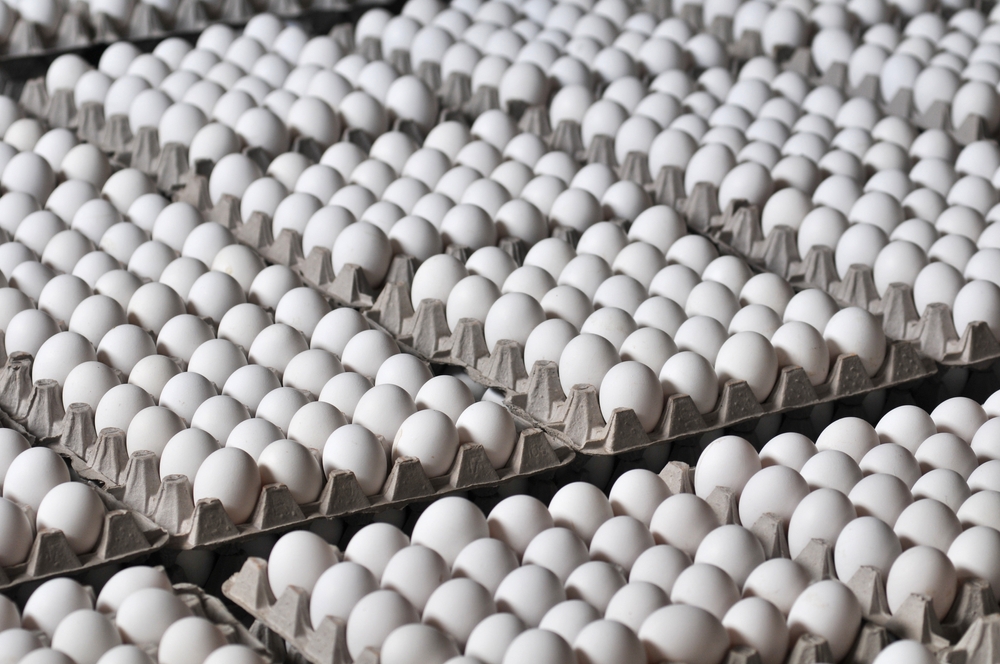
According to data from Ministry of Agriculture, Livestock and Food (MAGA) By 2025, Guatemala has a population poultry posture technique 16.17 million birdsdistributed in 379 registered farms.
Figures of the MAGA indicate that the per capita egg consumption In Guatemala it reaches 292 units per person per year.
To illustrate the importance of poultry sectorthe latest report on the cost of basic food basket of the National Statistics Institute (INE), corresponding to March 2026, shows that the Egg is the second most important product within the five main foods that make it up, only below the tortilla.
The million-dollar losses caused by egg smuggling
The poultry industry has a significant weight in the national economywith a value that is around Q35 billion annuallyincluding the production of chicken and eggaccording to representatives of the Poultry Farmers Guild attached to the Chamber of Industry of Guatemala (Greavi)
According to the union, the losses estimated by the smuggling egg They amount to Q730,080,000 in unrealized production and Q270,129,600 in tax collection, mainly for VAT and ISR. As a whole, the country stops producing and receiving around Q1,000,209,600 due to the entry of smuggled eggs and chicken.
Economic impact of egg smuggling in Guatemala
| Concept | Amount (Q) | Impact |
| Annual contribution of the poultry industry | 35,000,000,000 | Chicken and egg production |
| Loss in national production | 730,080,000 | Product that stops being generated |
| Loss in tax collection (VAT and ISR) | 270,129,600 | Income not received by the State |
| Estimated total impact | 1,000,209,600 | Direct effect of smuggling |
Unfair competition and price distortion
Representatives of the union point out that the entry of illegal products generates unfair competitionbecause the smuggling of egg and the chicken They come from countries with a lower tax burden, which reduces their production costs compared to the local market.
Depending on the sector, this situation distorts the internal marketsince the product enters without paying taxes and is marketed under conditions that directly affect national producers.
RELATED READINGS


Likewise, they explain that this phenomenon responds to illegal practices facilitated by the difference in tax burdens between countries – particularly with Mexico -, in addition to factors such as undervalued sales prices, possible money laundering schemes and the variation of the exchange rate in that country.
Health risks for national production
The sector warns that the egg smuggling not only involves tax evasion, but also health risks for national production.
In the case of eggs, the product may arrive with close expiration dates and in inadequate storage conditions.
In the case of chicken, the risk is greater, since the entry of live birds could introduce diseases not present in Guatemala, especially from Mexico, which could compromise national production in a matter of weeks.
The union adds that some of these diseases are not easily immunizable in the country, which increases the vulnerability of the productive system.
Furthermore, it warns that the eventual entry of exotic diseases could compromise the entire poultry industryaffecting both supply and prices for the consumer.
What measures have been promoted to combat smuggling
From the Guatemala Chamber of Industrythe sector has representation in the Interinstitutional Council for the Prevention and Combat of Tax Fraud and Customs Smuggling (Coincon), from which coordinated actions are promoted between public entities and the private sector.
The representatives of the union explain that, through this space, technical support is provided by identifying sectors vulnerable to smuggling, with the aim of promoting joint interventions that allow us to confront this phenomenon in a structural and sustained manner.