
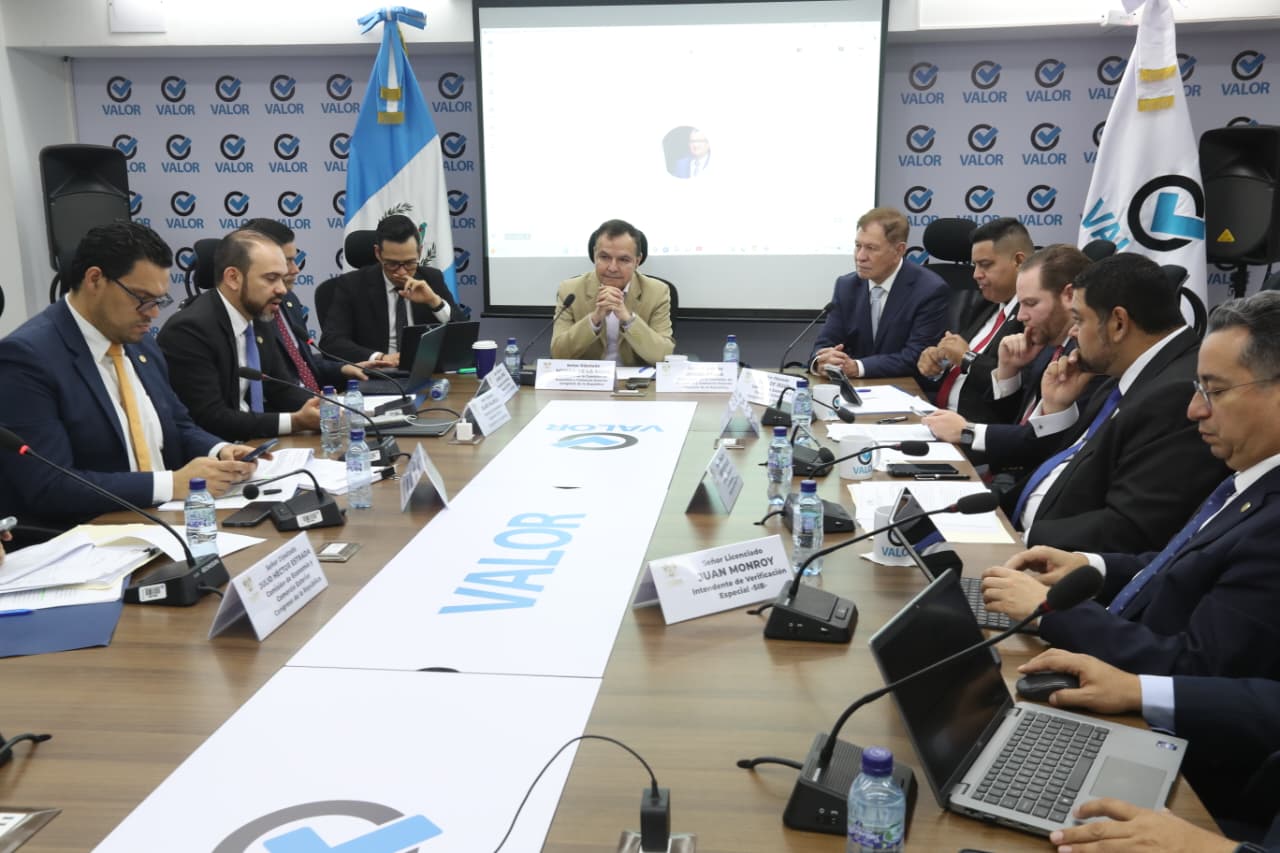
The deputies who make up the Economy and Finance commissions of Congress began the discussion of possible consensus on the amendments of initiative 6593called “Comprehensive Law against Money Laundering or Other Assets and the Financing of Terrorism.”
The list of amendments will be known on Thursday, April 30, and will be distributed to the political blocs to reach a consensus. On April 28, the review of the articles and proposals received will continue, to discuss them together with representatives of the Special Verification Intendancy (IVE), which is the financial intelligence unit (UIF) attached to the Superintendency of Banks (SIB), and the Banking Association of Guatemala (ABG).
The president of Congress, Luis Contreras, attended the meeting in both commissions and confirmed that the project will be heard on Tuesday, May 5 in plenary sessionas part of the agreements in the Legislature.
“We are already very close to issuing the opinion, where all the benches are being taken into account. They are going to meet on Wednesday to finish with two or three more amendments, so that the opinion can be concluded. The dynamic will be that the approved amendments will be sent and distributed so that on Tuesday, May 5, the anti-money laundering law can be scheduled as the first item,” explained Contreras.
The president of Congress added that Guatemala would be complying on time, as the bill was required. “Everything that is going to enter the plenary session is agreed upon,” Contreras stressed.
When asked about some of the doubts that still persist in the initiative, he explained that there are issues such as close collaborators, which is a very broad issue and requires specifying a definition. It also includes politically exposed persons (PEP), and its drafting is very close so that the law is precise and unambiguous, Contreras assured.
The total number of amendments presented was 51 to 39 articles, but only 12 were addressed.
Law against money laundering refined
Deputy Jorge Ayala, one of the speakers of the project, explained that the analysis of the amendments will continue and that on Tuesday 12 proposals from different legislative blocks were analyzed, that are being addressed in aspects related to improving the wording of the law.
It is estimated that the initial amendments will be concluded on Wednesday and that others may arise, which could be proposed and incorporated to comply with the calendar, so that the initiative is known on Tuesday, May 5 in the plenary session for its approval by articles and final drafting.
Ayala explained, in general terms, that one of the amendments known this Tuesday deals with the relationship of giving a judge the responsibility of setting a deadline when the Public Ministry establishes precautionary measures, such as confiscation or restriction of the availability of assets, real estate or accounts. These must, in accordance with the provisions of the law, be ratified by a judge.
To this end, a procedure was established in which the judge must grant a hearing in three days to confirm the measures; Otherwise, the Public Ministry must release those precautionary measures that it proposed.
He exemplified that another of the specific approaches refers to the duration in which obligated persons must retain information on the relationship with their clients. Currently, it is established that, in physical form, it is kept for five years and, digitally, for an additional ten years.
“We are already very close to issuing the opinion, where all the parties are being taken into account. They are going to meet on Wednesday to finish with two or three more amendments, so that the opinion can be concluded.”
Luis Contreras, president of Congress
However, it was considered that not all obligated persons should have the same commitment.
“It is not the same as a person who is dedicated to a commercial activity, for example, a sale of vehicles or a sale of jewelry, who is required to keep all records of commercial operations for 15 years. The entire digital part of ten additional years would be eliminated and only restrict this to the years established by Gafilat’s recommendations in this regard. That was another of the amendments that can be addressed,” Ayala stated.
The case of conversion to custodial sentence was also addressed. This deals with fines when a person has been convicted of the crime of laundering to a custodial sentence, plus a fine; but, if the amount of the fine cannot be paid, it would become a term that does not exceed two additional years to the sentence already served.
Commission sees consensus on anti-money laundering law
At the conclusion of this Tuesday’s meeting, deputy Julio Héctor Estrada Domínguez, president of the Congressional Finance Commission, assured that positive progress is being made to achieve a consensus at the technical table and present it to the plenary session of Congress next week. with the incorporation of the amendments.
The revisions are both in form and substance, which is why the program was extended.
“The (partisan) blocs have been quite constructive in terms of formulating their changes in particular. They have been addressed in politically exposed persons (PEP), suspicious transaction reports, and the law is trying to be more specific in its definitions, which are consistent with the standards of the Financial Action Task Force (FATF),” he added.