
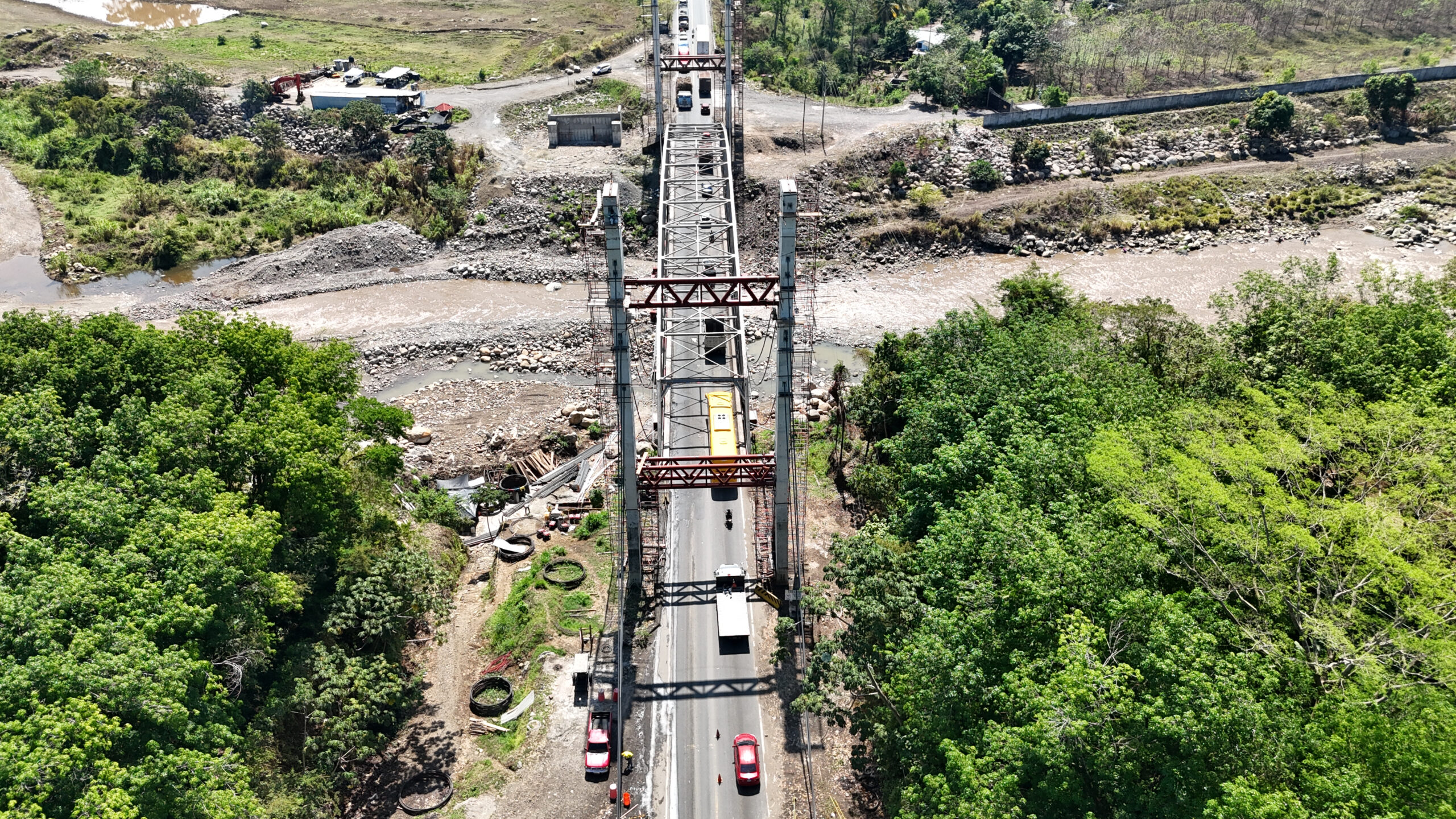
The infrastructure table of Guatemala No Se Detiene identified 33 bridges and 35 structures at risk in the country, facing the beginning of winter 2026. According to the analysis, some have cracks, unevenness, accumulation of sediments and lack of maintenance. The bridges are located on strategic routes such as CA-1, CA-2 and CA-9 North.
The Minister of Communications, Norma Zea, reacted to the publication of this information, stating during a press conference that not all structures present severe damage and that they are currently kept under monitoring, without representing an immediate risk.
“Not all of them are in critical condition and we are aware. We are already attending to them through Covial. It is a huge effort we are making because the need we have in road infrastructure is great,” he commented.
He added that, among the immediate priorities, the ministry seeks to intervene part of these bridges before winter.
According to information provided by the Ministry of Communications, Infrastructure and Housing (CIV) to Prensa Libre, the indicated structures are identified within their service network and the majority are reported as passable, with routine maintenance.
Of the official list of 35 bridges, four require emergency attention: Brisas de Mocá, Las Pericas, Santa Bárbara and Río Dulce. Two others are in the process of intervention, such as the Santiago bridge, where a new structure is being built with a physical progress of 60%, while the passage is maintained through a provisional bailey-type bridge.
In addition, 16 bridges are considered passable and receive maintenance work such as painting, repair of railings and other minor interventions.
Despite this, official data indicate that at least 54% of the listed bridges require some type of attention, whether technical evaluation or direct intervention, while several cases remain in administrative processes that could delay their repair.
According to Juan Carlos Zapata, the first step is to clearly define the concept of walkability. “When a bridge is no longer passable it is because in some way it no longer works, and that is what we want to avoid,” he indicated.
According to Zapata, it is also necessary to establish what international standards the country’s road network is under. “The bridges must be in optimal conditions and that is why maintenance must be constant. The great challenge we have as a country is that maintenance is not done with the magnitude and seriousness that it requires,” he stated.
Identified bridges
These are the bridges that the CIV argued to Free press which have a different status:
CA1-EAST
- Colorado River: According to the CIV, it is passable. However, it presented an emergency situation in 2024, but the problem was solved.
- Tamazulapa: evaluation actions are carried out to determine the work required.
CA2-WEST
- Guacalate (double meaning): does not merit attention at this time.
- Achiguate (double meaning): does not merit attention at this time.
- Siguacan: it is passable, prestressing is carried out to improve the load capacity
- Brisas de Mocá: there are two bridges in this section, one will be supported by project P-001-2023, it is currently in the study phase for the construction of a slab, it will be attended by emergency with article 95 of the Priority Road Infrastructure Law. At the moment vehicular traffic passes through the parallel Mocá.
- Nahualate: it is passable, prestressing is carried out to improve the load capacity.
- Ixtacapa: it is passable, routine maintenance is carried out on the structural elements.
- Samalá (Castillo Armas): it is passable, routine maintenance is carried out on the structural elements.
CA1-WEST
- Rogelia: it is passable, routine maintenance is carried out on paint and railings.
- Shower: it is passable, routine maintenance is carried out on paint and railings.
- El Boquerón-Selegua IV: is passable, routine maintenance is carried out on paint and railings
CA2-EAST
- Bishop Francisco Marroquín: administrative management will be evaluated to reactivate the project.
- Doña Leonor de Xicatencat: it is passable, routine maintenance is carried out on paint and railings.
- Bernal Díaz del Castillo: it is passable, routine maintenance is carried out on paint and railings.
- El Obraje: it is passable, routine maintenance is carried out on paint and railings
CA8
- Valle Nuevo Bridge: evaluation actions are carried out to determine the work to be carried out on this 4-lane bridge.
CA-9 North
- Belize Bridge: it is passable, it does not warrant attention at this time. There was a recent rehabilitation, due to the high traffic flow, a second phase of rehabilitation will be evaluated.
- Guijo: it is passable, routine maintenance is carried out on paint and railings.
- Palmilla: will be served through the expansion of the Teculután 4-lane project.
- Huyus: the bridge is passable, routine maintenance is being done on paint and railings.
- Santiago: work is underway on a new bridge with a physical execution percentage of 60%. A bailey bridge was installed for the temporary crossing.
- El Arenal: is passable, routine maintenance is carried out on paint and railings.
- Mayuelas: it is passable, routine maintenance is carried out on paint and railings.
- El Lobo: phase of the administrative process is evaluated.
- Doña María: phase of the administrative process is evaluated.
- Juan de Paz: it is passable, routine maintenance is carried out on paint and railings.
- Trenches: the approach for intervention will be evaluated.
- Spoons: the approach for intervention will be evaluated.
- Teculután: the bridge is passable, routine maintenance is carried out on paint and railings.
CA-11
- Jupilingo Bridge: it is passable, the approach will be evaluated for intervention.
CA13
- Río Dulce: preventive maintenance is carried out, its rehabilitation is in the contracting process by the General Directorate of Roads.
CA14
- Las Pericas Bridge: will be attended by emergency according to article 95 of the Priority Road Infrastructure Law.
DIPP without road network study
With the approval of the Priority Road Infrastructure Law in 2024, the creation of the Directorate of Priority Road Projects (DIPP) was contemplated, an entity in charge of maintaining the country’s main roads, including strategic bridges.
However, the institution has not yet started operations. The development of financial systems modules is still pending, the deadline for which was 30 days after the law came into force. Nor has the respective regulation been issued, a responsibility of the Executive, which had a period of 10 months from the entry into force of the regulations.
The DIPP adds a new delay: on April 25 of this year the contracting or agreement for the first evaluation of the state of the country’s priority road infrastructure was to be finalized.
Zapata pointed out that the law established that the study on the state of Central American roads, including bridges, should have been completed by April. “This has not even begun to be processed to be able to put it out to tender. It is already considerably delayed,” he stated.
He added that this study would allow for a technical diagnosis to guide an infrastructure investment plan with a long-term vision. “The law establishes that it must be updated every five years,” he explained.
He also considered that the Comptroller General of Accounts (CGC) should become more involved in verifying compliance with the law, given the accumulated delays in its implementation.
Low investment in infrastructure
According to Fundesa, in Guatemala public investment in infrastructure went from 3.22% of the gross domestic product (GDP) in 2008 to 1.49% in 2025. This represents a decrease of 1.73 percentage points in the period analyzed.
In contrast, private investment represented 15.07% of GDP in 2008 and 15.22% in 2025, with a variation of 0.15 percentage points.
Total investment in infrastructure, measured as gross fixed capital formation (GFCF), was 18.29% of GDP in 2008 and is estimated at 16.71% by 2025.
Records show that since 2015 public investment in infrastructure remains below 2% of GDP. Between 2015 and 2025 it ranged between 0.98% and 1.89%.
By 2025, of the total investment in infrastructure estimated at 16.71% of GDP, 15.22 points correspond to the private sector and 1.49 points to the public sector.
According to Zapata, with the studies completed and the DIPP operating, it would be possible to accelerate the maintenance of roads and bridges, in addition to implementing contracts based on service indicators. Under this model, payment to the contractor is made as the road remains operational and in adequate condition. “The responsibility for maintaining it is the private sector and it is not paid until the road is in operation,” he mentioned.