
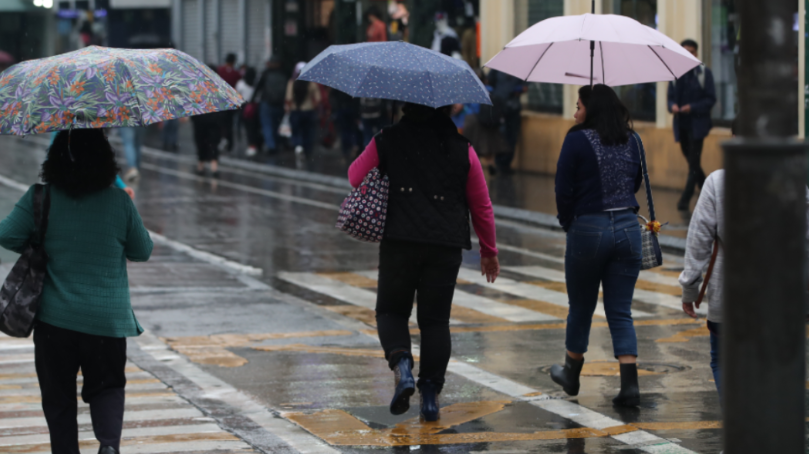
Edwin Rojas, director of Insivumeh, shared at a press conference, this Tuesday, May 5, details of the rainy season from May to July 2026, by region, in Guatemala.
He recalled that on April 15, a bulletin was issued about the rainy season, in which reference was made to the fact that the country would have a slightly earlier start to rain in some regions.
He also mentioned the behavior of the dog days, which could last from mid-June to early July.
He said that the forecasts have been confirmed, based on their trend, by the Regional Climate Forum, which was held in Belize.
He explained that the rain begins in the southern part of the country, continues in the central part and finishes establishing itself in the northern part.
Rojas added that in the bocacosta and west the rainy season began between the second and third week of April. Meanwhile, for the valleys of the Oriente, the Northern Transverse Belt and the Pacific, according to the estimate, rainfall began between the third and fourth week of April.
In Petén, the Caribbean and the central highlands, the rains will establish between the fourth week of April and the first week of May.
He highlighted that, on a national scale, the rainy season has begun and the volumes of precipitation are expected to be reflected in those accumulated by region.
The projections present precipitation deficit trends throughout the national territory.
In the eastern valleys, a precipitation range of 287 to 958 millimeters of rain is expected, with a deficit of between 50 and 266 millimeters.
The heat wave would be from mid-June to early July, with a tendency to be prolonged and with rainfall below normal. These conditions are associated with the possible transition towards the El Niño phenomenon, with a probability of 88%.
Rojas added that the El Niño phenomenon is not yet confirmed in Guatemala, although in June, July and August the probabilities could change.
The dog days are defined as a period of decreased rainfall levels and increased temperatures. This generally occurs between the end of June, July and August, according to the Insivumeh.
In a bulletin, Insivumeh expanded that smaller accumulations are expected in the central highlands, the west, the north and the valleys of the East.
In general terms, the accumulated precipitation for the quarter is projected below the 1991-2020 climatology in several regions of the country.
The most significant deficits could occur in sectors of the bocacosta, the Pacific, the Northern Transversal Belt and Petén, while in other regions the reductions would be more moderate.
Regarding temperature, warm conditions are expected in the low-altitude regions—Pacific, mid-coast, Caribbean, north and valleys of the East—, with average temperatures between 22 °C and 30 °C, and maximum temperatures that could reach between 30 °C and 38 °C.
In contrast, the central and western highlands will present milder conditions, with average temperatures between 14 °C and 22 °C, and more moderate maximums.
Category map
Rojas indicated that the map shows that, in May, June and July 2026, most regions will have below-normal precipitation behavior.
Stay up to date with the Now newsletter. Key information at the moment it happens. Subscribe here.