
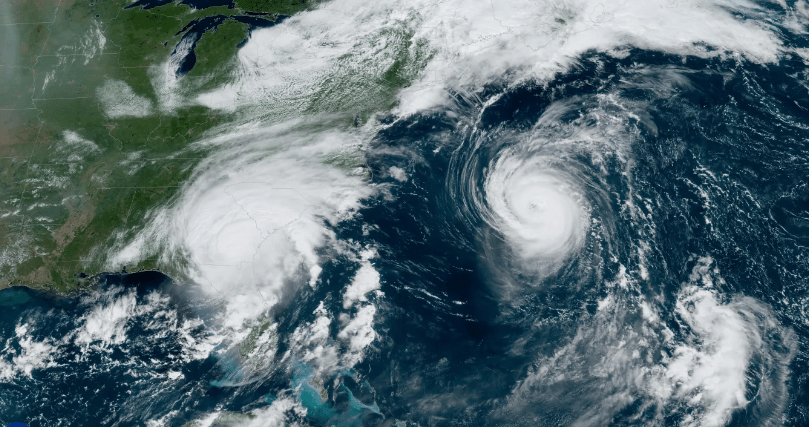
Authorities from the National Coordinator for Disaster Reduction (Conred) and Insivumeh reported this Tuesday, May 5, at a press conference, on the season of tropical storms, hurricanes and rains for 2026.
Edwin Rojas, director of Insivumeh, indicated that during the rainy season tropical storms and hurricanes are recorded, and he recounted the 2025 season.
He indicated that in that year, 13 tropical storms, five hurricanes and four major hurricanes were recorded in the North Atlantic.
Rojas explained that by 2026 the forecast indicates that The season will begin on May 15 in the Pacific and June 1 in the Atlantic.
A slightly less active behavior in these phenomena is expected in the North Atlantic and more active in the eastern Pacific.
In The North Atlantic is expected to have between 11 and 15 storms, between four and seven hurricanes, and between one and three major hurricanes.
While in the Eastern Pacific could have between 16 and 20 storms, between eight and 10 hurricanes and between three and five major hurricanes.
He said that these phenomena do not always manifest their effects in the national territory.
Rainy and dog days
For this year, a rainy season with atypical behavior, characterized by an early onset in different regions.
The heat wave would be in mid-June and early July, with a tendency to be prolonged and with rainfall below normal; These conditions are associated with the possible transition towards the El Niño phenomenon, with a probability of 88%.
The dog days are defined as a period of decreased rainfall levels and increased temperatures; It generally occurs between the end of June, July and until August, according to the Insivumeh.
Rojas added that the El Niño phenomenon is not yet confirmed, although in June, July and August the probabilities could change.
El Niño is a natural phenomenon that occurs in the Pacific Ocean and in the atmosphere, and is related to changes in sea surface temperature. The El Niño phase occurs when the Pacific region warms more than normal, weakening the trade winds and altering the way air moves in the atmosphere, causing changes in temperatures and rainfall, according to Insivumeh.
Stay up to date with the Now newsletter. Key information at the moment it happens. Subscribe here.